Local MCP Server: What It Is and How to Run One
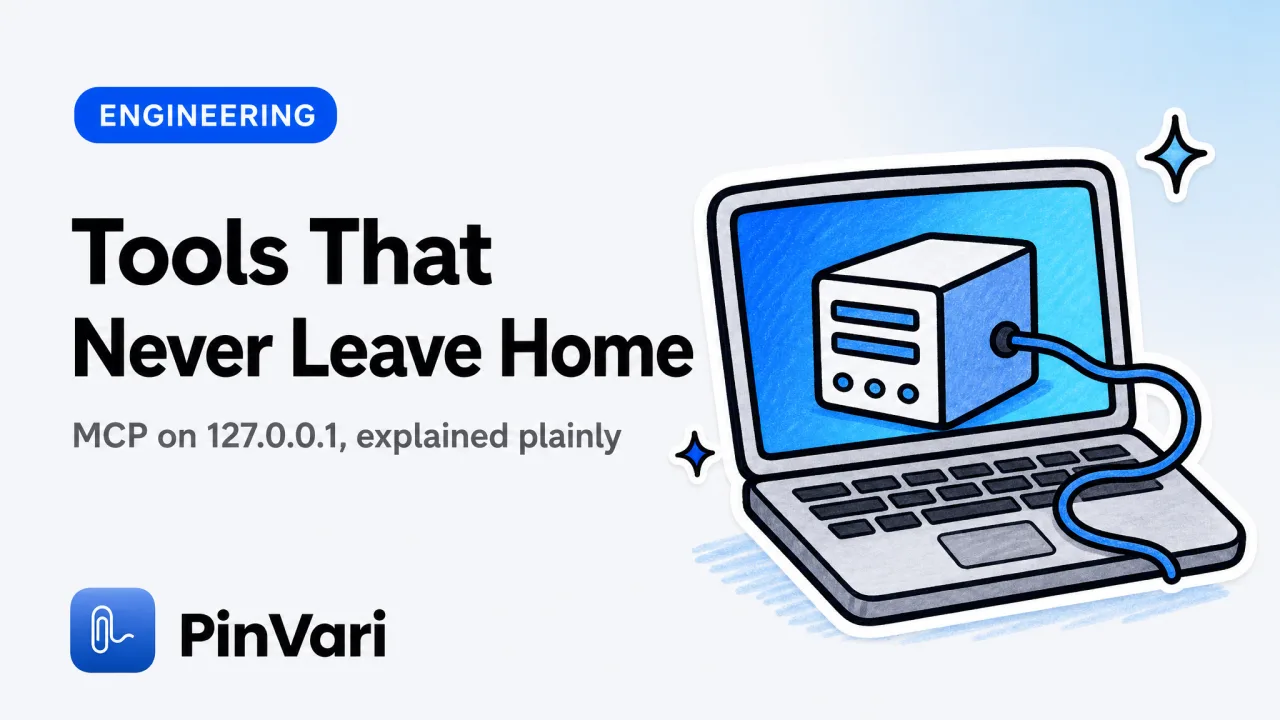
A local MCP server is a Model Context Protocol server that runs on your own machine, typically as a child process the agent launches over stdio or as a small service on 127.0.0.1, and it exposes named tools an AI coding agent can discover and call. Because it lives on your hardware, it can reach things a hosted server never could, like your local files, your git state, and the live contents of your screen, without sending any of it to the cloud.
Most MCP explainers stay abstract and leave you no clearer on what actually runs. The concrete version is simple: a local MCP server is just a program on your Mac that advertises a menu of tools, and your agent picks from that menu.
What is a local MCP server?
MCP is a standard for connecting an AI agent to external tools through one uniform interface. A server implements that standard; the agent is the client.
When the server runs on your machine rather than someone else's, it is a local MCP server.
The mechanics are plain JSON-RPC. The agent launches the server, sends initialize, the server replies with its capabilities, and the client calls tools/list to learn what is available.
During a session the model picks a tool, the client sends tools/call, and the server does the work and returns a structured result.
The key idea is separation of concerns. The server offers tools; the model decides when to use them.
That split is why the same server works across Claude Code, Cursor, and any other MCP client.
For the protocol from the ground up, see what an MCP server is and the broader Model Context Protocol overview.
"Local" is not a downgrade. A local MCP server trades reach into the public internet for reach into your machine, which is exactly what you want when the useful context is your files, your repo, or your screen.
What can a local MCP server do that a hosted one cannot?
It can touch your machine. A hosted MCP server lives on someone else's infrastructure, so it can only work with data you send it.
A local MCP server runs where your work is, so it can read what is already there.
That enables a different class of tool. A local server can read and write files in your project, run shell commands, inspect your git history, query a database on localhost, or observe the state of your screen.
None of that requires uploading anything, because the server and the data are on the same computer.
Privacy comes for free with locality. Nothing leaves the machine unless the server chooses to send it, which for a well-built local server is nothing at all.
That matters for proprietary code and for anything you would not paste into a cloud service.
There is a latency win too. Talking to a process over stdio or loopback is faster than a round trip to a remote host, which shows up when the agent calls a tool many times in a session.
Locality also gives you control over the tool's own dependencies. A local server can shell out to the exact version of a linter, formatter, or database client you already have installed, so it behaves the same way your own scripts do.
A hosted server runs against whatever the vendor provisioned, which can drift from your setup in ways that are hard to debug remotely.
How do you run a local MCP server on a Mac?
You register the server with your agent and point it at an executable. In Claude Code the command is short.
claude mcp add --scope user pinvari -- "$HOME/.pinvari/mcp/pinvari-mcp"That records the server's startup command in your config. When Claude Code launches, it starts the server, runs the handshake, and lists the server's tools, which you can confirm in the MCP status view.
A step-by-step walkthrough for macOS is in how to install an MCP server on a Mac.
Most local servers are distributed as a small binary or a script your package manager can run. The config just needs an absolute path to the command and any arguments, and the agent handles the rest of the lifecycle.
Run a new local MCP server by hand in your terminal once before wiring it into your agent. If it starts and prints its capabilities, any later "server not found" error is almost always a wrong path in your config, not a bug in the server.
If you want a shortlist of servers worth adding first, the best MCP servers for Claude Code is a good starting point.
Local vs remote MCP server: which should you use?
The choice comes down to where the useful data lives. If the tool wraps a public API, remote is fine; if it needs your machine, it has to be local.
| Aspect | Local MCP server | Remote MCP server |
|---|---|---|
| Runs on | Your machine | A hosted service |
| Transport | stdio or 127.0.0.1 | HTTP over the internet |
| Reach | Files, git, screen, localhost | Public APIs and cloud data |
| Privacy | Nothing leaves by default | Data is sent to the host |
| Latency | Very low | Network round trip |
| Best for | Local context and tools | Shared, hosted services |
Many setups mix both. You might run a local server for files and screen context and a remote one for a hosted API, and the agent treats them the same because the protocol is identical.
The decision is per-tool, not all-or-nothing.
A useful rule of thumb: if the answer to "where does the data physically live?" is "on my machine," the server should be local. Files, git history, running processes, and the screen all fail that test for a remote host, because sending them off the machine is both slower and a privacy hazard.
Public APIs and shared team data pass it, so those are fine to reach through a remote server.
What does a real local MCP server look like?
The clearest example on a Mac is a screen-context server, because reading your screen is something only a local process can do well. PinVari is a native macOS app that runs exactly this kind of local MCP server on 127.0.0.1.
You hold ⌥⌘A, circle or point at any on-screen UI element, and speak. It screenshots, transcribes on-device, and resolves the exact named accessibility element you circled, its role, label, value, and frame, with a confidence score and whether you circled or dwelled on it.
That resolution uses the macOS Accessibility API, which returns the real element under any point rather than a pixel guess.
The agent-facing tool is pinvari_next_instruction. It returns the resolved element path, your spoken instruction, the region you circled, and a screenshot cropped to that region;
pinvari_mark_done closes it out.
Your agent receives a named element it can act on, not an image it has to decode, and the deeper argument for that design is in how a local MCP server gives an agent screen context.
It is honest about hard surfaces. On a bare AXGroup it descends to the deepest labeled child; on Chromium and Electron windows that build their accessibility tree lazily it sets AXManualAccessibility and retries until a labeled node appears; on a raw canvas with no tree it falls back to on-device Vision OCR, and below its confidence bar it asks rather than guessing.
Because it is local, everything stays on the machine. Transcription and OCR run on-device through Apple frameworks, there are no API keys, and nothing is uploaded by default, so you bring your own agent and model.
It is a one-time $39 at launch, with details on the pricing page.
That is the local MCP server pattern at its best. The server resolves meaning on your side and hands the agent something already structured, which is only possible because it runs where your screen actually is.
FAQ
#
What is a local MCP server?
It is a Model Context Protocol server that runs on your own machine and exposes named tools an AI agent can call, usually over stdio or on 127.0.0.1. Because it runs locally, it can work with your files, git state, and screen without sending anything to the cloud.
#
How do I run a local MCP server?
Register it with your agent and point it at an executable, for example claude mcp add <name> in Claude Code, then restart so the agent runs the handshake and lists the tools. Run the server by hand once first to confirm it starts and advertises its capabilities.
#
Is a local MCP server safe?
A local server keeps data on your machine by default, which is safer than sending it to a hosted service, but it can still read whatever you grant it. Install servers you trust, prefer open-source or notarized builds, and check which files and permissions each one requests.
#
What is the difference between a local and a remote MCP server?
A local server runs on your machine over stdio or loopback and can reach local files, git, and your screen, while a remote server runs on a hosted service and reaches public APIs and cloud data. Local wins for privacy and latency; remote wins for shared, hosted tools.
#
Can a local MCP server read my screen?
Yes, if it is built to. On a Mac, a local server can use the Accessibility API to resolve the exact UI element under a point and Vision OCR for surfaces without an accessibility tree, all on-device.
That lets it hand an agent a named element instead of a raw screenshot.
#
Does a local MCP server need an internet connection?
Not for the protocol itself, since it runs as a local process over stdio or 127.0.0.1. A specific server only needs the network if the tool it wraps does, so a files, git, or screen-context server can work fully offline.
Hand your agent the exact element
PinVari resolves what you point at into a named, executable instruction — on-device, no keys, your own agent. One click inside PinVari connects Claude Code, Cursor, VS Code or Codex — or paste one CLI line from pinvari.com/connect.
PinVari → Connect → your agent (one click)Get PinVari — $39 →