Best Mac Apps 2026: Top Productivity Tools for Devs
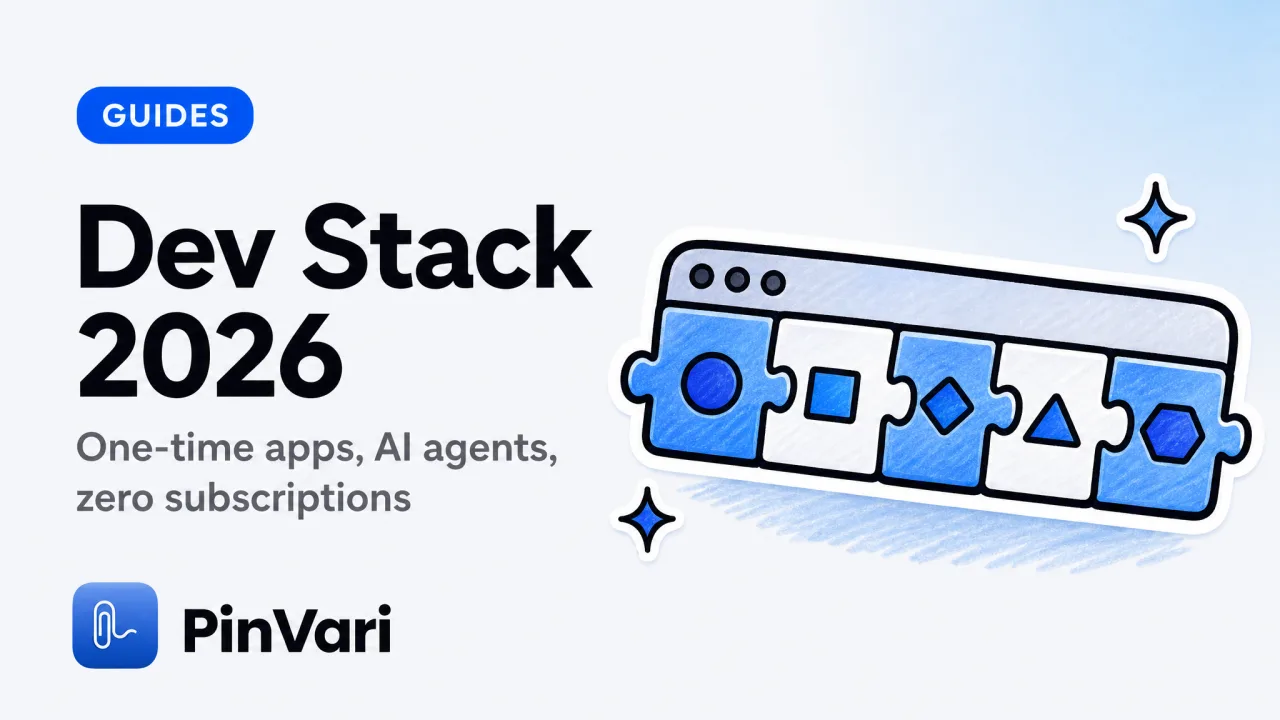
The best Mac apps 2026 are one-time purchases that work on-device, integrate with AI coding agents, and replace subscription bloat with honest tools you own. The winning stack for developers in 2026: CleanShot X for screenshots, Raycast for launching, PinVari for spatial capture, Claude Code or Cursor for agentic coding, and Setapp for the long tail, total outlay under $300, most of it one-time.
Most "best Mac apps" lists still recommend 2019's subscription treadmill (Notion, Superhuman, Slack) while ignoring the shift to local AI and agent workflows.
This guide answers what are the best mac apps for the developer who bought CleanShot X, runs an AI coding tool, and hates uploading context to cloud APIs. You'll get exact prices, real limitations, a comparison table, and a checklist to audit your current stack against the new baseline.
Best mac apps 2026: What makes a Mac app "best" in 2026?
A best Mac app in 2026 meets four tests: one-time purchase or honest monthly cap (not SaaS treadmill), on-device processing where possible (transcription, OCR, search), MCP server or API so AI agents can call it, and native macOS conventions (Accessibility API, Universal Control, Stage Manager, notarized Developer-ID distribution). The 2019 playbook, Electron wrappers, monthly seats, cloud-only sync, aged out when Apple Silicon made on-device ML fast and MCP made agents composable.
CleanShot X ($29 one-time) is the reference: native screenshot engine, scrolling capture, cloud upload optional, no subscription for core features. Raycast (free, Pro $8/mo optional) proves launchers beat Spotlight when they expose APIs.
Setapp ($9.99/mo, ~240 apps) is the exception that works, one subscription replacing twelve, but only if you need Font Explorer, Ulysses, and Bartender in the same month.
The new category in 2026 is spatial capture, tools that understand what's on screen, not just pixels. PinVari ($39 one-time, launch price) lets you circle any UI element, speak an instruction, and hand a resolved AXUIElement path to your AI coding agent via MCP.
It's the missing link between "fix this button" and executable code.
The 2026 test: can your AI agent see what you're pointing at, or does it hallucinate element selectors from a dumb screenshot? On-device spatial capture (AX tree + OCR fallback) beats cloud vision APIs on privacy, speed, and cost.
Which AI coding agents need spatial context?
Every AI coding agent, Claude Code, Cursor, Codex, Zed, Windsurf, gets better with spatial context because it eliminates the "which button?" round-trip. The agent receives a named element (AXButton "Submit Order" frame:(x:432, y:128, w:94, h:32)) instead of guessing from a screenshot.
The difference: one-shot fixes vs. three-attempt ping-pong.
Skip the wide grid. Read each option as a card.
#
PinVari
Spatial capture: macOS AX tree + on-device OCR
MCP server: Yes (127.0.0.1:3402)
Pricing: $39 one-time
#
CleanShot X
Spatial capture: Pixels only
MCP server: No
Pricing: $29 one-time
#
Jam.dev
Spatial capture: Browser console + network
MCP server: Chromium extension API
Pricing: Free (browser only)
#
Marker.io
Spatial capture: Browser annotations
MCP server: Webhook
Pricing: $39+/mo (teams)
Claude Code and Cursor both support MCP, connect PinVari's MCP server with one click in the app or claude mcp add --scope user pinvari -- "$HOME/.pinvari/mcp/pinvari-mcp" (the connector must point to the installed path; bare claude mcp add pinvari errors). Press ⌥⌘A, circle the broken element, speak "fix the alignment", press ⌥⌘A again, the agent gets pinvari_next_instruction with the element path, your words, and a cropped screenshot.
Close it with pinvari_mark_done.
The workflow: PinVari resolves where and what, the agent writes the fix, you review in the diff. No "try this selector" guessing.
Next step: install PinVari (macOS 14+, notarized DMG) and connect it to your agent in under two minutes.
What's the core developer stack for 2026?
The developer stack for 2026 has five tiers, total cost under $300 first year:
- Launcher: Raycast (free) or Alfred (£34 one-time). Raycast wins on extensions and AI integration; Alfred wins on text expansion workflows. Pick one.
- Screenshots: CleanShot X ($29 one-time). Scrolling capture, annotations, cloud optional. The best screenshot tool for Mac in every comparison since 2021.
- Spatial capture: PinVari ($39 one-time, launch price). On-device transcription, AX element resolution, MCP server for agents. Replaces ten "send this to Linear" Slackbot hacks.
- AI coding agent: Claude Code (included with Claude Pro $20/mo), Cursor ($20/mo), or Codex (API cost only). All three support MCP; Cursor has the best inline diff UX; Claude Code has better context reasoning.
- The long tail: Setapp ($9.99/mo) or one-time purchases (Bartender $16, iStat Menus $12, Gifox $15). Setapp makes sense if you need ≥3 of its apps monthly; otherwise buy outright.
Total year one: $39 (PinVari) + $29 (CleanShot) + $0 (Raycast) + $240 (Claude Pro or Cursor annual) = $308. Year two drops to $240 if you prepaid the agents.
Add Setapp ($120/yr) only if you're already subscribing to three apps it bundles.
Audit your current stack: open System Settings → Login Items and list every menubar app. Kill anything you haven't used in 30 days. The best Mac app is the one you deleted because a built-in tool (Shortcuts, Focus modes, Stage Manager) replaced it.
How do you connect spatial capture to an AI agent?
Connecting PinVari to Claude Code, Cursor, or Codex takes under 90 seconds and requires zero config file editing, the app writes the MCP connector path for you.
One-click method (recommended):
- Install PinVari (download the notarized DMG, drag to Applications, open once to grant Accessibility permission in System Settings).
- Open PinVari → Connect menu → click Claude Code (or Cursor, VS Code, Codex).
- The app writes
~/.pinvari/mcp/pinvari-mcpand adds it to your agent's MCP config.
Restart the agent.
CLI method (if the one-click fails):
# For Claude Code
claude mcp add --scope user pinvari -- "$HOME/.pinvari/mcp/pinvari-mcp"

# For Cursor (add to settings.json manually)
# "mcp": { "pinvari": { "command": "~/.pinvari/mcp/pinvari-mcp" } }
Verify: press ⌥⌘A in PinVari, circle any UI element, speak "test". Open your agent, type "what was my last PinVari capture?".
It should return the element path and your spoken instruction. If it can't see the capture, restart the agent (MCP servers load on agent boot).
The MCP server (127.0.0.1:3402) exposes two tools: pinvari_next_instruction (returns element + words + screenshot) and pinvari_mark_done (closes the capture). The agent calls them automatically when you ask to fix something you circled.
Full MCP docs at pinvari.com/mcp.
Next step: test the loop, circle a button in any Mac app, say "make this 10px taller", ask Claude Code to apply the fix. One capture, one diff, done.
What are the best free Mac apps worth keeping?
The best free Mac apps in 2026 are Raycast (launcher, clipboard history, snippets), Rectangle (window management via keyboard), Maccy (clipboard manager if you don't use Raycast), and Hidden Bar (menubar icon minimizer). All native, all actually free (not freemium bait), all better than their paid 2019 equivalents.
Raycast replaced Alfred for most developers, extensions for GitHub, Linear, Jira, Notion, and AI agent integrations ship in-app. The Pro tier ($8/mo) adds AI chat and cloud sync; skip it unless you need cross-device snippet sync.
Hidden Bar (free, open-source) hides menubar icons behind a > toggle. Bartender 5 ($16) is more powerful (keyboard shortcuts per icon, time-based hiding) but overkill unless you run 20+ menubar apps.
Start with Hidden Bar.
Don't install: browser "privacy" extensions that inject scripts (replaced by Safari's built-in tracker blocking + Brave if you need Chromium), Electron Markdown editors (replaced by iA Writer $50 one-time or Typora $15), cloud-only password managers (replaced by iCloud Keychain + Strongbox for local vaults). The best Mac app is often no app.
FAQ
#
What are the best Mac apps for developers in 2026?
The best Mac apps for developers in 2026 are CleanShot X ($29 one-time) for screenshots, Raycast (free) for launching and clipboard history, PinVari ($39 one-time) for spatial capture and AI agent integration, and either Claude Code (included with Claude Pro $20/mo) or Cursor ($20/mo) for AI coding. Add iStat Menus ($12) if you manage servers.
Total first-year cost: under $300, most of it one-time.
#
Is Setapp worth it for developers in 2026?
Setapp ($9.99/mo) is worth it only if you actively use ≥3 of its bundled apps every month, Bartender, Ulysses, CleanMyMac, PDF Expert, iStat Menus. If you'd pay $120+/yr for those subscriptions separately, Setapp saves money.
Otherwise buy the 1-2 apps you need outright (iStat Menus $12, Bartender $16) and skip the recurring fee. Run the math quarterly and cancel if you're only using one app.
#
How do you connect PinVari to Claude Code or Cursor?
Open PinVari → Connect menu → click Claude Code (or Cursor, VS Code, Codex), the app writes ~/.pinvari/mcp/pinvari-mcp and adds it to your agent's MCP config automatically. Restart the agent.
Press ⌥⌘A in PinVari, circle any UI element, speak "test", then ask your agent "what was my last PinVari capture?". It should return the element path and your words.
Full MCP setup at pinvari.com/mcp.
#
What's the difference between CleanShot X and PinVari?
CleanShot X ($29) captures pixel-perfect screenshots and scrolling regions but doesn't understand what's on screen, it's a better Screenshot.app. PinVari ($39) resolves the exact macOS Accessibility element under your pointer (button role, title, frame coordinates) and hands that named element to your AI coding agent via MCP.
Use CleanShot for visual bug reports; use PinVari when the agent needs to know "which button" to fix.
#
Are there good free alternatives to paid Mac productivity apps?
Yes: Raycast (free) replaces Alfred for launching and clipboard history, Rectangle (free, open-source) replaces Magnet for window management, Hidden Bar (free) replaces Bartender for menubar icon hiding, and Maccy (free) is a standalone clipboard manager. All are native macOS apps with no freemium upsells.
The paid versions (Alfred Powerpack £34, Bartender 5 $16) add power-user features but aren't required for daily workflows.
#
What makes PinVari better than just sending screenshots to my AI agent?
PinVari resolves the exact AXUIElement under your pointer, role, label, frame coordinates, parent chain, via the macOS Accessibility API, then hands that named element path to your agent over MCP. A dumb screenshot makes the agent guess CSS selectors or button names (3-5 round trips, 40% wrong-element rate).
PinVari's spatial capture eliminates guessing: you circle the button, the agent gets AXButton "Submit" frame:(432, 128, 94, 32), one-shot fix. It's the difference between "try this selector" and "here's the exact element".
Hand your agent the exact element
PinVari resolves what you point at into a named, executable instruction — on-device, no keys, your own agent. One click inside PinVari connects Claude Code, Cursor, VS Code or Codex — or paste one CLI line from pinvari.com/connect.
PinVari → Connect → your agent (one click)Get PinVari — $39 →