AI Coding Agents: What They Are and How to Use Them
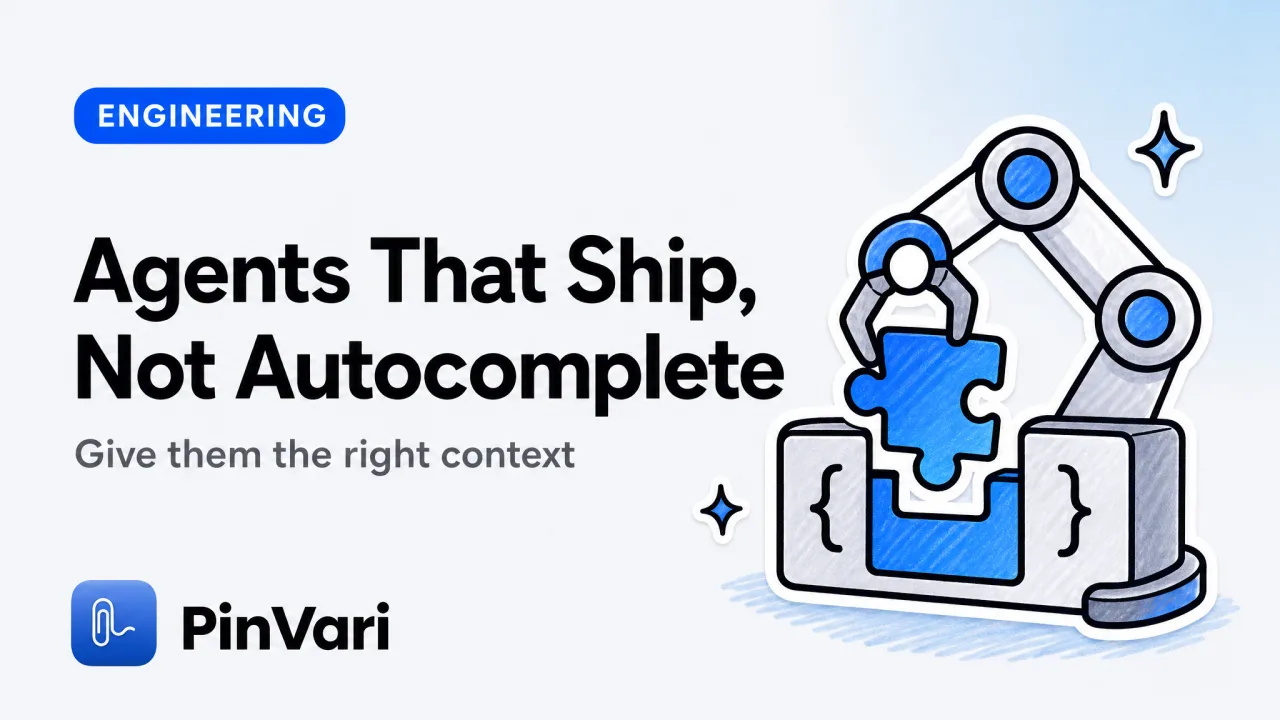
AI coding agents are programs that read a goal, plan a change across your whole codebase, and then write, run, and fix the code themselves. They go well past single-line autocomplete.
You use them by handing over a clear objective and the right context, then reviewing the diff they produce instead of typing each edit by hand.
Most explainers stop at "they write code for you" and skip the part that decides whether the output is any good. How precisely you can point the agent at the thing you mean matters more than which model sits underneath.
What are AI coding agents, exactly?
An agent is a loop, not a chat box. It takes your instruction, breaks it into steps, calls tools (read a file, run a test, grep the repo), observes the result, and repeats until the task is done or it gets stuck.
That loop is the difference between an assistant and an agent. A plain assistant suggests the next token; an agent takes actions and checks its own work.
GitHub Copilot's inline suggestions sit at one end. A CLI like Claude Code or Codex that edits files, runs your test suite, and iterates sits at the other.
The tools are what give an agent reach. Most read and write files, run shell commands, and search the tree.
Increasingly they also connect to external systems over the Model Context Protocol. The same agent can query a database, open a browser, or read your screen without bespoke glue for each capability.
The word "agent" is doing real work here. If a tool only completes text and never runs, tests, or verifies anything, it is an assistant. If it acts and observes in a loop, it is an agent. Autonomous code generation lives in that loop.
None of this makes the model smarter. It makes the model situated.
An agent with file access and a test runner will out-ship a stronger model with neither, because it can catch its own mistakes before you ever see them.
Where do AI coding agents fall down today?
They are strong at anything expressible in text and weak at anything that lives on screen. Ask for "a rate limiter on the login route" and the agent has everything it needs.
Ask it to fix "the button that looks wrong" and it has almost nothing.
This is the daily tax for anyone shipping a UI with an agent. You either type a paragraph describing which element, in which state, on which route, or you paste a screenshot and hope the model finds the right pixels.
Both are slow. Both go wrong often.
Screenshots feel like the fix and usually are not. An image is a large blob of tokens, it carries no structure the model can trust, and the agent still has to guess which of forty similar-looking nodes you meant.
That guess is where Claude Code edits the wrong element and quietly ships a change to the header instead of the modal.
Pasting UI screenshots into an agent is expensive and lossy. A single high-resolution image can cost thousands of tokens per turn, and it still leaves the agent inferring identity from pixels. See why screenshots waste Claude Code tokens before you make it a habit.
The gap is not the model's reasoning. It is the input format.
Text goes in cleanly. The visual state of your app does not.
How do you tell an agent which element you mean?
Give it the element, not a picture of the element. On macOS the Accessibility API already exposes the exact UI object under any point: its role, its label, its value, its frame, and its parent chain, through AXUIElementCopyElementAtPosition.
That is the input an agent can act on with certainty. Instead of "the second button in the toolbar," the agent receives a named node, AXButton "Publish", at a known frame, on a known URL, with a confidence score attached.
No pixel guessing.
PinVari is built on exactly this. You hold ⌥⌘A, circle or point at the element, and speak.
It screenshots, transcribes on-device, and resolves the named accessibility element you circled. Then it hands your own agent a resolved, executable instruction over a local MCP server on 127.0.0.1.
The resolution is honest about hard cases. When a point lands on a bare AXGroup, it descends to the deepest labeled child.
On Electron surfaces that build their tree lazily, it sets AXManualAccessibility and retries until a labeled node appears. On a canvas with no AX tree at all, it falls back to on-device Vision OCR.
If confidence is below the bar, it asks rather than guessing. The deeper mechanics are in how AI agents know which UI element you mean.
Point and speak beats type and paste because it collapses the whole "which element" negotiation into one gesture. The agent gets a named target and your spoken intent in a single structured payload.
AI coding agents comparison: how the main tools differ
There is no single best agent, only the right shape for your work. Here is an honest side-by-side of common choices and where each fits.
Claude Code
- Form factor: Terminal CLI
- Runs and tests code: Yes
- Best for: Repo-wide changes, multi-file refactors
Codex CLI
- Form factor: Terminal CLI
- Runs and tests code: Yes
- Best for: Scriptable, sandboxed autonomous runs
Cursor
- Form factor: AI-native editor
- Runs and tests code: Yes
- Best for: Devs who want an IDE, not a terminal
GitHub Copilot
- Form factor: Editor extension
- Runs and tests code: Partial
- Best for: Inline completion inside VS Code
Zed AI
- Form factor: Native editor
- Runs and tests code: Yes
- Best for: Fast native editing on macOS
The columns that matter for real work are whether the tool runs and verifies its own output, and whether it reaches beyond the editor into your tools. For a fuller breakdown of the daily-driver options, the AI coding assistant guide walks through the trade-offs.
Adoption is worth a sober note. The public research on AI coding agents research adoption is still young, and early studies show mixed productivity results.
Agents clearly speed up boilerplate and greenfield work. Gains on large, unfamiliar codebases are smaller and depend heavily on how well the developer scopes the task.
The takeaway is not that agents fail. The human skill of specifying intent precisely is what separates a fast team from a frustrated one.
What none of these fix on their own is the screen-context gap. They all speak text fluently, and they all struggle the moment the task is "this thing, right here."
What does the workflow look like end to end?
Here is the loop once the context problem is solved. You are reviewing a build, you spot a broken element, you circle it and say what is wrong, and the resolved instruction lands in your agent's queue.
- Hold ⌥⌘A, circle the misaligned dropdown, and say "this menu overflows its container on narrow widths."
- PinVari resolves it to a named element with role, label, frame, and the page URL, all on-device.
- Your agent calls
pinvari_next_instruction, gets the resolved element path, the spoken instruction, the circled region, and a cropped screenshot, then makes the fix and callspinvari_mark_done.
The point is that the agent never guessed. It received a named element it can act on, not a description it had to decode.
Keep your agent's tool surface tight. Every extra tool is another thing the model can pick wrong. A screen-context server, a git server, and your test runner cover most real work; add more only when a specific friction demands it.
Everything in that flow stays on your machine. Transcription and OCR use Apple frameworks, there are no API keys, and nothing is uploaded by default.
You bring your own agent and your own model. If handing your agent a named element instead of a screenshot is the piece you are missing, PinVari is a one-time purchase, and the details are on the pricing page.
FAQ
What is the difference between an AI coding agent and an AI assistant?
An assistant suggests text, usually inline completions, and stops there. An agent runs a loop: it plans, calls tools, executes code, observes the result, and iterates until the task is done, which is why agents can catch and fix their own mistakes.
Are AI coding agents good for enterprise development?
Yes, with guardrails. AI coding agents for enterprise development work best when scoped to a repo with a strong test suite, code review on every diff, and secrets kept out of context. The agent accelerates the work; your review process still owns correctness.
Do AI coding agents replace developers?
No. They shift the job from typing every line to specifying intent and reviewing output. The scarce skill becomes describing what you want precisely and judging whether the diff is right, not memorizing syntax.
Why does my AI coding agent edit the wrong UI element?
Because it is inferring identity from prose or pixels rather than receiving the element itself. When you paste a screenshot or describe "the button on the left," the model guesses among many similar nodes. Handing it a resolved, named accessibility element removes the guess.
What is the most useful context to give an AI coding agent?
Structured, unambiguous context: exact file paths, error output, failing tests, and for UI work, the named element rather than an image of it. The more the agent can trust the input without decoding it, the fewer wrong turns it takes.
Can AI coding agents work fully offline?
The agent's model usually calls a hosted or local LLM, but the surrounding context can be gathered locally. On a Mac, transcription, OCR, and accessibility resolution all run on-device, so screen context reaches the agent without anything being uploaded.
Hand your agent the exact element
PinVari resolves what you point at into a named, executable instruction — on-device, no keys, your own agent. One click inside PinVari connects Claude Code, Cursor, VS Code or Codex — or paste one CLI line from pinvari.com/connect.
PinVari → Connect → your agent (one click)Get PinVari — $39 →