AI Agent Workflow Automation: How to Chain Tool Calls
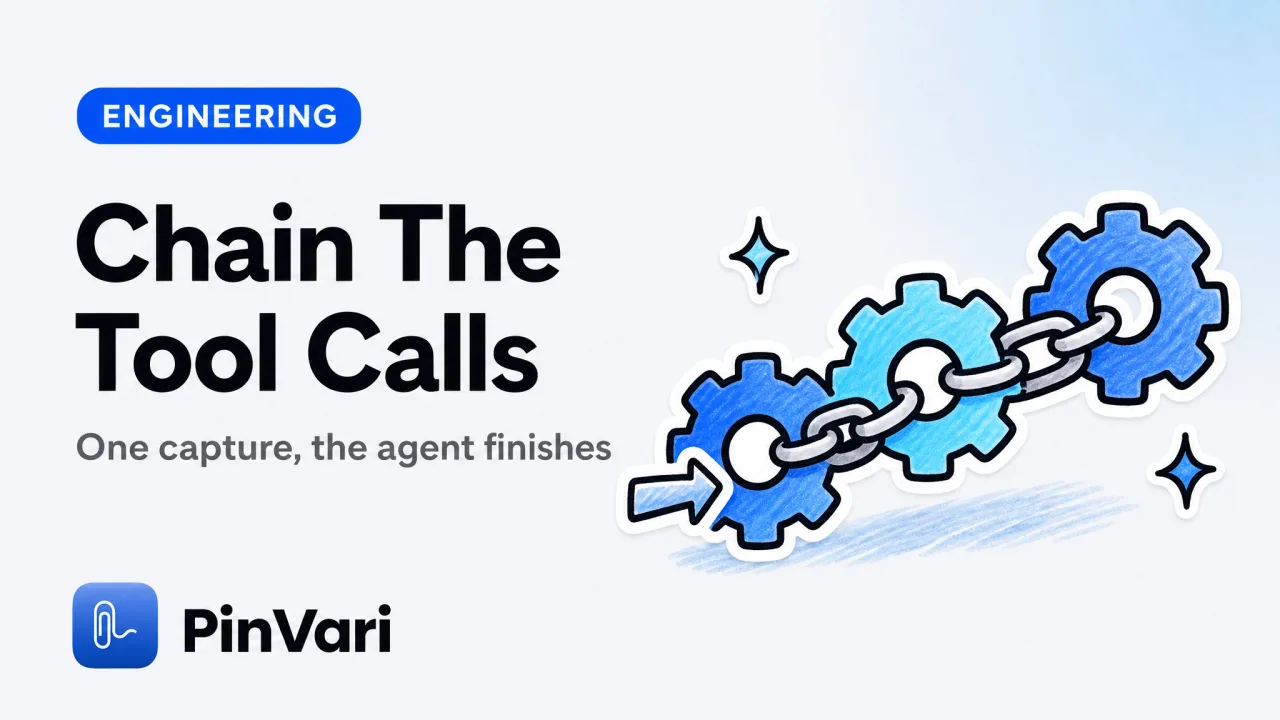
AI agent workflow automation is the practice of wiring an AI coding agent so it chains tool calls on its own, pulling a task, acting on it, and reporting back without you driving each step by hand. On a Mac you build it by giving the agent a small set of local tools it can call in sequence over an MCP server, so one capture turns into a fix with no copy-paste relay in the middle.
Most explanations of MCP stop at the protocol and never show the loop, which is why the whole idea stays abstract. The useful question is not "what is a tool call," it is "what has to be true for three tool calls to run back-to-back and land on the right result."
What does AI agent workflow automation actually mean?
AI agent workflow automation means the agent handles the intermediate steps of a task with tools, instead of pausing after each one to wait for you. You define the task and check the result; the agent reads, decides, calls a tool, reads the result, and calls the next.
The word people reach for is agentic coding, and the honest definition of agentic coding is just this: the agent has tools and a loop, so it can take several actions toward a goal before it needs you again. A fuller treatment lives in the agentic coding primer.
The part that trips people up is that a tool call is not magic. It is a function the agent invokes with arguments, gets structured output back, and reasons over.
Automation is what happens when the output of one call is good enough to be the input of the next without a human cleaning it up.
The unit of AI agent workflow automation is not the model, it is the tool contract. If each tool returns clean, named, structured data, the agent can chain calls. If a tool returns a blob the agent has to guess at, the chain breaks on the next hop.
What does a local MCP server do for a coding agent?
A local MCP server runs on your machine at 127.0.0.1 and advertises a list of named tools the agent can call. When you register it, the agent gains those tools the same way it already has file-read and shell tools, except these ones reach outside the codebase into your running system.
Concretely, you register a server once:
claude mcp add --scope user pinvari -- "$HOME/.pinvari/mcp/pinvari-mcp"That exposes three tools to the agent: pinvari_next_instruction, pinvari_mark_done, and pinvari_request_capture. Each is a real function with a defined input and output, which is exactly what a chain needs.
The deeper mechanics are in the local MCP server for agent screen context write-up.
The value of "local" is not only privacy, though the transcription and OCR do run on-device with nothing uploaded by default. The value is latency and trust.
The agent calls a function on the same machine, gets an answer in milliseconds, and never routes your screen through a third party to do it.
Here is what changes when the server exists versus when it does not.
| No local tools | Chained tool calls over MCP | |
|---|---|---|
| How a task reaches the agent | You paste text and images | The agent calls a tool and pulls it |
| What the agent receives | Prose plus a screenshot | Named element, instruction, confidence |
| Steps you drive by hand | Every one | Only the capture |
| What ends a task | You say "done" | The agent calls pinvari_mark_done |
| Ambiguity handling | Agent guesses | Agent calls pinvari_request_capture |
| Runs on-device | Depends on tools | Yes, server is on 127.0.0.1 |
The right column is the same agent and the same model. The only thing added is a set of tools that return structured data, which is what makes the calls chainable.
How do you chain tool calls in an AI agent workflow?
You chain them by making each call's output be the next call's input, with no human reformatting in between. The trick is designing tools whose output is already in the shape the next step needs.
Walk one real chain. You hold ⌥⌘A, circle a broken control, and say "this label should read Overview." The capture tool resolves the exact accessibility element you circled, its role, label, and frame, and holds it with a confidence score.
Now the agent runs the chain. Call one, pinvari_next_instruction, returns the resolved element path, your spoken instruction, the region you circled, and a cropped screenshot as evidence.
Call two, the agent's own file-edit tool, changes the right component because it was handed the element by name rather than a pixel guess. Call three, pinvari_mark_done, closes the task so the next one advances.
That is three tool calls with no relay step. The reason it holds together is that call one returns a named element and a confidence score, not an image the agent has to interpret.
When the input is precise, the middle of the chain never has to stop and ask you what you meant.
Queue several captures before you switch to the agent. Circle five elements and speak to each, then let the agent drain the queue with repeated pinvari_next_instruction calls. A review pass becomes one continuous chain instead of five stop-start handoffs.
The failure mode to design against is the wrong-element edit, where the agent confidently fixes a lookalike control. That happens when the input is a screenshot, because the agent has to re-derive which rendered thing maps to which line of code.
The full anatomy of that bug is in why Claude Code fixes the wrong element.
A copyable checklist for chaining tool calls
Use this as a starting contract for any automation like this you build, not just the loop above.
- Register the server once.
claude mcp add --scope user pinvari -- "$HOME/.pinvari/mcp/pinvari-mcp"puts the tools in the agent's list. Confirm the agent can see them before you build on top. - Make the first tool return structure, not pixels. Element role, label, frame, and a confidence score. A cropped screenshot can ride along as evidence, but it should not be the payload.
- Attach a confidence signal to every result. Below a threshold, the agent should ask, not act. A score of 0.8 is a reasonable line.
- Give the agent a way to ask for more.
pinvari_request_capturelets the agent request another point-and-speak instead of guessing when your words were ambiguous. - Give every task a clean close.
pinvari_mark_donemarks the task complete so the queue advances and nothing runs twice. - Keep provenance in the payload. Circled means you meant it; dwelled means maybe. The agent treats those differently.
The pattern underneath the checklist is the one in how to give Claude Code context: the tighter and more named the input, the fewer turns the agent wastes guessing. Every guess you remove is a tool call that does not have to be retried.
Where does the automation still need a human?
It needs you at the two ends, capture and verification, and it should refuse to hide either one from you. Automation that quietly acts on a low-confidence target is not saving you time, it is queuing up a broken build for later.
The capture end stays human because you are the one who knows which of three similar buttons is wrong. Point-and-speak keeps that step to a couple of seconds rather than removing it, which is the right trade.
The pointer trail binds "this" and "here" to wherever your cursor was at the instant you said each word, so naming stays fast without becoming a guess.
An AI agent workflow automation that never asks is not more automated, it is less honest. Insist on a confidence threshold and a provenance flag so the chain pauses on ambiguity instead of shipping a wrong edit.
The verification end stays human because the agent should report, not self-certify. A clean pinvari_mark_done gives you a checkpoint to glance at the result before the next task runs.
That checkpoint is cheap and it is what keeps a long chain from drifting.
None of this requires a subscription or an API key in the tool. You bring your own agent, whether that is Claude Code, Cursor, Codex, or Zed, and your own model.
PinVari ships as a notarized Developer-ID DMG and is a one-time $39 launch license through Polar, and the pricing has the full breakdown.
FAQ
#
What is AI agent workflow automation?
It is the practice of wiring an AI coding agent so it chains tool calls to complete a task with minimal supervision, pulling the task, acting, and reporting back. On a Mac the mechanism is a local MCP server that exposes named tools the agent can call in sequence.
#
What does agentic coding mean?
Agentic coding means the AI agent performs the intermediate steps of a task using tools, reading files, running commands, calling servers, instead of waiting for you to drive each one. Your job shifts to defining the task precisely and verifying the output.
#
How does a coding agent chain tool calls?
It feeds the structured output of one tool into the next call without a human reformatting step. That only works when each tool returns clean data, such as a named element and a confidence score, rather than an image the agent has to re-interpret.
#
Do I need an internet connection for this workflow?
The capture, transcription, and OCR run on-device through Apple frameworks, and the MCP server runs on 127.0.0.1. The only network traffic is whatever your own agent sends to whatever model you already use, which stays under your control.
#
Which agents support MCP tool chaining?
Any MCP client. The tools are tested with Claude Code, Cursor, Codex, and Zed.
You register the server once and the agent gains the tools, so the same chain works regardless of which agent you prefer.
#
What stops the agent from acting on the wrong element?
The first tool in the chain returns the exact accessibility element you circled, by role, label, and frame, plus a confidence score. The agent acts on a named target rather than inferring one from pixels, and below the confidence threshold it asks instead of guessing.
Hand your agent the exact element
PinVari resolves what you point at into a named, executable instruction — on-device, no keys, your own agent. One click inside PinVari connects Claude Code, Cursor, VS Code or Codex — or paste one CLI line from pinvari.com/connect.
PinVari → Connect → your agent (one click)Get PinVari — $39 →