Agentic Coding Meaning: What It Is & How It Works
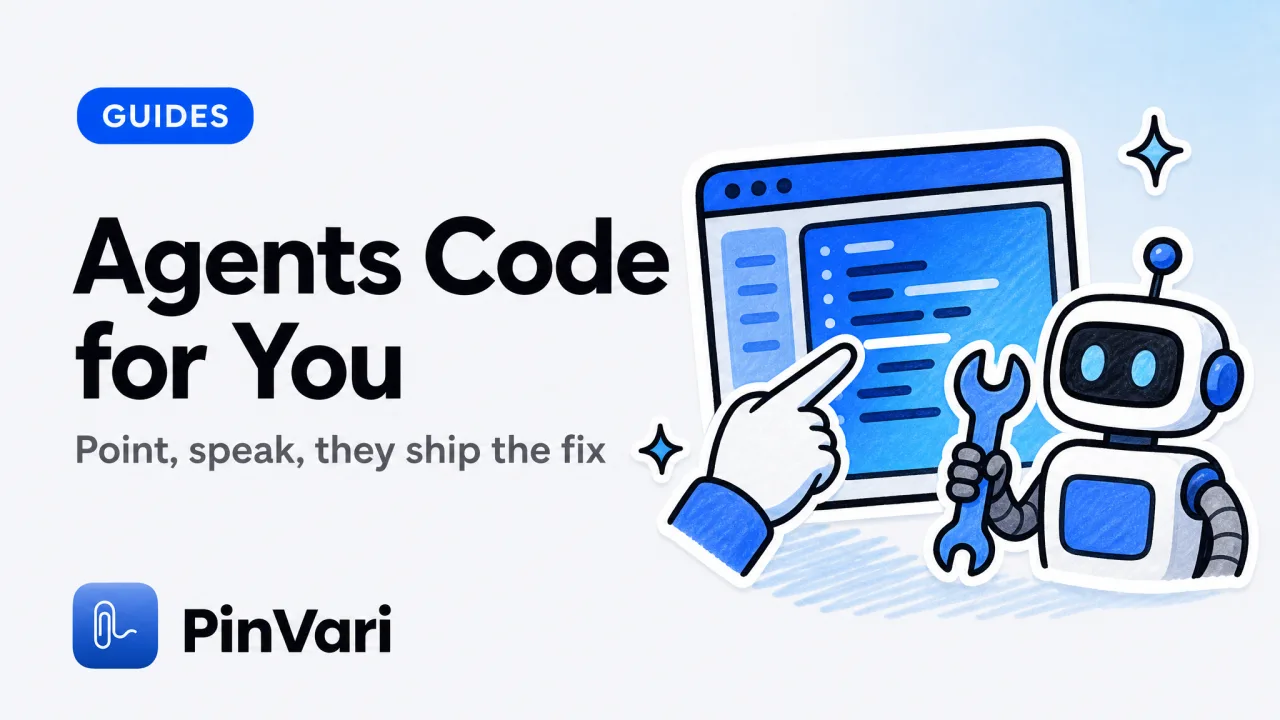
Agentic coding meaning is simple. Agentic coding means an AI agent writes, edits, and debugs your code autonomously, by observing what's on your screen, understanding which UI element you're pointing at, and executing the fix without you typing file paths or line numbers.
The agent reads the accessibility tree, resolves the exact button/field/component you circled, and hands back executable instructions to your AI code editor.
Most guides treat "agentic" as a buzzword for autocomplete with more steps; the real shift is deictic reference (pointing and saying "fix this") replacing copy-paste descriptions.
You're already running Claude Code, Cursor, or Codex CLI. You paste screenshots, type "the button in the top-right that says 'Submit'", and the agent still edits the wrong element because pixels don't carry names.
Agentic coding fixes that: you hold a hotkey, circle the button, say "disable this on empty input", and the agent receives AXButton "Submit" role=button parent=LoginForm frame={x:892 y:64 w:88 h:32} plus the cropped screenshot and your transcribed instruction. One capture, zero ambiguity.
Agentic coding meaning: What makes coding "agentic" vs just AI-assisted?
Traditional AI coding assistants wait for you to describe the task in natural language or highlight code blocks. Agentic coding inverts control: the agent observes your environment (screen, browser DOM, file tree), grounds your deictic words ("this", "that", "here") to real coordinates and named elements, and autonomously decides which files to open, which lines to edit, which tests to run.
The human points; the agent plans and executes.
Three components define agentic coding:
- Screen observation , reading the UI element under your pointer via the macOS Accessibility API (role, title, value, frame, parent chain) or falling back to on-device Vision OCR when the element tree is blind (canvas apps, some Electron windows). Generic screenshots lose the element's name and type; named AX data gives the agent a structural handle.
- Spatial capture , mapping your spoken words to specific points/regions on screen at the exact timestamp you said them. When you say "disable this on empty input" while circling a button, the agent binds "this" to
{timestamp: 0.42s, element: AXButton "Submit", confidence: 0.94}. No manual quoting of element IDs. - Autonomous execution , the agent writes the code, runs the formatter, opens a PR, or files a Linear ticket without waiting for you to approve every keystroke. You review the diff, not the plan.
Most developers stop at step 1 (pasting screenshots into Claude Code or Cursor) and never reach autonomy because the agent can't reliably resolve "the save button" from a 2560×1440 PNG. Agentic coding closes the loop by giving the agent named, executable references.
Key insight: Agentic coding treats your screen as the source of truth, not your clipboard. The agent observes what you point at, resolves it to a named component, and acts, no manual file-path hunting.
How do AI agents read the UI elements you're pointing at?
On macOS, every visible UI element (button, text field, checkbox, slider, table row) exposes an accessibility (AX) tree through the system API. When you point at a button, AXUIElementCopyElementAtPosition(x, y) returns a reference to that element's AX node with attributes: AXRole (button/textfield/group), AXTitle ("Submit"), AXValue (current text), AXFrame (screen coordinates), and a parent chain up to the window.
This is what VoiceOver reads aloud; AI coding agents can read the same data.
The challenge: the overlay window you draw on becomes the topmost layer, so a naive hit-test resolves to the overlay itself, not the app below. The workaround PinVari uses (you can verify in any agentic setup):
- Walk the on-screen window list (
CGWindowListCopyWindowInfo) excluding your own process. - Hit-test each window's bounds in front-to-back order until you find one containing the pointer.
- Call
AXUIElementCopyElementAtPositionon that window'sAXUIElement. - If the result is a bare
AXGroupwith no title, descend to the deepest labeled child (labeledDescendant).
Chromium and Electron apps build their AX tree lazily, the element doesn't exist until you try to read it. Set AXManualAccessibility=true on the process and retry after ~150 ms.
If the element still has no AXTitle, check AXDOMIdentifier and AXDOMClassList (Chromium identity attributes) to construct a name.
When AX fails (canvas games, some design tools), fall back to on-device Vision OCR (Apple's VNRecognizeTextRequest). OCR gives you the text but loses the element type and parent structure.
A button labeled "Save" and a heading reading "Save" look identical in OCR. Always prefer AX; use OCR as last resort.
Tip: In Cursor or Claude Code, enable MCP screenshot tools that return both the cropped image AND the resolved AX path. A PNG alone forces the agent to guess; AXButton "Cancel" role=button parent=ConfirmDialog is executable.
What does a complete agentic coding workflow look like?
Here's the loop for fixing a UI bug using agentic coding, not manual description:
- Spot the bug , open the app/browser, navigate to the broken state (empty form, failed validation, wrong color).
- Capture the element , hold ⌥⌘A (or your tool's hotkey), circle or point at the buggy component, speak the fix: "disable this button when email is empty". The tool screenshots, transcribes on-device, resolves the AX element, timestamps your words, and sends a JSON payload to the agent:
{element: "AXButton 'Submit' role=button parent=LoginForm frame={892,64,88,32}", instruction: "disable this button when email is empty", confidence: 0.94, screenshot_crop: base64...}. - Agent plans , your AI agent (Claude Code / Cursor / Codex) reads the element's parent chain (
LoginForm), searches the codebase for files matchingLoginForm.tsxorLoginForm.vue, infers the state binding (email.length === 0), and drafts the diff. - Agent executes , writes the code, runs Prettier/ESLint, runs the test suite if configured, commits with a message like
fix: disable Submit when email empty (PinVari capture #42), opens a PR or Linear ticket. - You review , the agent shows you the diff. Accept, tweak, or reject. No file-path hunting, no manual element inspection.
The differentiator: the agent receives a named, frame-precise element reference, not "the button at the bottom-right of the login modal". It knows AXButton "Submit" lives in LoginForm and can grep the codebase for LoginForm + Submit.
A screenshot alone requires the agent to OCR "Submit", guess the component name, and hope.
Most agentic workflows fail at step 2 because developers paste whole-window screenshots and type "the submit button" in chat. The agent has no structural anchor.
The fix: use a spatial-capture tool that resolves the AX element and binds your deictic words to coordinates.
Warning: If your agent edits the wrong element 30%+ of the time, you're feeding it pixel guesses instead of named AX paths. Switch to a tool that does element grounding before handing data to the agent.
Which tools actually support agentic coding today?
Skip the wide grid. Read each option as a card.
#
PinVari
AX Element Resolution: Yes (macOS AX API + OCR fallback)
Spatial Capture (Point-and-Speak): Yes (⌥⌘A, freehand marks, dwell detection)
MCP Integration: Built-in MCP server (127.0.0.1:3402)
On-Device: Transcription + OCR on-device
Agents Supported: Claude Code, Cursor, Codex, VS Code, Zed
#
Claude Code
AX Element Resolution: No (you paste screenshots)
Spatial Capture (Point-and-Speak): No
MCP Integration: MCP client (consumes tools)
On-Device: Depends on LLM (Claude 3.5 Sonnet not local)
Agents Supported: Self (you bring the context)
#
Cursor
AX Element Resolution: No (pixel-based screenshot context)
Spatial Capture (Point-and-Speak): No
MCP Integration: MCP support via config
On-Device: No
Agents Supported: Self
#
Jam.dev
AX Element Resolution: Partial (browser DevTools context)
Spatial Capture (Point-and-Speak): No (click to annotate)
MCP Integration: No
On-Device: No (uploads to cloud)
Agents Supported: Browser bugs only (no native apps)
#
If you want the Mac point-and-speak capture that names the element, see PinVari pricing. One-time $39 launch for the first 500 licenses, then $59.
FAQ
#
What does "agentic" mean in agentic coding?
Agentic means the AI system acts with agency, it observes, plans, and executes autonomously, not just when you prompt it. In coding, an agentic AI agent reads your screen's UI elements, resolves the component you're pointing at, writes the fix, runs tests, and commits without waiting for approval at each step.
Traditional autocomplete waits for you to type; agentic coding inverts control so the agent drives and you review.
#
Can I use agentic coding without an AI coding agent like Claude Code or Cursor?
No. Agentic coding requires two pieces: a spatial-capture tool that resolves named UI elements (PinVari, or a comparable AX-aware tool) and an agent runtime that plans and executes code autonomously (Claude Code, Cursor, Codex CLI, Zed).
The capture tool sends the element name and context to the agent via MCP; the agent writes the code. You can use the capture tool alone to file Linear tickets or annotate screenshots, but that's not agentic, it's just structured feedback.
#
Does agentic coding work on Windows or Linux?
macOS-only for full AX-tree-based element resolution (macOS exposes AXUIElement system-wide; Windows has UI Automation but no unified hotkey overlay API; Linux has AT-SPI but sparse app support). You can run agentic workflows on Windows/Linux by pasting screenshots into Claude Code or Cursor, but you lose named element grounding and rely on OCR guesses.
On-device transcription (Apple's Speech framework) is also macOS-only. Cross-platform agentic coding in mid-2026 means cloud-based screenshot OCR + manual element naming.
#
How much does it cost to set up agentic coding?
PinVari is $39 (one-time, first 500 licenses, then $59) via Polar, no subscription. You bring your own agent: Claude Code is free (you pay per API token to Anthropic, ~$3-15/100K tokens for Claude 3.5 Sonnet), Cursor is $20/mo for unlimited completions, Codex CLI is usage-based via OpenAI.
Total setup cost: $39 (PinVari) + $0-20/mo (agent), depending on token usage. No Mac App Store version (the MAS sandbox forbids global hotkeys and reading other apps' AX trees).
Distributed as a notarized Developer-ID DMG.
#
Can the agent request a screen capture mid-task without me triggering it?
Yes, if the capture tool exposes a request_capture MCP tool. PinVari does: the agent calls pinvari_request_capture mid-conversation, the notch island lights up asking you to point at something, you hold ⌥⌘A and circle the element, the capture flows back to the agent automatically.
This closes the loop for "I need to see that error message you mentioned", the agent asks, you point, it continues. Most screenshot MCP servers are one-shot (you capture, then paste); request-driven capture is rare in mid-2026.
#
What happens if the agent edits the wrong element?
Check the capture's confidence score. Below 0.8 means the AX tree was sparse or the element had no title, the tool fell back to OCR proximity guessing.
Below 0.5 means pure OCR with no named element. Reject the agent's edit and recapture with a tighter circle around the element's label (buttons usually have AXTitle on hover; text fields expose AXPlaceholder).
If the app is AX-blind (a canvas tool, a game), you're stuck with OCR + manual confirmation. The fix: file a bug with the app vendor to expose AX metadata, or switch to a web-based version (browser DevTools populate the AX tree).
Hand your agent the exact element
PinVari resolves what you point at into a named, executable instruction — on-device, no keys, your own agent. One click inside PinVari connects Claude Code, Cursor, VS Code or Codex — or paste one CLI line from pinvari.com/connect.
PinVari → Connect → your agent (one click)Get PinVari — $39 →