Vibe Coding Mobile Apps: Best Tools for App Building
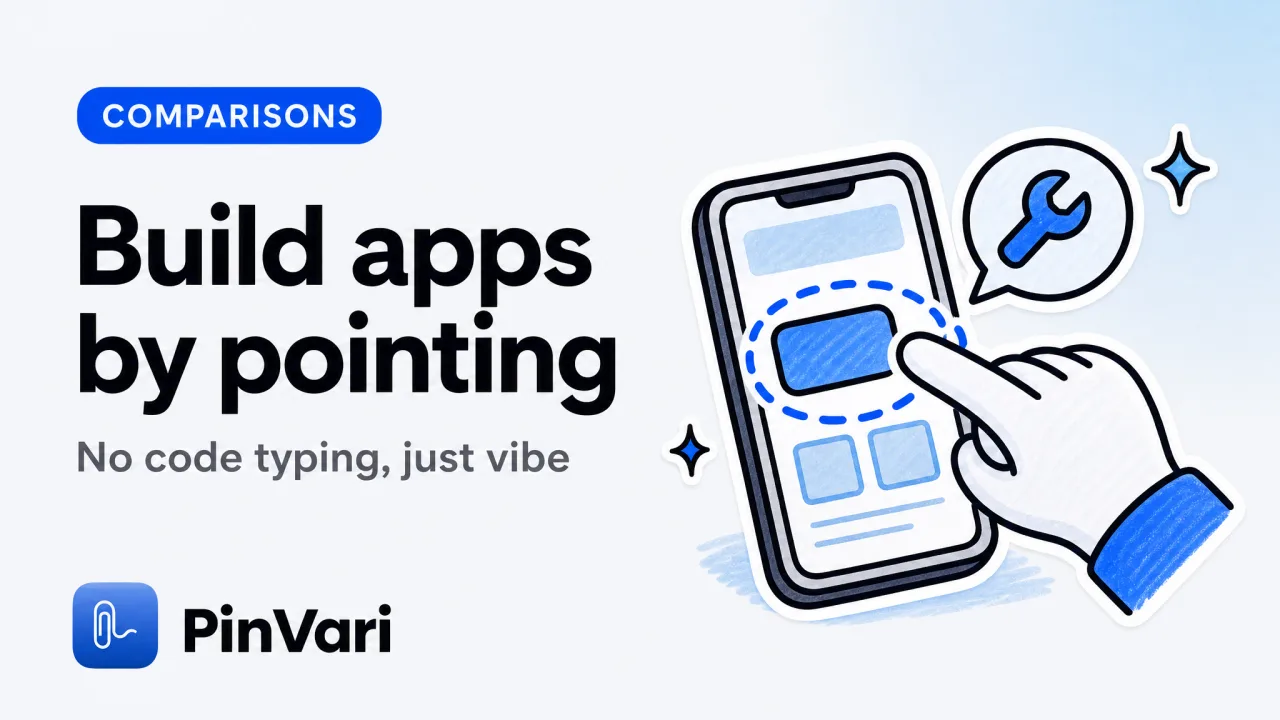
Vibe coding mobile apps means you describe the screen in plain English and an AI coding agent writes the code. In 2026 the fast loop pairs a point-and-speak capture tool with Claude Code, Cursor, Bolt, Lovable, or v0 so you can circle a too-small button and say "make this 44x44."
Most tutorials still assume you will type selectors. That is the slow half of the job. The named element plus a confidence score is what makes the second lap cheap.
What is vibe coding for mobile apps?
Vibe coding is building software by describing what you want. For mobile that is "login screen, email, password, gray background, rounded corners," then a generated React Native screen, SwiftUI view, or mobile-responsive web page.
The name stuck in late 2024 when Cursor and Claude Code let people stay in language instead of flipping back to code every five minutes.
You need three parts: a model, an agent that can edit a live project, and a capture layer that names what is on screen so the agent is not guessing.
Which vibe coding platforms support mobile apps?
Lovable
Mobile support: Web apps (mobile-responsive) Pricing: Free tier, $20/mo Pro Best for: Full-stack web apps with a backend Caveat: Not native iOS/Android; ships as a PWA
Bolt
Mobile support: Web apps (mobile-responsive) Pricing: Free tier, $20/mo Best for: Quick prototypes, no backend Caveat: Browser only, no native binary
v0 (Vercel)
Mobile support: Web components Pricing: Free tier, $20/mo Best for: Next.js / React components Caveat: No backend scaffold; you copy code out
Cursor
Mobile support: React Native, Swift, Kotlin Pricing: $20/mo Best for: Native apps with full control Caveat: You own the build tooling
Claude Code
Mobile support: React Native, Swift, Kotlin Pricing: Free + your Anthropic API key Best for: Native mobile plus vibe coding with Claude Caveat: Terminal agent, no hosted preview
Windsurf
Mobile support: React Native, web Pricing: Free tier, $15/mo Best for: Multi-file cascade edits Caveat: Newer than Cursor
Want an App Store binary? Cursor or Claude Code plus React Native (or Swift/Kotlin). Want a phone-friendly web app tonight? Lovable or Bolt.
Most "vibe coding mobile apps" guides still mean web apps that happen to fit a phone. True native needs Xcode or Android Studio plus a way to name the control you see in the simulator.
How do you vibe code a mobile app in 2026?
Pick the stack first. Lovable if you need a hosted backend. Bolt if you do not. React Native if you want one codebase on both phones.
Describe the first screen in chat: "email, password, blue login button, gray background." Preview it in the browser, or run npx expo start / the Xcode project for native.
When something is wrong, circle the broken element and say the fix. Press ⌥⌘A in PinVari, mark the button, say "44 pixels tall, #0066CC." The agent gets Button "Log In" plus frame, crop, and transcript. Reload. Repeat.
Put the iOS Simulator on one display and Cursor or Claude Code on the other. Capture, speak, watch the hot reload. That is the whole loop.
What's the difference between vibe coding websites and mobile apps?
Vibe coding websites emits HTML/CSS/JS. Mobile vibe coding either emits responsive web or native (JSX, SwiftUI, Compose).
The describe-generate-circle-fix loop is the same. The capture surface is not. Chrome has a DOM tree. A simulator has an iOS or Android tree. PinVari reads both because macOS exposes every on-screen window through Accessibility, including Simulator and emulator frames.
Web previews refresh in a couple of seconds. Native pays a rebuild: Expo hot-reload is a few seconds, a full Swift compile can be 15–30.
Can you vibe code with Claude for mobile apps?
Yes. Claude Code edits local files from natural language. Init in a React Native or Swift repo, then ask for a tab bar. When the simulator looks wrong, do not paste a full screenshot if you can hand it a named element instead.
Connect PinVari with one click (Connect → Claude Code) or:
claude mcp add --scope user pinvari -- "$HOME/.pinvari/mcp/pinvari-mcp"pinvari_next_instruction then carries the crop, the spoken line, and the AX path. "Make this button match that one" binds both AXButtons. Nothing is uploaded by default.
Which vibe coding platforms are free?
Lovable, Bolt, and v0 give monthly credits. Cursor's free tier is autocomplete; agent mode is $20/mo. Claude Code is free software; you pay Anthropic for tokens.
Bolt free plus a one-time $39 capture license is the cheapest serious stack. One named capture replaces three clarifying prompts, which matters at 50 free prompts a month.
Lovable and Bolt free tiers preview locally and skip a public deploy. v0 emits code you host yourself.
How do you stop the agent editing the wrong control?
The failure is "change the login button" when three buttons share a label. Point while you speak.
⌥⌘A, circle Log In, say "change this to blue." The agent sees AXButton "Log In" at a frame, plus the parent chain, so it does not restyle a different Submit buried in a ScrollView.
Same pattern we documented for Claude Code fixing the wrong element. The accessibility tree is the name, not the pixels.
What is the fastest vibe coding workflow for mobile apps?
Simulator on one display, agent on the other. Capture, speak, hot-reload. Scope Cursor agent mode to the repo so a color change can update the token and every caller.
Turn on whole-screen OCR only when the simulator is AX-blind (canvas, custom draw). Add a Cursor rule: use design tokens, never hardcode colors.
PinVari is a native macOS app: hold ⌥⌘A to mark, press again or ⏎ to finish, ⌥⌘V for voice-only. Marks are freehand. Dwell about 0.2s names a control without circling it. One breath can mark three things; each mark keeps its own words. Multi-display captures remember which monitor the ink was on.
Transcription and OCR stay on-device. You bring your own agent. Below 0.8 confidence it asks, and never silently guesses. On canvas or games the AX tree can be empty, so Vision OCR is the fallback.
FAQ
Can you vibe code native iOS apps in Swift?
Yes. Open the Xcode project in Cursor or Claude Code, run Simulator, circle SwiftUI views, speak the change. You wait on the rebuild, not on naming the view.
What is the best vibe coding app for beginners?
Lovable. Live preview, Supabase backend, no local Node setup. Type "todo app, purple header." Point with PinVari only when you need the exact control.
How do you add backend logic?
In Lovable, describe the endpoint in the same chat. Bolt is frontend; export and wire your own API. In React Native or Swift, say "on Log In, POST /api/login, spinner, then Home or a red alert."
Does PinVari work with Xcode simulators?
Yes. It hit-tests the Simulator window like any other macOS surface and resolves AXButton, AXTextField, AXStaticText. The agent edits the matching SwiftUI view.
Can you vibe code Android apps?
Yes, with the emulator plus Cursor or Claude Code. Android's tree is thinner on custom views, so PinVari falls back to on-device OCR when the AX node is empty.
What if the agent changes the wrong screen?
Login and Signup look alike. Always point at the screen you mean. The crop in the capture picks the file that matches what you saw, not the file the agent edited last. See AI agent workflow.
Hand your agent the exact element
PinVari resolves what you point at into a named, executable instruction — on-device, no keys, your own agent. One click inside PinVari connects Claude Code, Cursor, VS Code or Codex — or paste one CLI line from pinvari.com/connect.
PinVari → Connect → your agent (one click)Get PinVari — $39 →