Vibe Coding with Claude: A Workflow That Ships
Vibe coding with Claude means describing what you want in plain language and letting Claude Code, or Claude inside Cursor, write and fix the code while you steer from what you see on screen. The workflow that actually ships treats Claude as the builder and you as the director.
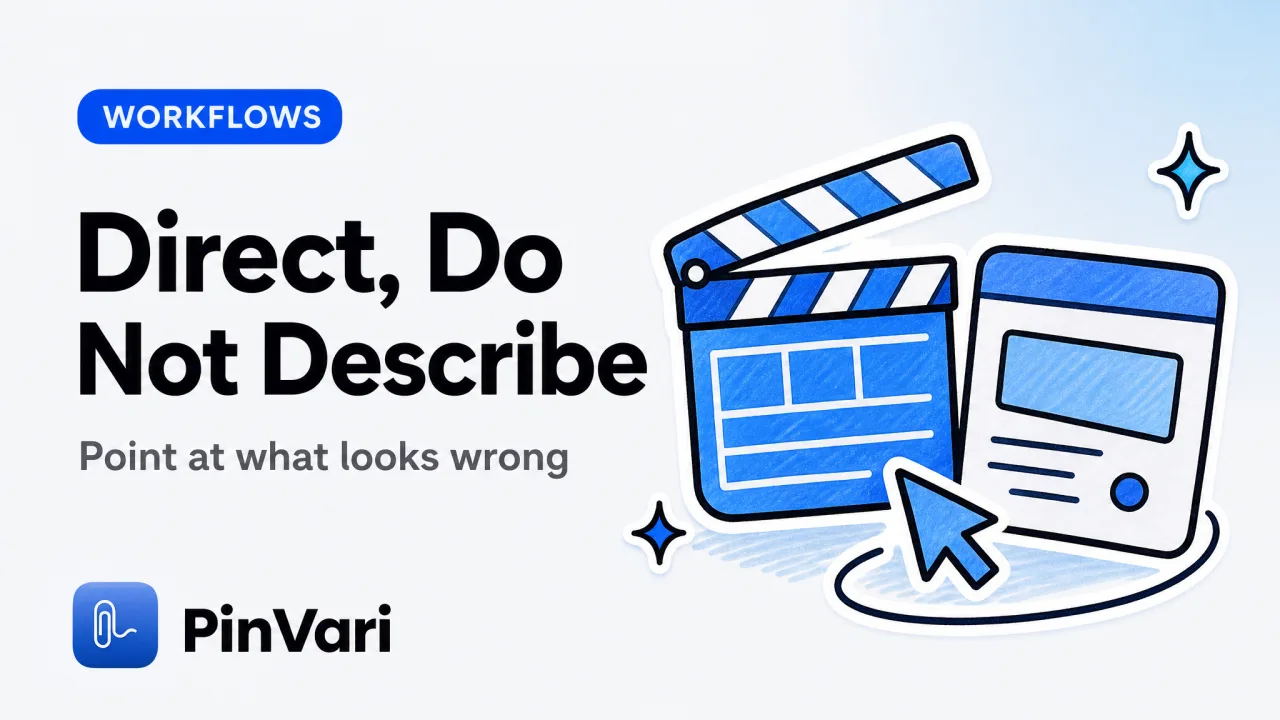
The single biggest speedup is pointing at the exact element that looks wrong instead of describing it in a paragraph. Most tutorials teach you to write better prompts, but the real bottleneck is the loop from "that looks off" to "fixed."
Prose keeps that loop slow because Claude has to guess which element you meant. If you are building a real product in Cursor, Lovable, Bolt, or v0 without deep coding skills, you already know the failure mode.
You type "the header feels cramped," Claude edits the wrong container, and you burn three rounds getting back to where you started. The fix is not a cleverer prompt; it is a tighter way to tell Claude what you are looking at.
What is vibe coding with Claude, exactly?
Vibe coding with Claude is building software by expressing intent in natural language and letting the model handle the implementation. You describe the outcome, Claude writes the code, you look at the result, and you correct it.
The term describes a loop, not a single prompt. The loop has four beats: you see something, you describe a change, Claude edits, you re-check.
The loop is only as fast as its slowest beat, and for most people that is the "describe a change" step, because turning a visual problem into precise words is genuinely hard. Claude is unusually good at the implementation beats.
Where beginners lose time is the translation beats, converting "that looks wrong" into something Claude can act on without guessing. That is a communication problem, not a coding one.
Vibe coding does not mean you skip specifics. It means you supply specifics about intent and target while Claude supplies specifics about syntax.
The vibe coding with Claude checklist (copy this)
Here is a repeatable checklist for a clean vibe coding session with Claude. Copy it and run it top to bottom.
- State the goal in one sentence. "A pricing page with three plan cards and a monthly/yearly toggle."
- Let Claude scaffold before you critique. Get the whole thing on screen first; do not micro-correct the first draft.
- Look at the running app, not the code. Open the preview and find the one thing that looks most wrong.
- Name the target precisely. Not "the toggle area" but "the yearly toggle button in the pricing header."
- Give expected versus actual. "The yearly toggle should highlight when active; right now nothing changes."
- Change one thing per round. Batched fixes hide which edit caused a regression.
- Re-check and commit. When a beat works, save it before the next change so you can roll back cleanly.
The step people skip is number four, and it is the one that decides the whole session. A vague target sends Claude editing adjacent code, and now you are debugging a fix you did not want.
A precise target keeps every round additive.
Keep a running note of what works. When Claude nails a component, paste that snippet into a "known good" note so you can restore it if a later round breaks it.
For choosing where to run this loop, the vibe coding tools landscape splits into browser builders and code-native agents. The checklist works in both.
Why does Claude keep fixing the wrong element?
Claude fixes the wrong element because a text description is ambiguous about targets, and the model resolves the ambiguity by picking the most likely candidate, which is often not yours. "The button at the top" could be four things on a busy page.
There are two ways to close the gap. You can learn the codebase well enough to name the component and file, which defeats the point of vibe coding.
Or you can give Claude the actual element you are looking at, so there is nothing left to guess. This is why Claude Code fixes the wrong element so often when you feed it prose.
A raw screenshot makes Claude read pixels and infer, which is a guess with extra steps. The question of whether Claude Code can see your screen matters less than whether it gets the named element under your pointer.
Pasting a full-window screenshot into Claude feels like giving context, but it forces the model to OCR and locate your target from pixels. That is slower and less reliable than handing it the element's name and role directly.
On a large screenshot it also burns tokens you did not need to spend.
How do you point at the exact element for Claude?
You point at the exact element by capturing it as structured data and handing that to Claude, instead of describing it. On macOS, the operating system already knows the name, role, and position of every control through the Accessibility API.
The interaction is point-and-speak. You hold ⌥⌘A, circle or point at the element that looks wrong, and say the fix out loud.
Example: "make this toggle highlight when it is active." The tool resolves the element via AXUIElementCopyElementAtPosition, transcribes your speech on-device, and binds words like "this" and "here" to exactly where your pointer was when you said them.
That produces a named, executable instruction, which lands in Claude Code over a local MCP server running on 127.0.0.1. Claude reads the element path and your instruction through a tool call, so it acts on a resolved target rather than a paragraph.
This is the concrete version of giving Claude Code the context it needs: the element name, its role, its frame, and your intent, in one payload.
The speaking part is not a gimmick. Talking through a fix is faster than typing it, and push-to-talk voice for Claude Code on Mac keeps your hands on the work instead of on a prompt box.
Point at the thing, say what should change, and Claude gets a target it cannot misread. For vibe coders who want the loop from "that looks wrong" to "fixed" to take seconds, PinVari resolves the element and hands it to Claude for a one-time $39, on-device, with no API keys and nothing uploaded by default.
Vibe coding tools compared: where does Claude fit?
Claude fits as the reasoning engine behind the build, whether you run it in the terminal via Claude Code or inside an editor like Cursor. The other tools differ mostly in how much of the stack they hide from you.
Claude Code
Best for: Full control, real repos.
You bring: Claude, a terminal.
Runs where: Your machine.
Cursor
Best for: Editor-native agent.
You bring: Cursor plus a model key.
Runs where: Desktop app.
Lovable
Best for: Web apps from prompts.
You bring: Just the idea.
Runs where: Browser.
Bolt
Best for: Fast web prototypes.
You bring: Just the idea.
Runs where: Browser.
v0
Best for: UI components, React.
You bring: Design intent.
Runs where: Browser.
Browser builders like Lovable, Bolt, and v0 are the fastest way to see something running. They are ideal for vibe coding websites and simple apps.
The tradeoff is that you have less access to the underlying code when something breaks in a way the prompt box cannot reach. Claude Code and Cursor give you the real repository, which matters the moment your project outgrows a prototype.
Either way, the element-targeting problem is the same. Pointing at the exact control beats describing it regardless of which tool you build in.
FAQ
What is vibe coding with Claude?
It is building software by describing what you want in plain language and letting Claude write and fix the code while you direct from the running app. You supply intent and targets; Claude supplies the implementation.
How do I vibe code with Claude as a beginner?
Start with a one-sentence goal, let Claude scaffold the whole thing, then correct one specific element at a time. The key skill is naming the exact element you want changed, not writing clever prompts.
Why does Claude edit the wrong part of my app?
Because a text description is ambiguous about which element you mean, and Claude picks the most likely candidate, which may not be yours. Giving Claude the actual named element you are looking at removes the guesswork.
Can I vibe code websites and mobile apps with Claude?
Yes. Browser tools like Lovable, Bolt, and v0 are strong for websites and web apps, while Claude Code and Cursor handle full repositories including mobile projects.
Is voice faster than typing for vibe coding?
For correcting what you see, usually yes. Speaking a fix while pointing at the element is faster than typing a description, and push-to-talk capture keeps your attention on the app instead of a prompt box.
Do I need to know how to code to vibe code with Claude?
No, but you do need to be specific about intent and target. Claude handles syntax; your job is to say clearly what should change and which element it applies to.
Hand your agent the exact element
PinVari resolves what you point at into a named, executable instruction — on-device, no keys, your own agent. One click inside PinVari connects Claude Code, Cursor, VS Code or Codex — or paste one CLI line from pinvari.com/connect.
PinVari → Connect → your agent (one click)Get PinVari — $39 →