Vibe Coding Best Practices That Ship
Vibe coding best practices are the habits that keep an AI editor from rewriting your product while you try to fix a pad. You still point at an outcome.
You just refuse the prompt that says "make it nicer" and the accept-all that follows.
If you need the definition, start with vibe coding and the walkthrough how to vibe code. This post is the list I wish I had after I watched Cursor delete a working auth flow because I said "clean this up."
What are vibe coding best practices, in one pass?
Work in a running preview. Speak or type one verb.
Limit the blast radius. Look at the diff. Run the thing you can see.
Commit when it is true.
That is the whole practice. The rest is how people skip a step and call it speed.
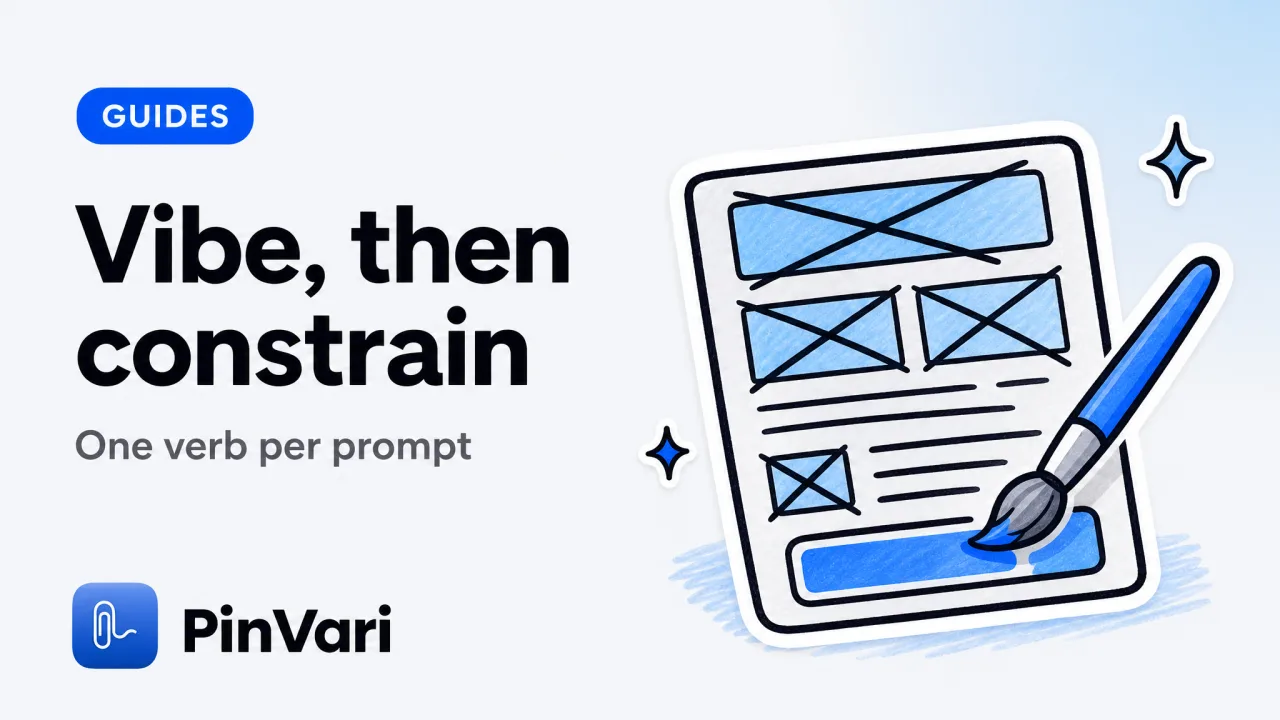
One verb per prompt is the rule I break the least. "Move the price above the title" ships.
"Polish the card and also the nav" ships a stranger's app.
Scope
Do: name the screen and the control
Do not: say "the app feels messy"
Agent
Do: accept file-by-file
Do not: apply 40-file diffs after a vibe
Proof
Do: click the path you changed
Do not: trust "I fixed it" in chat
Memory
Do: a short rules file
Do not: a 2,000-line manifesto the model ignores
Vocabulary
Do: point when you cannot name the component
Do not: invent CSS you saw on Twitter
The vibe coding tools post is the shopping list. Practices are cheaper than a new tool.
How do I prompt without sounding like an engineer?
Use product words. "The upgrade button on the billing page stays gray after I type a valid card." That is a complete ticket.
You do not need to say disabled={true}. You need to say which button and what you expected.
If you do not know the component name, do not guess PrimaryButton. Guessing is how Lovable edits the marketing CTA and leaves billing alone.
Hold ⌥⌘A, circle the control, say the sentence. On-device transcript.
Named AX element. Crop.
Your agent in Cursor, Claude, or Codex gets the bundle over local MCP.
claude mcp add --scope user pinvari -- "$HOME/.pinvari/mcp/pinvari-mcp"Or PinVari → Connect. App running.
127.0.0.1:3402.
Vibe coding is not "no specification." It is specification by pointing. The spec still has to exist.
Vibe coding with Claude is the same practice in a terminal agent.
How do I stop the agent from rewriting everything?
Never say "refactor" unless the task is a refactor. Never say "production ready" unless you will read the diff.
Pin files when the editor lets you. In Cursor, @-mention the one component.
In Lovable/Bolt/v0, stay on the screen you are looking at and refuse "apply to the whole project" if that toggle exists.
New chat when the last ten turns were wrong. Old wrong turns are a second system prompt.
"Make it like Linear" is not a practice. It is a mood. The agent will fetch a vibe of purple and tables. You will not get Linear.
I keep a three-line rule: stack, test command, "do not edit files I did not name." That rule has saved more nights than any model upgrade.
The diff is the product while you are vibe coding. If you will not look at it, you are not shipping.
You are generating.
What does a good vibe session look like?
I start with a visible bug or a visible gap. I do not start with architecture.
I capture or type the change. I let the agent touch a small set of files.
I click the path. I commit with a sentence a stranger could read.
If the preview is wrong, I recapture the same control. I do not add a second request about fonts.
Fonts wait.
If confidence on a capture is below about 0.8, I circle again or dwell (~0.2s) so the resolver can leave a bare AXGroup. Canvas and some Electron views fall back to on-device OCR.
I treat those as softer signals.
Three marks in one breath are fine if each mark has its own words. One breath that says "these" with no buckets is how you get a random three-file edit.
Commit more than you think. Vibe coding without git is a trap. The undo in the editor is not a history. It is a suggestion.
Mid-task, if the agent is lost, let it request a capture. The notch island lights up.
You point. You do not type a paragraph about "the other modal."
How should beginners practice this week?
Day 1: change copy on one button. Day 2: move one element.
Day 3: fix one overflow. Day 4: add one empty state.
Day 5: file the same change as a ticket without the agent, to see if you can describe it.
If day 5 is impossible, you have been lucky, not skilled. Pointing is a skill.
So is refusing a bad diff.
Keep the tool count low. One editor, one preview, one capture path.
The pricing page is the one-time Mac app if you want named capture without a subscription. Use free dictation for prose if you want.
Do not confuse the two.
macOS 14+, Apple Silicon and Intel, Developer-ID DMG. Hotkeys ⌥⌘A / ⌥⌘V / ⌥⌘P.
Nothing uploaded by default.
Practices I retired
"Just one more prompt" after a good diff
Pasting the whole page as a screenshot
Accept all because the spinner was long
Rules files longer than the feature
A second editor for the same repo
How I review an agent diff when I cannot read every line
I do not pretend I will parse a 400-line change. I parse the file list first.
If a file I did not name is in the list, I reject the whole thing and I say so. "Only the billing card." That sentence is a practice.
It is also a test of whether the agent is listening.
Then I search the diff for deletions. Vibe tools love to delete a handler they do not understand.
A deleted onClick is the usual way a pretty button becomes a brick.
Then I click. If I cannot click, I did not finish.
Chat saying "done" is not a QA step.
When the preview looks right and the diff still scares me, I ask the agent to explain the diff in five bullets, one per file. If it cannot, I revert.
An explanation that names the wrong component is a gift. You just caught the lie before users did.
I also keep a screenshot of the last good state in the ticket or the chat. Vibe coding without a before-image is how you gaslight yourself.
The capture tool already has the before. Use it.
For multi-display setups I preview on the same display I marked. A layout that is "fine" on a 27-inch and broken on the laptop is a bug I created by reviewing the wrong glass.
If you are pairing with a founder who only speaks, let them own the marks and you own the git. That split is a practice.
Two people both accepting diffs is how you ship two designs.
The last practice is knowing when to stop vibe coding and write a test or a spec. After the third visual pass on the same control, I write the expected state in a sentence the agent can fail against.
Pointing got me here. A check keeps me here.
None of this needs a new identity as a "vibe coder." It needs a smaller prompt and a named control. The rest is taste.
FAQ
What are vibe coding best practices for complete beginners?
One screen, one verb, look at the diff, click the result, commit. Point at the UI when you cannot name the file.
Do not start with a rewrite of auth.
Is vibe coding real engineering?
It is real if you keep a constraint and a check. It is not if you accept multi-file diffs you cannot explain.
The label does not matter. The revert does.
Should I vibe code in Lovable or in Cursor?
Lovable, Bolt, and v0 are faster to a first preview. Cursor is faster the moment you have a repo you care about.
Practices are the same. Blast radius is not.
How do I give the agent feedback on visual bugs?
Name the control or point at it. Send a crop.
Say expected versus actual. Do not send a desktop PNG and a mood.
How long should a vibe session last?
Until the next commit. If you have been prompting for an hour without a commit, you are in a hole.
Branch, or revert, or start a new chat with the one true sentence.
Do I need MCP to vibe code well?
No. You need a tight loop.
MCP helps when the loop includes the running screen. Paste still works.
Paste is just slower and wrong more often.
Hand your agent the exact element
PinVari resolves what you point at into a named, executable instruction — on-device, no keys, your own agent. One click inside PinVari connects Claude Code, Cursor, VS Code or Codex — or paste one CLI line from pinvari.com/connect.
PinVari → Connect → your agent (one click)Get PinVari — $39 →