Vibe Coding: Build Software by Describing What You Want
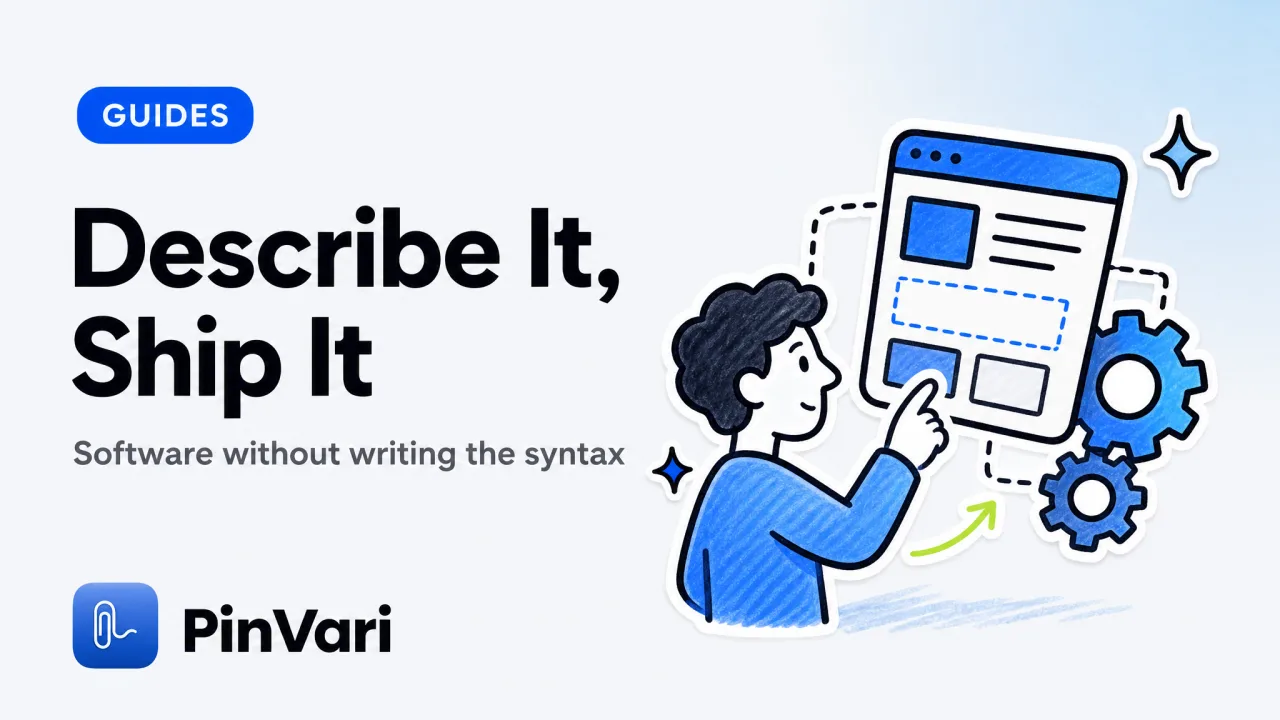
Vibe coding is building software by describing what you want in plain language and letting an AI agent write the code. You steer with intent and feedback instead of typing syntax.
The tightest loop from "that looks wrong on screen" to "that is fixed in the code" matters more than any single clever prompt. Most guides get this backwards: they obsess over prompt wording and ignore the part that actually slows you down, which is telling the model which thing on screen is broken.
I have watched people ship real products this way with Cursor, Lovable, Bolt, and v0 while barely reading the diffs. The pattern that separates a smooth session from a frustrating one is how fast you can point the AI at the exact problem, not skill with code.
What is vibe coding, really?
Vibe coding names a workflow, not a tool. You describe a feature, the model writes it, you look at the running result, and you react to what you see.
You act as the product manager and the QA; the model is the typist. The word covers a spectrum.
On one end, a non-coder builds a landing page in a browser tool and never opens a file. On the other, an experienced engineer drives Claude Code and reviews every change but still works by intent rather than by hand-editing.
Both are vibe coding because both replace "write this line" with "make it do this." The skill that carries over from traditional development is not syntax.
It is being specific about what you want, and noticing quickly when the result is wrong. If you cannot describe the problem precisely, the AI fills the gap with a guess.
Vibe coding shifts your job from producing code to producing clear intent and fast feedback. The quality of your feedback loop decides how far you get.
If you are brand new to this, the honest starting point is picking one agent and one project. The best coding software for beginners walks through which tools forgive early mistakes.
Which vibe coding tools and platforms actually ship?
There is a difference between a demo and a tool you can build a real product with. The vibe coding platforms that hold up are the ones with a real preview, a real file system, and a real way to fix what you see.
Browser platforms like Lovable, Bolt, and v0 generate a working app from a prompt and show you a live preview. They are excellent for getting from zero to something you can click.
Their weakness shows up on the tenth revision, when you want to nudge one element and the model rewrites three unrelated things. Editor-based agents like Cursor and Claude Code sit on top of your actual codebase.
They are slower to start but far stronger once the project has structure, because they read your files and keep changes scoped. This is where most serious vibe coding ends up.
Browser app builder
Example: Lovable, Bolt, v0.
Best for: Zero to live preview fast.
Where it struggles: Precise edits on a mature project.
Editor agent
Example: Cursor, Claude Code.
Best for: Real codebases, scoped changes.
Where it struggles: Higher setup and mental overhead.
Terminal agent
Example: Claude Code, Codex CLI.
Best for: Full control, scripting, git.
Where it struggles: No GUI, steeper start.
Screenshot plus chat
Example: Any plus CleanShot X.
Best for: One-off fixes, patient iteration.
Where it struggles: Slow, ambiguous, burns tokens.
For a deeper breakdown of the specific apps and their pricing, this guide to vibe coding tools compares the free and paid options. The tool choice matters less than people think.
What matters is how each one handles the moment you say "no, not that, that."
Why does the feedback loop break for vibe coders?
The loop breaks at a single point: you can see what is wrong, but you cannot name it in the terms the AI needs. You think "that dropdown is misaligned."
The agent thinks in files, components, and element roles. Nobody translates between the two, so the agent guesses.
Here is the concrete failure. You take a screenshot, paste it into your agent, and type "fix the spacing on this button."
The screenshot is pixels. The agent has to infer which <button> in your code corresponds to the shape you circled, based on position and nearby text.
When two buttons look alike or the design is mid-change, the inference is wrong. Claude Code fixing the wrong element is the exact symptom.
The agent edits a similar-looking component, you verify, it is wrong, you re-prompt. Each wrong round costs time and leaves the UI still broken.
A screenshot tells your agent what the screen looks like, not which element you mean. Pixel data is the least reliable way to point at one specific control among many that resemble it.
Voice input helps the describing half. Speaking "move this down and add more padding" is faster than typing it.
But voice alone does not solve the pointing half. You still have to say which "this," and the agent still has to guess.
How do you point at a bug instead of describing it?
The fix is to give the agent the actual element you are looking at, resolved by name, not by pixel. macOS already exposes this.
Every on-screen control has an accessibility record with a role, a label, a frame, and a parent chain, reachable through AXUIElementCopyElementAtPosition. A tool that reads that record can hand your agent something like AXButton "Get Started" at (680, 320) inside AXGroup "hero-section", along with a confidence score.
How AI agents know which UI element you mean walks the full resolution chain, including what happens on Electron windows where the accessibility tree loads lazily. This is what PinVari does.
You hold ⌥⌘A, circle or point at the broken control, and speak the fix. It screenshots the region, transcribes your words on-device, resolves the named accessibility element under your pointer, and hands your own agent a resolved, executable instruction over a local MCP server on 127.0.0.1.
When the element has no accessibility label, it falls back to on-device Vision OCR. The result is that "this" becomes a specific named control before it ever reaches the model.
The agent knows which button, not which pixel region. Because everything runs on your machine, there are no API keys and nothing is uploaded by default.
Whether or not you use a dedicated tool, name the element out loud in your prompt. "The AXButton labeled Continue inside the login card" beats "this button" every time.
What does a vibe coding tutorial workflow look like end to end?
A vibe coding session that survives a real project has a rhythm. Describe, look, react, and keep each reaction tightly scoped.
Start by describing the feature in one or two sentences, not a paragraph. "A pricing page with three tiers and a monthly/annual toggle."
Let the agent build it and show you the preview. Then react to what you see, one element at a time.
If the toggle is misaligned, do not type "the page looks off." Point at the toggle, say "align this to the center of the card," and let the agent apply a scoped change.
Small, named corrections keep the model from rewriting things that already work. Verify in preview after every change.
Vibe coding rewards short cycles. A five-second check after each edit catches drift before it compounds.
When you get stuck because the agent cannot see your screen, remember it is not supposed to by default. Whether Claude Code can see your screen explains that the CLI agent has no eyes unless you feed it screenshots or connect a screen-context layer through MCP.
Vibe coding with Claude specifically works best when the agent has both the element and the intent. Give it the named control, the spoken fix, and a cropped screenshot of just that region, and one round usually does it.
If pointing instead of explaining is the part of your loop you most want to fix, PinVari is a one-time purchase built for exactly that. It works with Cursor, Claude Code, Codex, and Zed through the same local handoff.
FAQ
What is vibe coding in simple terms?
Vibe coding is building software by telling an AI what you want in plain language instead of writing the code yourself. You describe features and fixes, the AI writes the code, and you review the running result and react to it.
Can you really build a real product with vibe coding?
Yes, people ship real web apps, tools, and sites this way, especially with editor agents like Cursor and Claude Code that work on an actual codebase. The limit is not the coding; it is how precisely you can describe problems and how fast you can point the AI at them.
What tools do I need to start vibe coding?
You need one AI coding agent (Cursor, Claude Code, or a browser builder like Lovable or v0) and a way to show it what is wrong on screen. At minimum that is a screenshot tool plus your keyboard.
Why does the AI keep changing the wrong thing?
Because a screenshot only shows pixels, so the agent has to guess which coded element matches the shape you circled. When several controls look alike, that guess is often wrong.
Is vibe coding good for beginners with no coding skills?
It is one of the most accessible ways to build software today, but it is not magic. You still need to be specific about what you want and notice quickly when the result is off.
Does vibe coding work with Claude Code?
Yes, Claude Code is a strong fit because it works on your real codebase and supports MCP servers. Vibe coding with Claude works best when you give it the named element, the spoken instruction, and a cropped screenshot.
Hand your agent the exact element
PinVari resolves what you point at into a named, executable instruction — on-device, no keys, your own agent. One click inside PinVari connects Claude Code, Cursor, VS Code or Codex — or paste one CLI line from pinvari.com/connect.
PinVari → Connect → your agent (one click)Get PinVari — $39 →