Lovable vs Bolt: Which Vibe Coding Tool Wins?
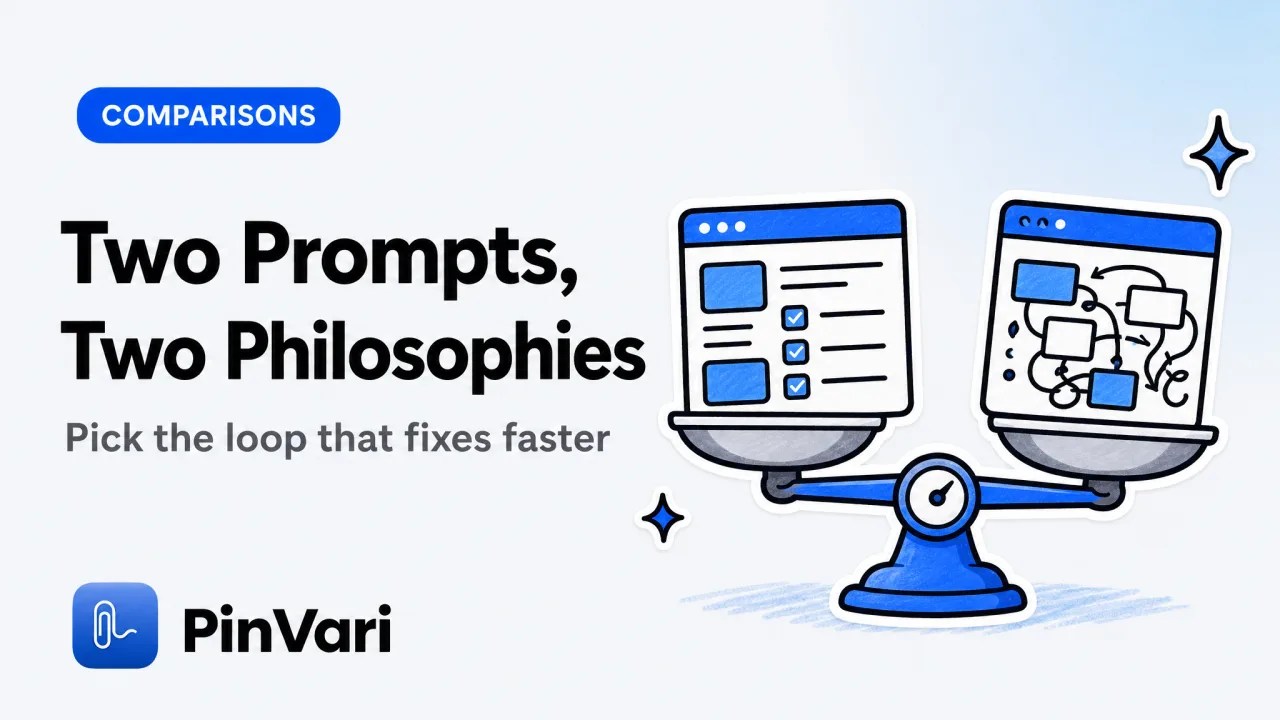
Lovable vs Bolt comes down to one split: Lovable is the better pick if you want a guided full-stack app with auth and a database wired up for you, and Bolt is better if you want raw control over the code plus the freedom to run any npm package straight in the browser. Both turn a plain-English prompt into a working web app in minutes, and both leave you stuck the second you need to describe a visual bug you can see on screen but cannot name in code terms.
Most Lovable vs Bolt comparisons rank the two on prompt quality and demo polish, then skip the part that actually eats your afternoon. The real bottleneck is the loop between spotting something wrong on screen and getting the AI to change the right thing.
Lovable vs Bolt: what is each one actually for?
Lovable leans opinionated. You describe an app, and it scaffolds a full stack with a database, authentication, and a deploy target already connected, so a non-coder gets to a shippable product without touching config.
It hides the plumbing on purpose.
Bolt leans open. It runs a real Node environment in your browser, lets you install packages, edit files directly, and see the terminal, which suits someone who wants to poke at the code and understand what changed.
You trade hand-holding for control.
That is the honest core of the choice. One optimizes for "get me to a working app," the other for "let me steer the app." Neither is wrong, and plenty of people start in one and export to a proper editor later.
If you have never shipped software before, start where the guardrails are highest and graduate later. Our rundown of the best coding software for beginners walks through what "beginner-friendly" should actually mean before you commit a weekend to one tool.
Which builds a real product faster?
For a first working version, Lovable usually gets a non-coder to "it runs and logs in" with fewer decisions. The database and auth are already there, so you spend your prompts on features, not setup.
Bolt gets you to a working version just as fast for anything front-end heavy, and pulls ahead once you need a specific library or a bit of logic the guided path does not cover. The second you want to install a package, Bolt stops fighting you.
The catch on both is the second lap. Getting to a first version is quick, but the tenth change, the one where you are nudging spacing, fixing a broken hover state, or renaming a label, is where the vague-prompt tax shows up, and it lands equally hard on Lovable and Bolt because neither knows which rendered element you are looking at.
Here is the side-by-side that matters for shipping, not for a demo reel.
| Dimension | Lovable | Bolt |
|---|---|---|
| Best for | Full-stack apps, fast | Front-end control, any npm package |
| Backend and auth | Wired for you | You assemble it |
| Editing the code | Guided, abstracted | Direct file and terminal access |
| Learning curve | Lowest | Low, steeper if you go deep |
| Export to a real editor | Yes | Yes |
| Where it stalls | Custom logic outside the rails | Describing visual bugs precisely |
Notice the last row. Both platforms are excellent at generating and both are bad at the same thing, which is understanding a change you can only describe by pointing at the screen.
Which is better for non-coders?
Lovable, narrowly, because it removes the most decisions. A non-coder does not want to choose a database or wire an auth flow, and Lovable makes those choices for you so the prompt stays about the product.
But "better for non-coders" hides a trap that neither tool solves. The moment your app has a real UI, you stop describing features and start describing defects, and that is where a beginner's vocabulary runs out.
You know the pricing card looks wrong. You do not know it is called PricingCard, that the gap is a padding-top, or that "the button jumps" is a hover-state regression.
So you type "make the top part look better," the AI guesses, and you burn three rounds before it edits the thing you actually meant.
The failure mode is the same on every vibe coding platform: vague words in, wrong element edited, tokens spent, morale gone. The fix is not a better prompt. It is a way to name the exact element without knowing its name.
Where do Lovable and Bolt leave you stuck?
Both are browser tools, and both preview your app in a browser tab. That preview is the scene of every hard bug, and it is exactly where prose fails you.
When you drag a screenshot into a chat, the model still has to guess which of five similar buttons you mean, and it routinely edits the wrong one. We broke down why that happens in how AI agents know which UI element you mean, and the short version is that a picture is not a name.
The Lovable vs Bolt decision, then, is real but incomplete. Whichever you pick, you still need a faster way to turn "that looks wrong" into "change this named control," or you will lose your speed advantage in the review loop.
This is where a lot of vibe coders end up exporting to a full editor like Cursor or Claude Code for the fixes, then coming back. If that is your path, the pattern that keeps agents from editing the wrong element is worth reading before you rack up wasted rounds.
How do you fix a visual bug you can't name?
You point at it and say what is wrong, and let software resolve the name for you. That is the whole idea behind PinVari, a native macOS app that sits over your Lovable or Bolt preview and turns a gesture plus a sentence into a precise instruction.
You hold ⌥⌘A, circle the broken card in your browser preview, and say "this pricing card is too cramped, add breathing room at the top." PinVari screenshots the region, transcribes your voice on-device, and resolves the exact named accessibility element you circled, including its role, label, and frame, with a confidence score attached.
Because your app runs in a browser, PinVari reads the browser's real URL through the accessibility AXWebArea and the labeled element under your cursor, so the instruction is anchored to the actual control, not a pixel region. When the accessibility tree is empty on a canvas surface, it falls back to on-device Vision OCR rather than guessing.
Then it hands that resolved, named instruction to your own AI coding agent over a local server on 127.0.0.1, or files it straight to Linear, GitHub, or a shareable page. Your agent knows which control you meant by name, so it edits PricingCard, not the nearest lookalike.
The point is not the screenshot. It is that the deictic word "this" gets bound to a named element with a confidence score, so a non-coder can direct an agent with the precision of someone who reads the codebase.
It runs on-device with no API keys and nothing uploaded by default, so your half-built product stays on your Mac. You bring your own agent and your own model.
It ships as a notarized DMG for macOS 14 and up on Apple Silicon and Intel, and it is a one-time $39 launch license rather than another monthly bill; the full pricing is on the product page.
If you are still weighing platforms before you build, our broader guide to vibe coding tools covers the full field, and the deeper Lovable vs Bolt vs Replit breakdown adds the third contender most people compare next.
FAQ
#
Is Lovable or Bolt better for beginners?
Lovable is slightly better for absolute beginners because it wires the backend, database, and auth for you, so you make fewer technical decisions. Bolt is close behind and pulls ahead once you want direct control over files, the terminal, or specific npm packages.
#
Can you export code from Lovable and Bolt?
Yes, both let you export a real codebase and continue in an editor like Cursor or Claude Code. Many people prototype in Lovable or Bolt, then move to a full editor once they need custom logic or precise UI fixes.
#
Why does the AI keep editing the wrong element?
Because a prompt or a screenshot does not name the element, so the model guesses among similar controls. Resolving the exact named accessibility element under your cursor removes the guess, which is what tools built on the macOS Accessibility API do.
#
Do I need to know how to code to use Lovable or Bolt?
No, both are built for people who describe apps in plain English. The limit is not writing code, it is describing visual bugs precisely, which is why pointing at the broken element and speaking closes the loop faster than typing.
#
Which is cheaper, Lovable or Bolt?
Both run credit or subscription pricing that changes often, so check their current plans directly. The larger hidden cost for a non-coder is wasted iteration rounds, which a precise point-and-speak instruction reduces more than a cheaper plan does.
#
Can I use Lovable or Bolt on a Mac without cloud uploads?
The platforms themselves run in the browser and send your prompts to their servers. If keeping your work on-device matters, pair them with local, on-device tooling for capture and voice so your screen context and transcription never leave your Mac.
Hand your agent the exact element
PinVari resolves what you point at into a named, executable instruction — on-device, no keys, your own agent. One click inside PinVari connects Claude Code, Cursor, VS Code or Codex — or paste one CLI line from pinvari.com/connect.
PinVari → Connect → your agent (one click)Get PinVari — $39 →