Lovable vs Bolt vs Replit: Which Wins in 2026?
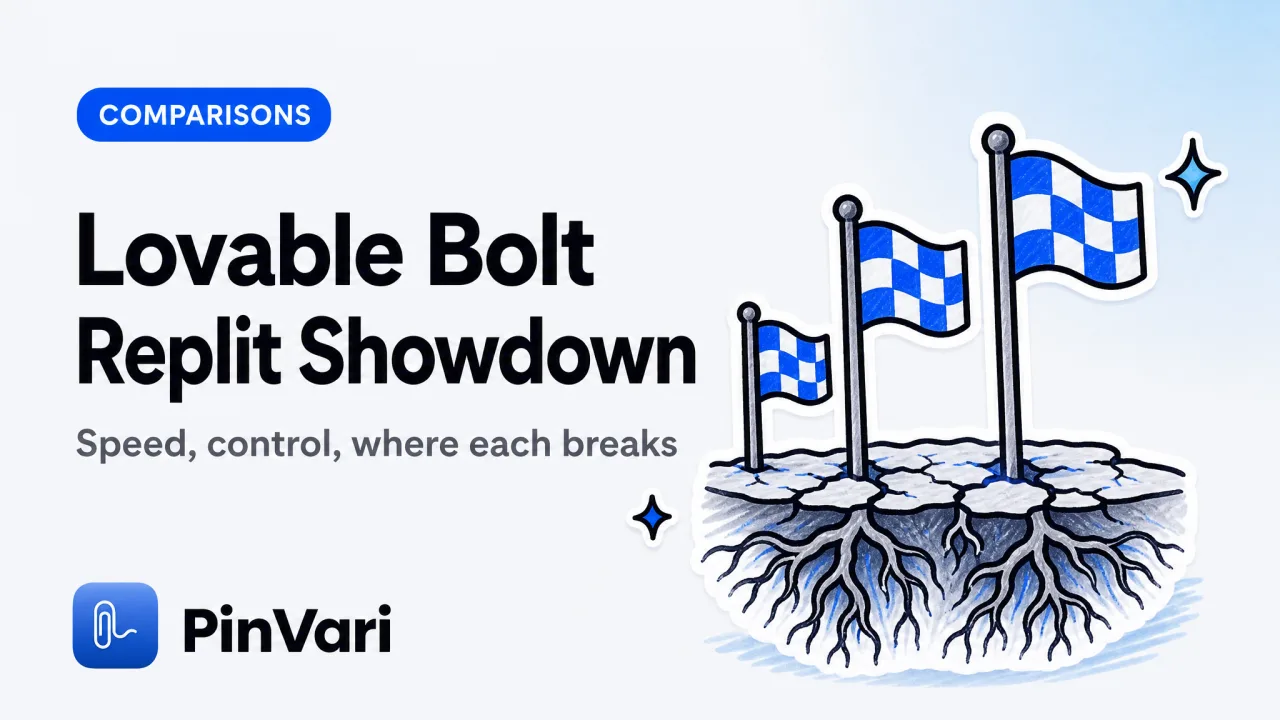
Lovable wins if you want a deployed, Stripe-ready SaaS in 24 hours and don't plan to touch raw code. Bolt wins if you need full control over the stack and can debug when the AI hallucinates imports. Replit wins if your team iterates live in the same REPL and you're comfortable with the nix-based environment.
Most comparison posts rank features in a vacuum , the real deciding factor is how you fix bugs when the AI ships broken UI, and none of these tools can see what you're circling on screen.
Lovable vs bolt vs replit: What sets Lovable, Bolt, and Replit apart?
Lovable (lovable.dev) is a fully managed frontend builder that turns prompts into production React apps with Supabase backends, Stripe checkout, and one-click Vercel deploys. The AI writes to Lovable's curated Shadcn/Radix component library, so every button and modal follows a cohesive design system.
You describe features ("add a pricing table with three tiers"), it ships code, you iterate in natural language. Speed is the moat , most users publish a working MVP in under 6 hours.
The limit: you're locked to Lovable's stack (React + Supabase + their component set). When you export, you get clean code, but customizing beyond the component library means writing React yourself.
Bolt (bolt.new, by StackBlitz) runs a full-stack WebContainer in the browser , Node, npm, file system, terminal, the works. It supports any framework (Next, Vue, Svelte, vanilla JS) and deploys to Netlify with one click.
The AI generates entire projects from a prompt, and you can edit files directly or chat further instructions. The upside: total freedom , install any package, use any API, write raw SQL.
The downside: the AI sometimes hallucinates dependencies or writes code that breaks mid-edit, and you're debugging in a browser-based terminal. Bolt's collaboration story is weaker (no live multiplayer like Replit).
Replit (replit.com) is a cloud IDE with native AI pair programming (Replit Agent). It spins up a full Linux VM (nix-based) where you can run Python, Go, Rust, Node , any language.
Multiple people can code in the same REPL simultaneously (think Google Docs for code). The AI Agent can scaffold apps, install packages, debug errors, and even run tests.
Iteration speed is the hook , change a file, the preview refreshes instantly, your teammate sees it live. The catch: the nix environment can be opaque if you're used to Docker or plain apt, and Replit's deployment story (Replit Deployments) is less mature than Vercel/Netlify.
For AI coding agents, Replit's Agent is built-in; Lovable and Bolt expect you to bring your own (Cursor, Claude Code, Codex).
Skip the wide grid. Read each option as a card.
#
Stack freedom
Lovable: React + Supabase only
Bolt: Any framework/stack
Replit: Any language (nix VM)
#
Speed to deploy
Lovable: ~6 hrs to live SaaS
Bolt: ~1 day for polished app
Replit: Instant preview, slower prod deploy
#
Design consistency
Lovable: High (curated components)
Bolt: DIY (you pick libraries)
Replit: DIY (you pick libraries)
#
Collaboration
Lovable: Solo (invite for review)
Bolt: Solo (share link)
Replit: Real-time multiplayer
#
AI agent
Lovable: Built-in chat
Bolt: Built-in chat
Replit: Built-in (Replit Agent)
#
Export/eject
Lovable: Clean React code
Bolt: Full source always
Replit: Full source always
#
Price (starter)
Lovable: $20/mo (Maker plan)
Bolt: Free tier, $20/mo Pro
Replit: Free tier, $20/mo Hacker
#
Best for
Lovable: Non-coders shipping SaaS
Bolt: Devs wanting full control
Replit: Teams iterating live
All three tools assume you can describe bugs in text. When the AI ships a layout that breaks on mobile or a button that doesn't fire, you type "fix the checkout button alignment" , and the agent guesses which element you mean. If you can't name the CSS class or the component prop, you're stuck in a slow prompt loop. Spatial capture (point and speak with ⌥⌘A) resolves the named accessibility element and hands it to the agent, cutting the "which button?" back-and-forth.
The fastest path to a shipped product is whichever tool matches your existing skills plus the ability to point at broken UI and say "this" without typing selectors.
When Lovable is the right choice
Lovable optimizes for non-coders who want a polished SaaS live today. You describe a feature ("user dashboard with usage stats"), it generates React components styled with Tailwind and Shadcn, wires them to Supabase tables (auth, CRUD, real-time), and deploys to Vercel.
The design system is coherent , every modal, every form, every button follows the same visual language. You're not wrestling with CSS or chasing down icon imports.
For vibe coders building a waitlist page, a directory, or a micro-SaaS, Lovable's curated library is a feature, not a limit.
When it breaks: Lovable's AI is prompt-tuned for its own component set. If you ask for a feature outside that library (a custom canvas animation, a headless CMS integration), it'll try, but the output often requires manual React work.
And when a component looks wrong , say the pricing cards overflow on iPad , you're describing the bug in text: "make the cards stack vertically on tablet." The agent doesn't see your screen, so it guesses which breakpoint or flexbox rule to change. If the first guess fails, you're looping.
Action step: Use Lovable if you're shipping a landing page + Stripe checkout + user dashboard and you don't know React. Pair it with accessibility tree inspection (Command Center in PinVari shows every element with role/label) so when something breaks, you can point at the exact <Button> or <Card> and say "this card's padding is wrong" , the named element (e.g., AXButton "Sign up") flows to your AI coding assistant with the screenshot, no guessing.
When Bolt is the right choice
Bolt gives you a full-stack playground with zero local setup. Prompt it to build a Next.js app with Prisma and PostgreSQL, it scaffolds the project, installs dependencies, and runs npm run dev in a browser-based Node runtime.
You get a file tree, a terminal, a live preview. The AI can edit any file, install any package, even write server-side API routes.
For devs who want control over the stack (maybe you need a specific Tailwind config or a custom Express middleware), Bolt is closer to Cursor or Claude Code but hosted.
When it breaks: Bolt's AI sometimes hallucinates package names (tries to npm install a library that doesn't exist) or writes code that compiles locally but fails in the WebContainer (certain Node modules don't run in-browser). When you see a broken import or a blank screen, you're debugging in a cramped browser terminal.
And if the layout breaks , a modal that won't close, a navbar that clips , you're describing it in text: "the navbar z-index is wrong." The agent doesn't see the overlap, so it tries random CSS tweaks.
Action step: Use Bolt if you're comfortable reading stack traces and you need framework freedom (Vue, Svelte, SolidJS). When the AI ships broken UI, point at the element causing the issue and speak ("this modal's backdrop won't dismiss") instead of typing a vague description.
The named element (AXGroup "Modal backdrop", frame coords, role) tells the agent exactly what to fix. Connect Cursor MCP or Claude Code MCP to PinVari so the spatial capture flows directly into your agent's next turn.
FAQ
#
Is Lovable better than Bolt for beginners?
Yes. Lovable's curated component library and one-click Vercel deploy remove most setup friction.
You describe features, it ships a coherent UI. Bolt requires more debugging patience (broken imports, WebContainer quirks) and assumes you can read stack traces.
If "beginner" means "I don't code but I want a live product," Lovable wins. See best coding software for beginners for a broader list.
#
Can I use Replit for production apps or just prototypes?
You can use Replit for production, but the deploy story is rougher than Vercel or Netlify. Replit Deployments works for simple apps (Flask, Express, static sites), but configuring autoscaling, custom SSL, and CDN requires reading docs.
Most teams use Replit for fast iteration and deploy to Vercel/Render/Railway for prod. If your app stays under 100 concurrent users, Replit Deployments is fine.
#
Does Bolt support Python or just JavaScript frameworks?
Bolt's WebContainer runs Node only. You can run Python via Pyodide (Python compiled to WebAssembly), but it's limited (no native C extensions, slower performance).
For Python projects, use Replit (full Python runtime in a nix VM) or code locally in Cursor. Bolt excels at Next.js, Vue, Svelte , anything Node-based.
#
How do I fix UI bugs when the AI ships broken layouts in any of these tools?
All three tools expect you to describe bugs in text ("the button is misaligned," "the modal won't close"). The AI guesses which element you mean.
The faster loop: point at the broken element, speak the fix, and let the agent see the named accessibility node. On macOS, hold ⌥⌘A in PinVari, circle the element, say what's wrong.
The app resolves the named element (role, label, frame, confidence) and hands it to your AI agent (Claude Code, Cursor, Codex) over MCP. The agent fixes the exact element, no guessing.
Connect in one click: PinVari → Connect → pick your editor. Learn more at pinvari.com/mcp or check element grounding for how named elements work.
#
Which tool is fastest if I just want a landing page live by tomorrow?
Lovable. Prompt "build a SaaS landing page with hero, pricing table, and waitlist form," it generates the React app with Supabase auth, you tweak colors/copy in natural language, deploy to Vercel in one click.
Most users finish in 4-8 hours. Bolt and Replit require more hands-on iteration (picking frameworks, debugging deploys).
For landing pages specifically, Lovable's curated design system is the speed advantage.
#
Can I connect PinVari to Lovable or Bolt, or only local editors?
PinVari connects to local AI agents (Claude Code, Cursor, Codex, Zed) via MCP (127.0.0.1:3402). Lovable and Bolt run in the browser with their own built-in AI chat , they don't expose an MCP server.
The workflow: scaffold the app in Lovable or Bolt, export the code, open it in Cursor or Claude Code locally, connect PinVari, then iterate with spatial capture. The browser-based tools can't ingest PinVari's pinvari_next_instruction payload (named element + screenshot + transcript) because they don't run MCP locally.
For the full MCP agent list, see AI coding agents.
Hand your agent the exact element
PinVari resolves what you point at into a named, executable instruction — on-device, no keys, your own agent. One click inside PinVari connects Claude Code, Cursor, VS Code or Codex — or paste one CLI line from pinvari.com/connect.
PinVari → Connect → your agent (one click)Get PinVari — $39 →