Computer Use AI Anthropic: Screenshots vs Named Elements
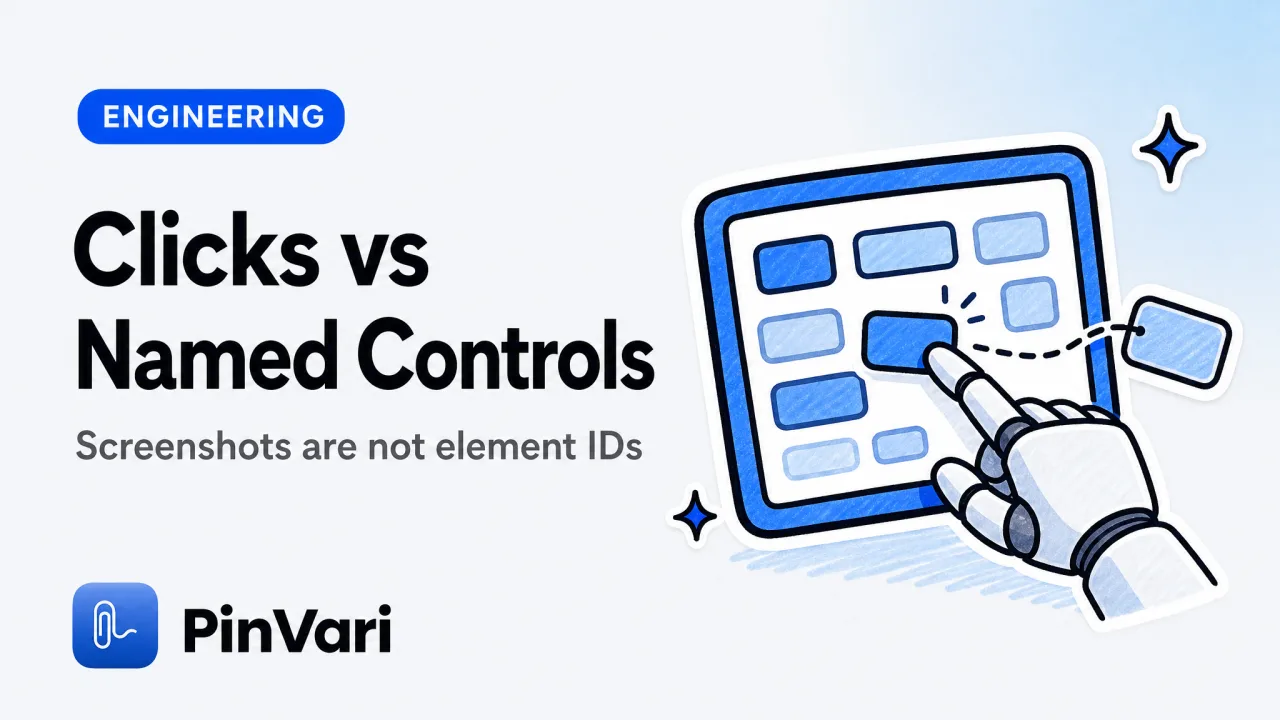
Computer use AI Anthropic is a screenshot-and-click loop: Claude looks at a picture of the desktop, then emits mouse and keyboard actions to operate the GUI. That is useful when no API exists, and it is a poor way to tell an agent which button in your app to change.
Most write-ups treat computer use as the future of every agent. The missing split is driving a stranger's UI versus resolving a named control you already circled.
What is computer use AI Anthropic, in plain terms?
Anthropic shipped computer use as a model capability. The agent receives frames, reasons about pixels, and returns actions like move, click, type, and scroll.
It is closer to a remote-control operator than to a compiler. There is no guaranteed Accessibility name. There is a bounding box the model invented from a bitmap.
That design matches the problem it was built for: operate software that will not give you a structured tree. A booking site, a legacy Windows tool, a settings panel with no API.
It does not match the problem a Mac developer has at 11 p.m.: "this toggle in my Electron app is on the wrong row." You already have the AX tree. Paying a model to re-guess it from pixels is backwards.
The can Claude Code see my screen note is the short version of that limit. This page is the computer-use version.
How does Anthropic computer use actually see the screen?
It sees a screenshot. Sometimes several, in a loop.
Each frame is tokens. A retina Mac desktop is a lot of pixels. The model then proposes coordinates, which may be right, close, or aimed at a neighbor that looks similar.
There is no confidence channel from the OS. There is no circled-versus-dwelled provenance. There is no deictic bind between the word "this" and the pointer at the moment you said it.
If the UI shifts one row, yesterday's click path misses. If two icons share a shape, the model picks one.
Computer use is not a screen reader. It does not call AXUIElementCopyElementAtPosition. Treat it as vision plus actuators, and budget for missed clicks the same way you budget for flaky selectors in a UI test.
Computer use vs a local MCP capture
These are different architectures. Do not flatten them into "AI can use a computer."
Anthropic computer use
Type: Model-driven GUI operator.
Input: Screenshots, sometimes accessibility extras the host adds.
Output: Mouse and keyboard actions.
Who points: The model.
Where it runs: The host that granted desktop control, often with cloud model calls.
PinVari + your agent
Type: Human-pointed spatial capture, agent consumes the result.
Input: Your circle or dwell, on-device transcript, AX hit-test.
Output: A resolved instruction over MCP on 127.0.0.1.
Who points: You.
Where it runs: On-device capture, your own Claude Code / Cursor / Codex / Zed.
The how AI agents know which UI element piece is the deixis write-up. Computer use has no deixis unless you add it yourself.
PinVari binds each spoken word to the element under the pointer at that timestamp. Hover about 0.2s and dwell can resolve without a circle. Multiple marks in one breath get separate word buckets.
The agent does not need to click the control to know its name. It already has role, label, frame, confidence, and a crop.
If you want the model to operate a GUI, computer use AI Anthropic is the family of tools. If you want the model to edit the right component, hand it a named element and keep the mouse in your hand.
Why do MCP-curious developers reach for computer use first?
Because the demo is obvious. A model moves a cursor. That looks like agency.
MCP is quieter. A local server exposes tools. The model calls pinvari_next_instruction and gets a structured payload. No cursor animation.
The Model Context Protocol intro is the protocol. The Claude Code MCP guide is the client. Computer use is not a replacement for either.
A useful mental model: computer use is an actuator. MCP is a socket. You can hang a screenshot tool on MCP, or a named-element tool, or both.
PinVari's connector lives at ~/.pinvari/mcp/pinvari-mcp. One click inside the app (PinVari → Connect) or:
claude mcp add --scope user pinvari -- "$HOME/.pinvari/mcp/pinvari-mcp"Never the bare claude mcp add pinvari. That errors. The app must be running on 127.0.0.1:3402.
Agent tools you can name as fact: pinvari_next_instruction, pinvari_get_capture, pinvari_list_captures, pinvari_get_frame, pinvari_request_capture, pinvari_mark_done, pinvari_health. Docs sit at pinvari.com/mcp.
pinvari_request_capture is the bidirectional piece computer use tries to fake with more screenshots. The notch island lights up, you point, the capture flows back. The model asked you to show it the thing instead of clicking around the dock.
What does the agent actually receive?
Not a full desktop PNG if you do it right.
The circled region. The resolved element: role, label, frame, confidence, circled-vs-dwelled. The spoken instruction, split per mark. Typed notes. A cropped screenshot.
Around that, spatial context: focused-window text up to 40,000 characters including text scrolled out of view, an interactive-element map, optional whole-screen on-device OCR, the browser URL from AXWebArea, selected text, and a timestamped pointer trail.
Vague instructions can be flagged UNSPECIFIC. The rule is ask, never guess.
Computer use AI Anthropic usually receives the opposite: a wide frame and a hope that the model will find the button. Token cost goes up. Wrong-element edits go up. The screenshots waste tokens argument applies even harder when every step is another frame.
When is Anthropic computer use the right tool?
Use it when you do not control the target app and there is no API. Booking a demo account in a vendor portal. Exercising a desktop tool you cannot rebuild.
Use it in a sandbox. Granting a model the mouse is a security decision, not a convenience toggle.
Do not use it as your only bug-report channel for software you are shipping on a Mac. You already have Accessibility. Hit-testing a point is cheaper and more honest than another screenshot loop.
Honest AX limits still apply on the capture side. Canvas and some Electron surfaces need OCR. Confidence below about 0.8 should ask. PinVari does that instead of pretending the tree is complete.
Multi-display captures remember the monitor. Pause/resume (⌥⌘P) keeps scroll-aware marks. Sessions recover after a crash. None of that is computer use. It is capture hygiene.
A setup that keeps computer use in its lane
Install your agent. Install PinVari on macOS 14+ (Apple Silicon or Intel) from the notarized Developer-ID DMG.
Connect MCP. Practice ⌥⌘A on a real window, then ⌥⌘V for voice-only when the element is already focused.
When the agent needs another look mid-task, let it call pinvari_request_capture instead of granting it the mouse.
Keep Anthropic computer use for the uninstrumented GUI on the other side of the wall. Do not point it at your own settings sheet just because the demo is pretty.
Capture stays on-device. No API keys for PinVari itself. The $39 launch license (first 500, then $59) is a one-time Polar purchase, team seats available, no subscription on the core app. Numbers live on pricing.
Does computer use AI Anthropic need desktop permission?
Yes. The host has to grant screen read and input injection. That is a wider grant than a local MCP connector that only returns a capture you already made.
A 127.0.0.1 server cannot click the Dock. Computer use can, if you let it.
Keep those permissions on a throwaway user account when you experiment. Do not leave click-the-desktop enabled on the same login you use for banking and production deploy keys.
The named-element path never needed that grant. You pointed. The OS named the control. The agent received a payload.
That is why MCP-curious developers should try a capture server before they try a mouse-driving loop. The demo is quieter. The permission story is cleaner.
FAQ
What is computer use AI Anthropic used for?
It lets Claude operate a graphical interface by looking at screenshots and issuing clicks and keystrokes. It is aimed at software you cannot call through an API, not at naming a control in an app you are building.
Does Claude computer use replace MCP?
No. MCP is how an agent calls local tools. Computer use is one possible skill those tools might wrap. A named-element capture server is a different tool with a different payload.
Can Anthropic computer use read the macOS Accessibility tree?
Computer use is a vision-and-action loop. It does not replace AXUIElementCopyElementAtPosition. If you want the OS name of a control, capture that name explicitly and send it over MCP.
Why is computer use expensive compared to a cropped capture?
Each desktop frame is a large image in the prompt, and the loop may need several frames. A cropped screenshot plus a named element is smaller and less ambiguous, which is why token-aware teams stop pasting full-screen PNGs.
Is computer use AI Anthropic safe on a personal Mac?
Giving a model the mouse is a grant of control. Use a dedicated profile or machine, and do not treat it as a default for everyday coding. A local capture tool that never uploads by default is a narrower permission.
How do I give Claude the element I mean without letting it click around?
Point at it. A hotkey capture that hit-tests the AX tree and returns the bundle on pinvari_next_instruction is the direct path. The model reads a name and a crop instead of hunting pixels.
Hand your agent the exact element
PinVari resolves what you point at into a named, executable instruction — on-device, no keys, your own agent. One click inside PinVari connects Claude Code, Cursor, VS Code or Codex — or paste one CLI line from pinvari.com/connect.
PinVari → Connect → your agent (one click)Get PinVari — $39 →