Speech to Text Mac Shortcut: Set Up Voice Dictation
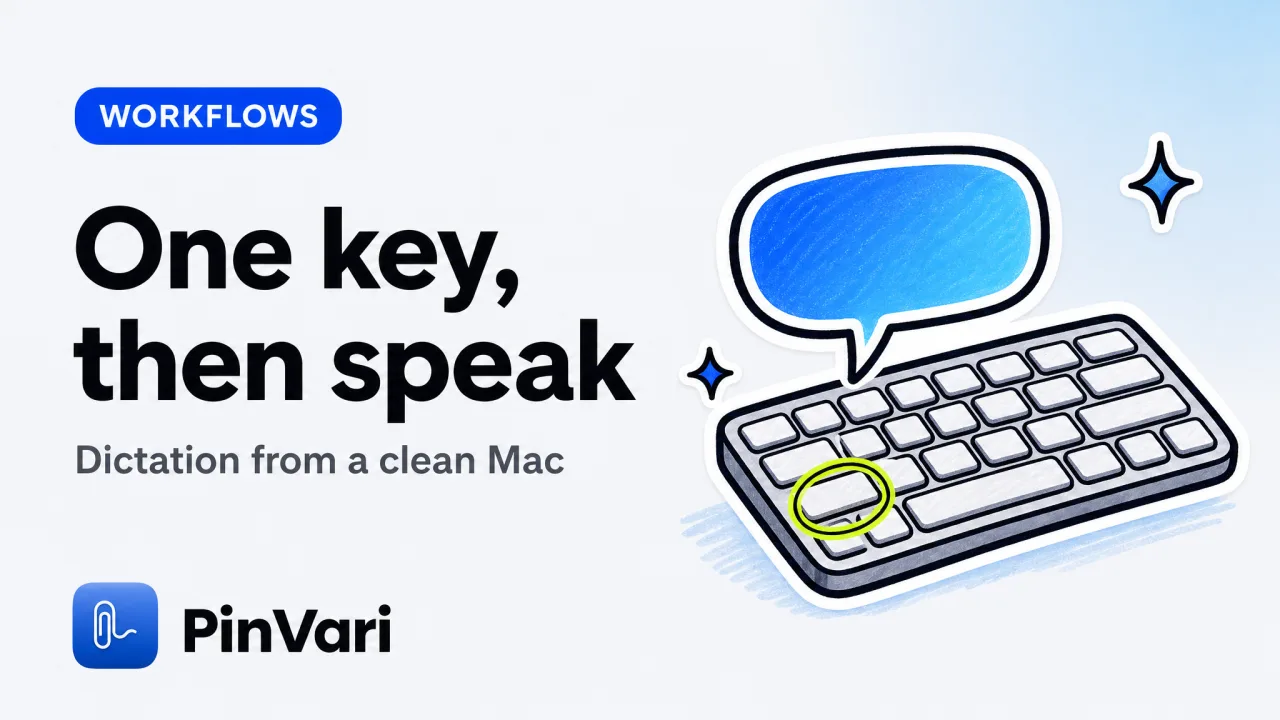
The speech to text Mac shortcut is the Dictation hotkey you turn on in Keyboard settings, then press to start and stop talking into the focused field. From zero, you enable Dictation, pick a shortcut that does not collide with your editor, and test in Notes before you trust it in code.
Most setup posts stop at "press the function key twice." That gets words into a text box. It does not get a named button into Claude Code.
This is the from-zero path, then the line where dictation should stop and a capture tool should start.
What is the speech to text Mac shortcut?
On current macOS the built-in path is Dictation, not the older Enhanced Dictation bundle you may remember from 2014. You choose the shortcut. Apple no longer ships one magic key that works the same on every Mac and every keyboard.
Open System Settings → Keyboard → Dictation. Turn Dictation on. Set a shortcut. Common picks are a double press of the right Command key, or a custom combo you will actually remember.
The shortcut starts listening. A second press, or a pause, stops it. Words land at the caret.
That is voice to text on Mac at the OS layer. It is local enough for notes if you stay on on-device dictation. It has no idea what you were pointing at.
The shortcut writes at the caret. If the caret is in Slack, you get a Slack message. If the caret is in Cursor, you get a prompt. The OS does not care.
Pick a shortcut you will not hit by accident in a game, a browser, or an IDE. A double-press of Right Command is easier to remember than a five-key chord you will never use.
How do you turn on speech to text on a Mac from zero?
Do this once. Do not skip the Notes test.
- Update to macOS 14 or later if you can. The settings names below match Sonoma and newer.
- Open System Settings.
- Go to Keyboard.
- Open Dictation.
- Switch Dictation On. Confirm the language.
- Click Shortcut and pick one. If every default fights VS Code, choose Customise and pick a combo you never use for Run or Debug.
- Open Notes. Press the shortcut. Say "The caret is in Notes." Stop. Read the line.
If nothing appears, the shortcut is colliding or Dictation is still off. If the language is wrong, you will get confident nonsense. Fix language first.
Microphone permissions live under Privacy & Security → Microphone. Notes, Terminal, and your editor each need their own grant if they capture audio themselves. System Dictation uses the OS mic path.
For talk to text on Mac in any app, this is the whole setup. You do not need a third-party app to draft an email.
Test in Notes, then Mail, then your editor. Each app handles the incoming text a little differently. Some steal focus. Some insert a trailing space. Learn that before a live demo.
Which speech to text Mac shortcut should a developer pick?
Avoid anything that is already a chord in your editor.
Command-Space is Spotlight. Control-Space is often input source. Option-Command-A is a capture hotkey in PinVari (⌥⌘A). Do not reuse that for OS Dictation if you also point-and-speak.
I use a double-press of Right Command for OS Dictation and I leave ⌥⌘A for marking a UI element. ⌥⌘V is voice-only in PinVari when the mark already exists. Two different jobs. Two different keys.
If you wear headphones, set the input device explicitly. Dictation follows the current input. A Bluetooth headset that sleeps will look like a broken shortcut.
External keyboards on a Mac laptop sometimes do not send the same function-key events. If Fn-Fn does nothing, stop fighting it and set a custom combo.
| Goal | Shortcut habit |
|---|---|
| Notes and Mail | OS Dictation, double-Right-Command |
| Commit messages | Same, caret in the Git field |
| UI bugs for an agent | ⌥⌘A, circle, speak |
| Voice-only after a mark | ⌥⌘V |
Two jobs, two keys. Mixing them is how you dictate a rant into a code file.
How do you make the speech to text Mac shortcut useful for coding?
Dictation is good at prose. It is bad at symbols.
Say "open angle bracket div close angle bracket" if you like pain. Do not. Type markup. Speak the intent: "this primary button still says Submit on the German locale."
Auto-punctuation helps in Notes. In a terminal it will insert periods you did not want. Turn it off if you dictate paths.
For long audio you already recorded, you want transcription, not a shortcut. How to transcribe on Mac covers files. The shortcut is for live speech into a field.
Wispr Flow sits in the same habit slot as OS Dictation, at about $12 to $15 a month, with better push-to-talk feel for some people. It still writes words. It still does not resolve AXButton.
A dictation apps for Mac list is the next stop if the OS shortcut feels slow. Try the OS path for a week first. You may not need the subscription.
Do not dictate secrets. A one-time password spoken at a cafe is now in the air and in the field. Type those. Same for staging tokens.
When should you stop using the speech to text Mac shortcut?
Stop when the task is "fix this control" and the agent cannot see the control.
A paragraph in Cursor that starts with "the thing on the right" is a failed shortcut, not a failed model. Hold ⌥⌘A, circle the control, speak the outcome. The packet is a crop, a named element (role, label, frame, confidence), and a transcript produced on-device.
claude mcp add --scope user pinvari -- "$HOME/.pinvari/mcp/pinvari-mcp"The connector talks to the app on 127.0.0.1:3402. Never run the bare claude mcp add pinvari. The app must be running.
If you hover about 0.2s, dwell detection resolves the element without a circle. Three marks in one breath get three word buckets. ⌥⌘P pauses while you scroll. Window text can ride along, up to 40,000 characters including text scrolled out of view.
Confidence below 0.8 asks. It does not silently guess a selector. On canvas, on-device OCR is the fallback.
That layer is a one-time $39 launch license, not another dictation subscription. The price is on the product page.
Dictation fills fields. Capture fills agents. Keep both. Do not pretend they are the same shortcut.
OS Dictation
Type: built-in speech to text
Capture: the focused field
Resolution: none. Words at the caret.
Third-party push-to-talk
Type: paid overlay, often a subscription
Capture: the focused field, sometimes any app
Resolution: still words. Faster habit, same limit.
Point-and-speak capture
Type: native overlay plus on-device STT
Capture: circled element, crop, window text
Resolution: AX role, label, frame, confidence.
If you are setting this up for a teammate, sit with them for the Notes test. Watching someone hit a colliding shortcut is faster than a Slack thread about a dead mic.
Keep a one-line team doc: which shortcut is OS Dictation, which is the capture hotkey, and which app owns the microphone. New hires will otherwise remap the capture key and then file a ticket that Dictation is broken.
FAQ
What is the default speech to text Mac shortcut?
There is not one default that is safe on every keyboard. You set it under System Settings → Keyboard → Dictation. A double-press of Right Command is a common choice that avoids most IDE chords.
Why does my speech to text Mac shortcut do nothing?
Dictation is off, the shortcut collides, the wrong input device is selected, or the app never received focus. Test in Notes. Check Privacy → Microphone. Change the shortcut before you reinstall macOS.
Is Mac speech to text on-device?
Apple offers on-device dictation for supported languages. Stay on that if you care about notes staying on the Mac. Third-party apps vary. Read their privacy page before you speak customer data.
Can I use the speech to text Mac shortcut in Terminal?
Yes, if the caret is in that window. You will still get prose, not escaped shell tokens. Type commands. Speak comments or commit messages.
How is this different from Voice Control?
Voice Control is a hands-free UI for clicks and navigation. Dictation inserts text. You can enable both. They solve different jobs and they fight if you assign the same keys.
Should I replace the OS shortcut with an AI coding capture tool?
No. Keep the OS shortcut for Mail and Notes. Add a point-and-speak hotkey when the words need a named UI element. Replacing one with the other is how you end up dictating CSS into Slack.
Hand your agent the exact element
PinVari resolves what you point at into a named, executable instruction — on-device, no keys, your own agent. One click inside PinVari connects Claude Code, Cursor, VS Code or Codex — or paste one CLI line from pinvari.com/connect.
PinVari → Connect → your agent (one click)Get PinVari — $39 →