Lovable for Vibe Coding: When It Works
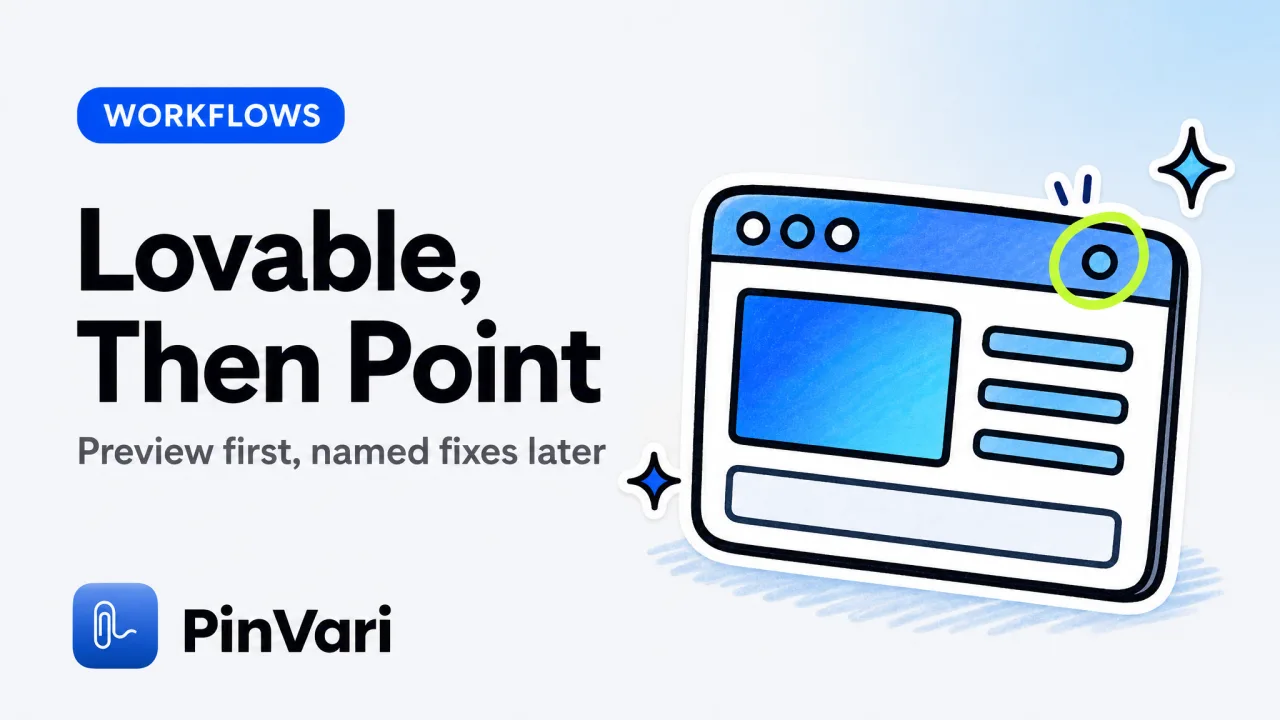
Lovable for vibe coding is a browser workflow: you describe an app in plain language, Lovable generates a working preview, and you steer by writing what you see. It is one of the fastest ways to go from a blank page to something you can click.
The catch shows up after the first demo. Most people keep typing "make that button bigger" and the model guesses which button, then rewrites a sibling.
I have used Lovable the same way I use Bolt and v0: to get a preview, then to fight the tenth tweak. The fight ends when the feedback names a control instead of a vibe.
If you are new to the phrase itself, vibe coding is the workflow, not the vendor. Lovable is one platform on that list.
What is Lovable for vibe coding, in practice?
You type a product sentence. Lovable scaffolds a frontend, often with a backend hook, and shows a live preview. You click around, you type another sentence, it patches the project.
You are the PM and the QA. Lovable is the typist. That is vibe coding. The skill is specific intent, not syntax.
Lovable is a vibe coding platform in the browser-builder class, next to Bolt and v0. Editor agents like Cursor and Claude Code sit on a real repo instead.
Use Lovable when you do not want a local toolchain yet. Leave it when you need diffs you trust, native Mac windows, or an agent that can read a named accessibility element.
Lovable wins the first hour. Named-element feedback wins the tenth hour. Plan the handoff before you fall in love with the preview.
When does Lovable for vibe coding work?
It works when the request is a whole screen. "A signup page with email, password, and a social row" is a good Lovable prompt.
It works when you are comparing layouts, not pixels. You can throw away a generated nav and ask for another.
It fails when two controls look alike. "The green button" on a marketing page with four green buttons is a lottery.
It fails when the bug is in a native wrapper, an Electron shell, or a design tool sitting next to the preview. Browser builders cannot circle a Mac app.
For a map of the rest of the field, vibe coding tools splits browser builders from editor agents. Read that before you pick a second tool.
Zero to preview
Best for: Landing pages, CRUD shells, internal tools.
Input: A paragraph of product intent.
Risk: Generic UI that looks like every other generated app.
Tenth revision
Best for: One spacing fix, one label, one disabled state.
Input: A named element plus one outcome sentence.
Risk: Prompt-only feedback that rewrites neighbors.
Handoff to an editor
Best for: Real git, real review, real agents.
Input: The repo plus a capture of what is still wrong.
Risk: Exporting without a list of open UI nits.
How do I give Lovable better feedback?
Write the problem, not the widget, until you are sure of the widget. "Users cannot tell the form is submitting" is better than "add a spinner" if you have not decided the UI.
Once you can see the control, name it. "Primary Submit on the signup card stays enabled while the request is in flight."
Attach a crop. A full-page screenshot teaches the model to "improve" the hero while you complained about the footer.
If you run the preview on a Mac next to Cursor, you do not have to stay inside Lovable's chat. Circle the control in the preview window, speak the fix, and hand the bundle to Cursor over local MCP.
That is the how to vibe code loop I actually use: generate in the fastest preview, finish in the agent that owns the files.
Circle three nits in one breath. Per-mark word buckets keep "this padding" attached to the first mark and "this label" attached to the second. One chat blob cannot do that.
Lovable vs Cursor vs Claude Code for the same app
Skip a wide grid. Pick the job.
Lovable is a hosted preview. Cursor is an editor agent on your disk. Claude Code is a terminal agent on your disk.
Lovable does not need a local Node install to start. Cursor and Claude Code assume you have a repo.
When the UI is wrong, Lovable wants another prompt. Cursor and Claude Code can take a resolved element path if you connect a screen MCP.
Connect with one click (PinVari → Connect → Cursor / Claude Code) or:
claude mcp add --scope user pinvari -- "$HOME/.pinvari/mcp/pinvari-mcp"The app must be running. The connector talks to it on 127.0.0.1:3402. Never use the bare claude mcp add pinvari.
pinvari_next_instruction returns the path, the spoken words, the region, and a crop. pinvari_request_capture lets the agent ask you to point again.
Bring your own agent. Lovable is a product with its own model. Cursor and Claude Code are yours. A local capture tool should not force a third cloud.
Limits you should expect
Lovable cannot see native Mac chrome. If your "app" is half a website and half a desktop wrapper, browser feedback will miss the wrapper.
AX can be thin on canvas-heavy previews. On-device OCR is the fallback. Below 0.8 confidence, ask. Do not let any model silently pick a lookalike.
Multi-display setups fool both you and the tool. The preview on the studio display and the chat on the laptop are two screens. Marks should remember which monitor they were drawn on.
Wispr Flow proves people will pay $12–15/mo to talk to a Mac. Talking is not enough. The words have to bind to a pointer trail so "this" means a control.
CleanShot X will give you a beautiful PNG of the preview. It will not name the button. PinVari is the layer above a screenshot.
Do not keep an entire production app inside a browser builder because the first prompt felt magical. Export or sync to git while the surface area is still small.
An honest week-one workflow
Day one: one Lovable project, one user job, one preview. Do not generate a design system.
Day two: click every empty, error, and success state. File nits as named controls, not as a new prompt novel.
Day three: if you are still in Lovable chat for spacing, move the repo to Cursor. Keep Lovable as a reference preview if you want.
Day four: connect a local screen MCP. Hold ⌥⌘A, circle, speak. Use ⌥⌘V when you only need voice.
Day five: let the agent request a capture mid-task. The notch island lights up, you point, it continues.
If you want that Mac loop as a one-time purchase, PinVari is $39 at launch (first 500, then $59) via Polar. macOS 14+, Apple Silicon and Intel. Nothing uploaded by default.
How do I know it is time to leave Lovable?
Leave when you are arguing with the chat about one control. That is an editor job.
Leave when you need a real pull request. Browser builders hide git until you export, and that delay is how unique snowflake projects are born.
Leave when two people must review the same UI. A named element in Linear is a review artifact. A prompt thread is not.
Stay one more day if the preview is still teaching you the product. That is the honest use of Lovable for vibe coding: cheap screens, fast no.
Export with a nit list, not a vibe. Write five named controls that are still wrong. That list is the first Cursor session.
If the preview is in Safari or Chrome, a browser annotation tool can mark the site. Jam.dev will grab console logs. It will not mark a native wrapper around the preview.
If you keep a desktop build next to Lovable, circle the desktop control. The agent that owns the files is the one that should receive the capture.
I also stop when I notice I am prompting about color tokens for the third time. That is design-system work. Put it in a rule file in Cursor, not in another Lovable paragraph.
The week-one workflow above is enough. If you need a second week in Lovable, you are probably avoiding git.
FAQ
Is Lovable good for vibe coding?
Yes, for the first preview. Lovable for vibe coding is a fast way to see a generated UI without standing up a repo.
It is a weaker place to do precise visual QA. Name the element or move to an editor agent when tweaks start colliding.
Can I use Lovable and Cursor together?
Yes. Generate or prototype in Lovable, then open the code in Cursor when you need real diffs.
Point at the preview from the Mac and send the named element to Cursor so the editor agent does not guess from a pasted PNG.
Does Lovable understand my screen?
Lovable understands the project it generated and the text you type. It does not resolve macOS accessibility elements in other windows.
If the bug is in the preview, a crop plus a name still beats "the button." If the bug is in a native app, you need desktop capture.
What is the biggest mistake people make with Lovable?
They stay in prompt-only mode after the architecture is set. The model then "helps" by rewriting working layout.
Lock the job. Change one named control per turn. Export to git earlier than feels comfortable.
Do I need to know how to code to use Lovable for vibe coding?
No. You need to know the job the user is trying to finish, and you need to notice when the preview is wrong.
The vocabulary problem is real. Pointing is how you skip the vocabulary. Speaking "this should stay disabled" while the pointer is on Save is enough.
How do I stop Lovable from editing the wrong element?
Name the control and crop the screenshot. If you have an accessibility label, use it.
If two controls share a label, include the parent group. If you are on a Mac with a capture tool, let it resolve role, label, frame, and confidence for you.
Hand your agent the exact element
PinVari resolves what you point at into a named, executable instruction — on-device, no keys, your own agent. One click inside PinVari connects Claude Code, Cursor, VS Code or Codex — or paste one CLI line from pinvari.com/connect.
PinVari → Connect → your agent (one click)Get PinVari — $39 →