Jam.dev Alternative for Native Mac Apps
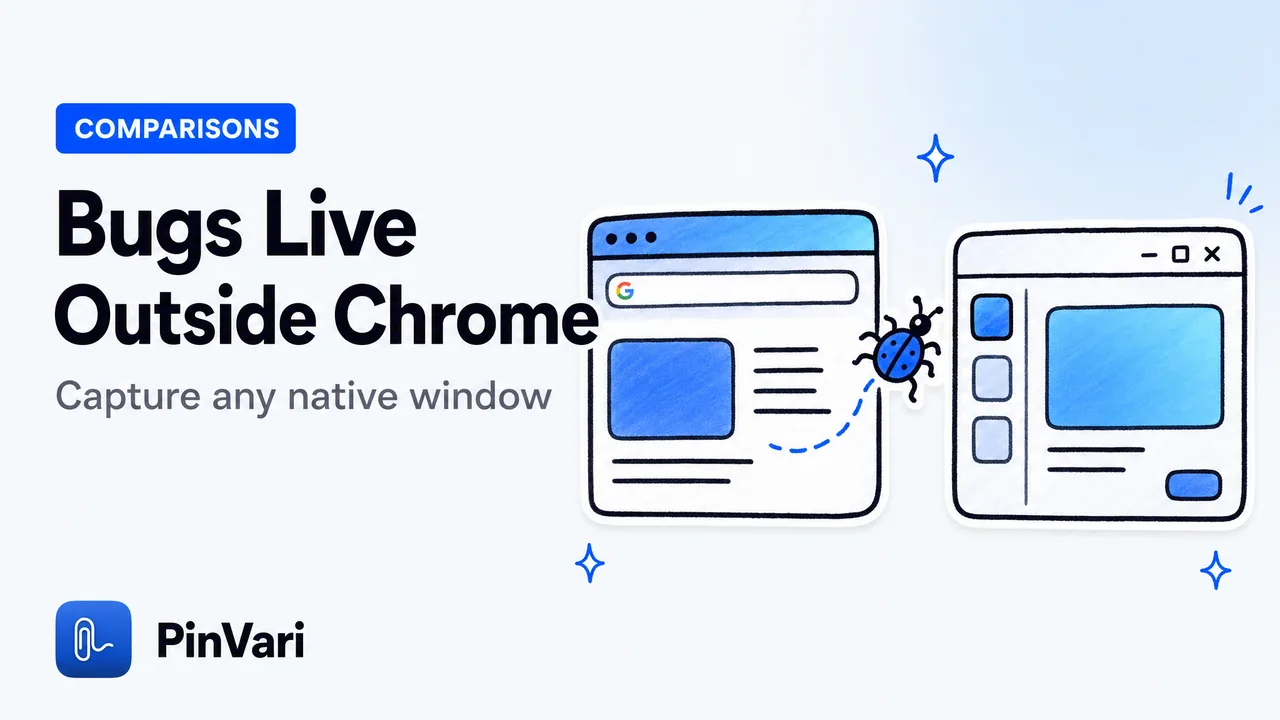
The best Jam.dev alternative for native Mac apps is PinVari, a macOS capture tool that works in any window: IDEs, Electron apps, native SwiftUI, not just Chrome tabs. Where Jam.dev records browser sessions and console logs, PinVari lets you hold a hotkey, circle any on-screen UI element in any app, and speak the bug out loud.
Most comparisons stop at "Jam is browser-only, so use something else." The more useful question is what a native capture tool should actually hand off once the bug leaves the browser.
Why can't Jam.dev capture native Mac apps?
Jam.dev is a browser extension. It lives inside Chrome and Chromium-based browsers, which is exactly why it captures console errors, network requests, and repro steps so well.
It has a front-row seat to the page's runtime.
That same architecture is its ceiling. A browser extension cannot see outside the browser: no view into a native window, an Electron app rendered by a separate process, or your IDE.
So the moment your bug is in Xcode, a Tauri app, a Figma canvas, or a Slack desktop client, Jam.dev has nothing to record. You are back to a raw screenshot and a paragraph of prose describing which of five near-identical buttons you meant.
If every bug you file lives in a web app you open in Chrome, Jam.dev is a great tool and you may not need an alternative. The case for switching starts when your bugs live in native windows, desktop Electron apps, or your editor.
Is there a Jam.dev alternative for native Mac apps that talks to AI agents?
Yes. PinVari is built for the surfaces Jam.dev can't reach, and it is designed around AI coding agents rather than a human reading a ticket later.
The interaction is push-to-talk. You hold ⌥⌘A, draw a freehand circle around the broken element (or several elements in one pass), and describe the bug while you point.
PinVari screenshots the region, transcribes your voice on-device, and resolves what you circled.
The word "resolves" is the whole difference. Jam.dev and a plain screenshot give an agent pixels.
PinVari gives it the exact named accessibility element: its role, its label, and its frame, pulled from the macOS Accessibility API.
So the handoff isn't "there's a bug somewhere near these coordinates." It's "the button labeled Save Draft in the toolbar is misaligned," resolved to a named node your agent can reason about. If you want the mechanics of how words like "this" bind to a specific control, we cover that in how AI agents know which UI element you mean.
How does PinVari know which element you circled?
macOS exposes the UI element under any screen point through AXUIElementCopyElementAtPosition, which returns the element's role, title, value, and parent chain. PinVari walks that chain to name the thing you pointed at instead of guessing from a pixel.
The macOS Accessibility API is the same plumbing screen readers use, aimed here at UI feedback.
PinVari handles the honest edge cases instead of pretending they don't exist.
The capture overlay sits on top of everything, so a naive hit-test would resolve to PinVari's own window. It uses chainExcludingSelf to walk the on-screen window list and hit-test the real app underneath.
Electron and Chromium build their accessibility tree lazily, so a fresh window can come back empty. PinVari sets AXManualAccessibility and retries for about 150ms until a labeled element appears.
When your circle lands on a bare AXGroup with no label, labeledDescendant descends to the deepest labeled child. And when a Chromium node has no title, its identity attributes (AXDOMIdentifier, AXDOMClassList) give it a usable name.
Every resolved element carries two things a screenshot never could: a confidence score, and circled vs dwelled provenance. "Circled" means you deliberately drew around it, so it's trusted.
"Dwelled" means your pointer merely passed over it while you spoke.
Below roughly 0.8 confidence, PinVari flags the element as uncertain rather than silently handing your agent a wrong guess. A tool that admits "I'm not sure which one you meant" is worth more than one that confidently edits the wrong component.
Jam.dev vs PinVari: which fits your stack?
Here is the honest split. Neither tool is trying to be the other.
Jam.dev owns browser sessions, PinVari owns everything that isn't a browser.
Skip the wide grid. Compare each tool as a card.
Jam.dev
Native macOS apps: No.
IDEs and Electron: No.
Console / network: Yes.
Voice: No.
Named UI element: No.
On-device: Cloud.
AI agent route: No.
Linear / GitHub / Slack: Yes.
Price: Free, with paid tiers.
PinVari
Native macOS apps: Yes.
IDEs and Electron: Yes.
Console / network: No.
Voice: Yes.
Named UI element: Yes.
On-device: Yes. No API keys. Nothing uploaded by default.
AI agent route: Yes, over local MCP.
Linear / GitHub / Slack: Yes.
Price: One-time $39 launch.
Marker.io
Native macOS apps: No.
IDEs and Electron: No.
Console / network: No.
Voice: No.
Named UI element: No.
On-device: Cloud.
AI agent route: No.
Linear / GitHub / Slack: Yes.
Price: About $39 per month.
CleanShot X
Native macOS apps: Yes, image only.
IDEs and Electron: Yes, image only.
Console / network: No.
Voice: No.
Named UI element: No.
On-device: Yes.
AI agent route: No.
Linear / GitHub / Slack: No.
Price: One-time.
The row that matters for this comparison is the first one. Bug capture outside Chrome is the entire reason to reach for PinVari. If your bug is on a web page, Jam.dev's console capture is genuinely hard to beat.
CleanShot X earns a mention because it's the Mac screenshot king, but it captures a picture with zero understanding of what's in it. PinVari is the layer above a screenshot: it knows the pixels and the named element behind them.
What happens when the accessibility tree is empty?
Sometimes there is no accessibility element to resolve. A game, a <canvas>, a remote desktop, or a stubborn Electron surface can all return a blank AX tree.
This is the failure mode most tools quietly ignore.
PinVari falls back to on-device Vision OCR on the circled region. It reads the visible text inside your loop and uses that to name the element, so a "Checkout" button on a canvas still comes through as "Checkout" rather than "unknown region at 840, 210."
PinVari also reads the window's full text, which gives your agent surrounding context beyond the single element. It runs on Apple's on-device Vision framework, so the text of your screen never leaves your Mac.
For browser bugs specifically, PinVari still reads the real URL. It pulls the active tab's address from the focused window's AXWebArea via Accessibility, no scripting or automation permission required.
How do captured bugs reach my AI agent or tracker?
A capture is only useful if it lands somewhere. PinVari has two exits, and you pick per capture.
The first is your own AI coding agent. PinVari runs a local MCP server on 127.0.0.1, and you connect it with claude mcp add --scope user pinvari -- "$HOME/.pinvari/mcp/pinvari-mcp".
It works with Claude Code, Cursor, Codex, and Zed. You bring your own agent and your own LLM.
Over that connection, the tool pinvari_next_instruction hands the agent the resolved element path, your spoken instruction, the region you circled, and a screenshot cropped to it. The agent carries out the change and calls pinvari_mark_done to close the loop.
Because you bring the agent, there are no API keys and nothing uploaded by default.
The second exit is a tracker. The same named-element capture can file a ticket to Linear, GitHub, or Slack, or become a shareable page for a teammate.
That's the workflow we walk through in filing bugs to Linear and GitHub by voice.
Captures collect in a dark notch island, a Dynamic-Island-style HUD near the top of the screen, and in a lighter Command Center window when you want to review a batch before sending.
PinVari is distributed as a notarized Developer-ID DMG, not through the Mac App Store. The App Store sandbox forbids the global hotkey and reading other apps' accessibility data, which are the two things that make cross-app capture possible.
What does a Jam.dev alternative for native Mac apps cost?
PinVari is a one-time $39 at launch for the first 500 licenses, then $59, sold through Polar as merchant of record. There is no subscription for the core app, and team seats are available.
You can see the current tiers on the pricing page.
That pricing sits deliberately against Marker.io's $39+/mo: the same number, paid once instead of monthly, aimed at native windows instead of web pages.
Requirements and the honest limits
PinVari needs macOS 14 (Sonoma) or later, and runs on Apple Silicon and Intel. It needs Accessibility and Screen Recording permission, because reading the element under your pointer and grabbing the region are exactly the capabilities the OS gates behind those toggles.
It is macOS-only. There is no Windows or Linux build, and there is no browser-tab console log.
If you need the network trace and JavaScript errors from a web session, that is Jam.dev's job, not this one.
The realistic setup is both: Jam.dev for browser bugs, PinVari for everything native, IDE, and Electron, both feeding the same tracker.
FAQ
Can Jam.dev capture native Mac apps?
No. Jam.dev is a Chrome and Chromium browser extension, so it captures bugs inside browser tabs. It cannot see native macOS apps, IDEs, or Electron windows, which is the main reason developers look for a native alternative.
What is the best Jam.dev alternative for native Mac apps?
PinVari, if your bugs live outside the browser. It captures any on-screen element in any macOS app by voice, resolves the exact named accessibility element with a confidence score, and hands it to your AI coding agent or a tracker.
Does PinVari send my screen to the cloud?
No. Transcription and OCR run on-device using Apple frameworks, and PinVari has no API keys of its own. You bring your own AI agent over a local MCP server on 127.0.0.1, so nothing is uploaded by default.
How is this different from just taking a screenshot?
A screenshot is pixels with no meaning. PinVari resolves the named UI element under your circle, its role, label, and frame from the macOS Accessibility API, so your agent edits the element you meant instead of guessing from an image.
Which AI agents does PinVari work with?
Claude Code, Cursor, Codex, and Zed, over a local MCP server. You add it with claude mcp add --scope user pinvari -- "$HOME/.pinvari/mcp/pinvari-mcp", and the agent pulls the resolved element, your spoken instruction, and the cropped screenshot through pinvari_next_instruction.
Do I need the Mac App Store version?
No, and there isn't one. PinVari ships as a notarized Developer-ID DMG because the App Store sandbox blocks the global hotkey and cross-app accessibility reads that make capturing any window possible.
Hand your agent the exact element
PinVari resolves what you point at into a named, executable instruction — on-device, no keys, your own agent. One click inside PinVari connects Claude Code, Cursor, VS Code or Codex — or paste one CLI line from pinvari.com/connect.
PinVari → Connect → your agent (one click)Get PinVari — $39 →