Tools Required for Product Manager: AI & Feedback
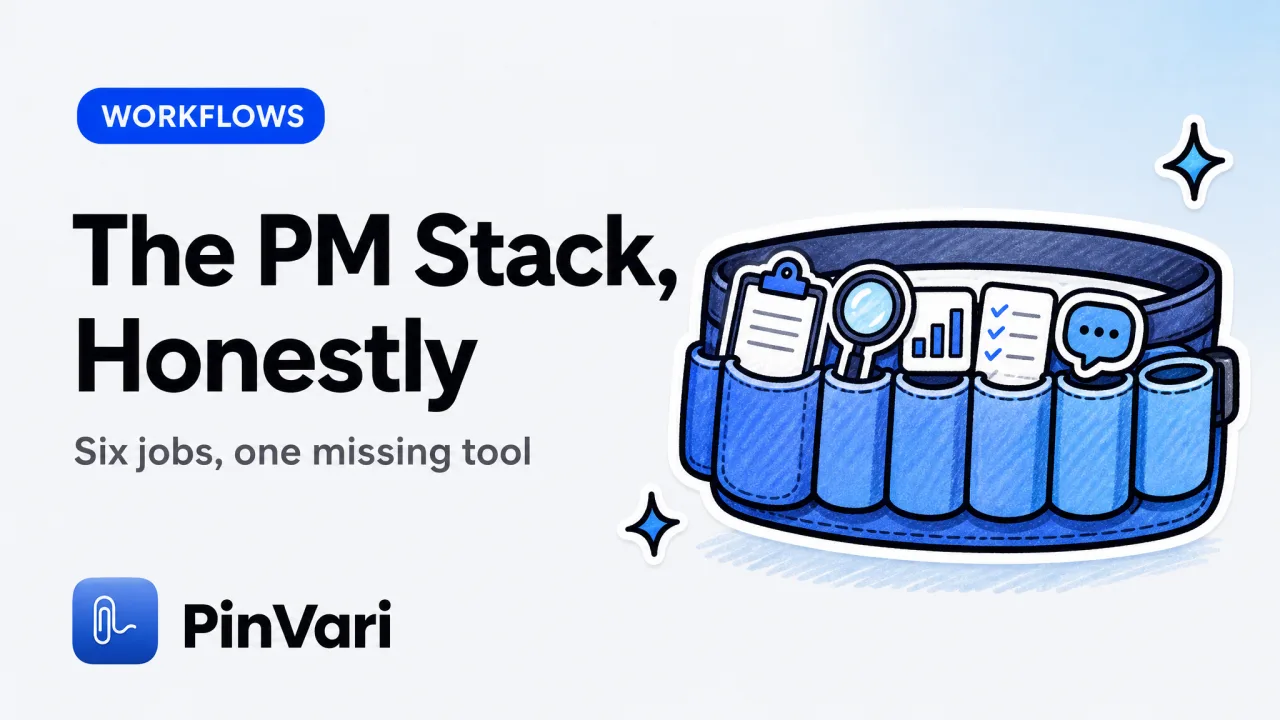
The tools required for product manager work fall into six jobs: discovery, roadmap, tracker, analytics, communication, and review feedback. Most PMs have solid tools for the first five and improvise the sixth, which is why feedback on a build so often gets misread by the developer or the AI agent meant to act on it.
The usual listicle names twenty apps and ranks them, which is not the useful question. The useful question is which jobs a product manager actually has to cover, and where the standard stack quietly leaves a hole.
What are the tools required for product manager work?
The tools required for product manager work map to the six jobs above, and you need one solid choice per job rather than one of everything. Redundant tools create the real cost, context-switching, so the goal is coverage without overlap.
Buying more of the same job does not help. A PM with three trackers and two analytics suites is slower than one with a clean tool per stage, because every extra surface is another place feedback and decisions can fragment.
The discipline is one tool per job, chosen so its output feeds the next job without a manual rewrite.
Here is the honest breakdown by job, not by brand.
| Job | What it does | Common choices |
|---|---|---|
| Discovery | Capture and synthesize user input | Interviews, surveys, product feedback tools |
| Roadmap | Prioritize and sequence work | Roadmap and planning apps |
| Tracker | Turn decisions into issues | Linear, GitHub, Jira |
| Analytics | Measure what shipped | Product analytics suites |
| Communication | Align stakeholders | Docs, Slack, decks |
| Review feedback | Report what is wrong on screen | Usually improvised |
Five of these six have mature, obvious answers. The sixth, review feedback, is where PMs paste a screenshot into Slack with a paragraph and hope the developer reads it the way they meant it.
The tools required for product manager work are usually complete except for one job. Review feedback, the step where you say "this control is wrong," is the one most stacks leave to prose and screenshots, and it is the step where meaning leaks.
The feedback tool most PM stacks are missing
The missing tool is the one that turns "this looks off" into a precise, named target a developer can act on without a follow-up. Every other job in the stack has structured output; review feedback is the one still written as a story.
Think about what actually happens when you review a build. You spot a button in the wrong place, a label that reads wrong, spacing that is off by a few pixels.
You describe it in words, attach a full-screen shot, and the developer has to map your sentence back onto a specific rendered control.
On a busy screen, that mapping fails often. The developer fixes a lookalike, closes the ticket, and you reopen it.
The round-trip erases the time the rest of your polished stack saved you.
What closes the gap is capturing feedback the way you already point at things in a meeting. On a Mac, a point-and-speak tool lets you hold ⌥⌘A, circle the control, and say what is wrong, and it resolves the exact accessibility element you circled, its role, label, and frame, with a confidence score.
That resolved element is the structured output the review step was missing. It travels to your tracker or your agent as a named target, not a paragraph the reader has to decode.
How should a PM give feedback a developer can act on?
Give feedback that names the target, states the delta, and carries evidence, in that order. The target is which element.
The delta is expected versus actual. The evidence is a shot cropped to the element, not the whole screen.
The mistake is leading with the story. "On the settings page, when I was looking at the top area, the thing near the toggle seemed off" makes the reader hunt.
Lead with the element, then the change you want, and the feedback becomes a task instead of a puzzle.
A reusable structure helps here. If you already keep a feature request template, use the same discipline for review notes: one field for the element, one for expected, one for actual.
The same rigor that makes a feature request actionable makes a review note actionable.
When you review, batch your notes. Circle and speak to every issue on a screen before you switch tools, so the developer gets one clean list of named targets instead of a trickle of Slack messages they have to reassemble into a plan.
For a full method on judging a build, not just filing the notes, the walkthrough in how to evaluate a website design pairs well with this. Evaluation tells you what is wrong; precise feedback is how you hand it off.
Which tools does a product manager need at each stage?
Match the tool to the stage of the work, because a discovery tool and a review tool solve different problems and a single app rarely does both well. Here is the checklist by stage.
- Before building, discovery. Interviews, surveys, and product feedback tools to decide what is worth doing. The output is a ranked problem list.
- Planning, roadmap. A prioritization view that sequences the ranked list against capacity. The output is a committed sequence.
- Executing, tracker. Linear, GitHub, or Jira to turn the sequence into issues the team works. The output is closed tickets.
- Reviewing, feedback. The step this article keeps returning to, where you check the build and report what is wrong precisely. The output is named, actionable notes.
- After shipping, analytics. Product analytics to see whether the change moved the metric. The output is evidence for the next discovery round.
Notice the loop closes at review feedback. The review step is where the roadmap meets reality, and if its output is vague prose, the whole loop slows down at the exact moment it should be tightest.
Adding more discovery or analytics tools will not fix a review-feedback gap. If your developers keep fixing the wrong control, the problem is the fidelity of your feedback, not the size of your stack.
Do PMs need AI tools, or just better feedback?
Most PMs need better feedback first, and better feedback happens to be what makes AI tools useful in the first place. A product manager AI tool that summarizes a vague note produces a confident, vague task, so the input quality is the lever.
If your team ships with an AI coding agent, the review step is where you touch that agent directly. A capture with a named element can be handed to the agent over a local MCP server, or filed to Linear, GitHub, or Slack, using the same structured payload.
The routing is covered in point-and-speak bug reports to Linear and GitHub.
The reason a named target matters more with an agent than with a human is that the agent has less shared context. A human developer might recognize which button you meant from habit; an agent works from what it is given, and a resolved element is far more reliable than a screenshot it has to interpret.
So the answer is not to bolt an AI layer onto a stack that already leaks at the review step. Fix the review step, and both your developers and any agent you use get an input they can act on the first time.
Of all the tools required for product manager review work, the one that names the target is the highest-leverage addition you can make.
Think of it as sealing the loop rather than extending it. Your discovery and analytics tools tell you what to build and whether it worked; the review tool is what makes sure the thing you shipped is the thing you meant.
When that step outputs a named element instead of a paragraph, every other tool in the stack gets a cleaner signal to work from.
The capture side runs on-device, with transcription and OCR through Apple frameworks and nothing uploaded by default. You bring your own agent, whether that is Claude Code, Cursor, Codex, or Zed.
It ships as a notarized Developer-ID DMG and is a one-time $39 launch license through Polar rather than a subscription, and the pricing has the full breakdown.
FAQ
#
What tools are required for a product manager?
A product manager needs coverage across six jobs: discovery, roadmap, tracker, analytics, communication, and review feedback. Most stacks are complete except for review feedback, the step where notes on a build get written in prose and misread.
#
What is the best way for a PM to give feedback to developers?
Name the exact element, state expected versus actual, and attach a cropped screenshot as evidence. Leading with the element instead of a story turns a review note into a task the developer can act on without a follow-up.
#
Do product managers need AI tools?
Better feedback usually matters more than adding an AI layer, because an AI tool acting on a vague note produces a confident but vague result. Precise, named feedback is what makes both developers and AI agents reliable.
#
What is the difference between a feature request form and review feedback?
A feature request form captures what should be built; review feedback reports what is wrong with what was built. Both benefit from the same discipline, naming the target and separating expected from actual behavior.
#
How do PMs give feedback that an AI coding agent can act on?
Hand the agent a named target rather than a screenshot. A point-and-speak tool resolves the exact accessibility element you circled and passes it to the agent over a local MCP server, so it edits the right control instead of guessing.
#
Can one tool cover discovery and review feedback?
Rarely well, because they solve different problems. Discovery tools synthesize user input into a problem list, while review-feedback tools capture a precise, named target on a live build, so most PMs use a dedicated tool for each.
Hand your agent the exact element
PinVari resolves what you point at into a named, executable instruction — on-device, no keys, your own agent. One click inside PinVari connects Claude Code, Cursor, VS Code or Codex — or paste one CLI line from pinvari.com/connect.
PinVari → Connect → your agent (one click)Get PinVari — $39 →