How to Learn AI Coding in 2026
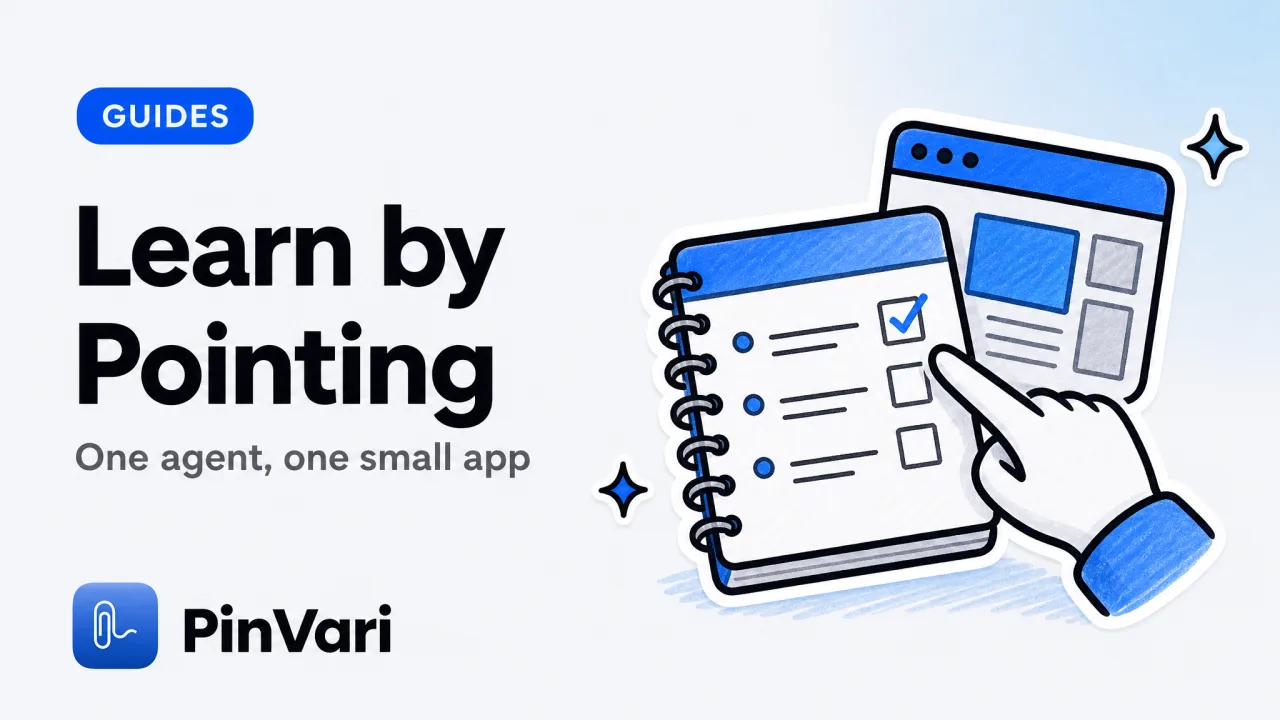
How to learn AI coding in 2026 is not a bootcamp syllabus. You pick one agent, you pick one tiny app, and you practice the loop of describe, run, point, fix until that loop feels boring.
Most beginner guides start with tools ranked by hype. The ranking does not matter if you cannot tell the model which thing on screen is wrong.
I learned faster when I stopped asking "what language" and started asking "what job is the user trying to finish." The agent can pick a language. You still have to see the UI.
If you need a first install, the best coding software for beginners is the companion to this page. This one is the study method.
What does "learn AI coding" actually mean?
It means you can steer an AI coding assistant to a working result you understand well enough to test. You do not need to write every line.
One agent is enough for week one. Two agents is a stall.
You still need to know when it is wrong. That is the whole skill. The model will happily ship a disabled button that looks finished.
Two tracks exist. Track A is vibe coding in a browser builder. Track B is an editor or terminal agent on a real folder.
Either track works for week one. Switching every day does not.
Learning AI coding is learning a feedback loop, not a language. The language arrives as a side effect of reading diffs you asked for.
How to learn AI coding in the first seven days
Day one: install one agent. Cursor if you want a window that looks like an editor. Claude Code if you are fine in a terminal. See how to use Claude Code if you pick the terminal.
Day two: one user job. "A page where I add a name and see it in a list." Not a startup.
Day three: click the empty, error, and success states. Write down what is wrong in outcome sentences.
Day four: stop pasting whole-window screenshots. Crop, or circle the control.
Day five: add voice if typing the same complaint slows you down. ⌥⌘V is voice-only; ⌥⌘A starts a mark.
Day six: read the diff. You do not have to write it. You have to notice a file you did not mean to touch.
Day seven: do the same app again from memory of the job, not from memory of the prompts. If you cannot restate the job, you learned prompts, not the product.
Keep a running "I do not know this word" list. Look up props, state, and disabled when they appear in a diff. Do not pre-study a glossary.
Which AI should a beginner learn with?
There is no single best AI for coding for a beginner. There is a best fit for how you like to look at files.
Browser builder (Lovable, Bolt, v0)
Feel: Preview first.
Learn: Jobs and UI states.
Miss: Real git habits, native apps.
Cursor
Feel: Editor with an agent.
Learn: Files, diffs, rules.
Miss: You will hide in chat if you never open the tree.
Claude Code
Feel: Terminal agent.
Learn: Commands, repo truth, MCP.
Miss: The terminal scares some people on day one. That fear fades.
I would not start with five models. I would not start with a "best of" tournament. One agent for two weeks.
You bring your own LLM either way. A capture tool should not force a second cloud.
The vocabulary problem, and how to skip it
Beginners bounce because they cannot say AXButton or flex. They say "the thing."
The model then edits the wrong thing. You think you are bad at prompting. You are bad at pointing.
macOS can resolve the control under your pointer. Role, label, frame, confidence, circled vs dwelled. You speak "this should stay off until the name is filled" while the pointer is on Save.
Deictic words bind to the pointer trail. "This" is not poetry. It is a timestamp.
Dwell (~0.2s) resolves without a circle. Multiple marks in one breath get their own words.
That is how you learn AI coding without first learning the design-system names. The names appear in the capture, then in the diff.
Do not paste a full-screen shot into a small context window as your first habit. You will teach yourself that more pixels equal more help. They equal more guesswork and more tokens.
What to practice besides prompting
Practice test states. Empty list, one item, long string, error.
Practice one-change turns. One named control, one outcome.
Practice reading a diff for blast radius. If the agent touched a file you did not name, ask why.
Practice refusing silent guesses. If two buttons look alike, say so. Confidence below 0.8 should ask.
Practice local context. A local MCP server on 127.0.0.1 can hand the agent a capture without uploading the screen.
claude mcp add --scope user pinvari -- "$HOME/.pinvari/mcp/pinvari-mcp"The app must be running. Bare claude mcp add pinvari errors. One-click connect exists inside the app for Claude Code, Cursor, VS Code, and Codex.
pinvari_request_capture is the mid-task version of asking a teacher to look. The notch lights up, you point, the agent continues.
A small syllabus that is not a course
Week two: add one more screen, not one more tool.
Week three: file a real ticket to GitHub or Linear with a named element, even if you are the only developer.
Week four: use pause/resume (⌥⌘P) on a long page so you learn scroll-aware marks.
Month two: read MCP docs at pinvari.com/mcp if you like plumbing. Skip them if you do not. The one-click path is enough.
You do not need to know Accessibility internals. It is fine to treat role and label as "the true name of the button."
If you work on a Mac and want the capture side as a one-time license, PinVari is $39 at launch (first 500, then $59) via Polar. macOS 14+, Apple Silicon and Intel. On-device transcription and OCR. Nothing uploaded by default.
CleanShot X will still be useful for pretty PNGs. It will not teach the agent a name. Jam.dev will teach you browser bugs. It will not see a native window.
How to learn AI coding without drowning in tools?
Freeze the stack. One agent, one preview, one capture method. Write them on a sticky note.
Every new YouTube video will tell you the stack is obsolete. It is not obsolete in week one. Your loop is the scarce thing.
When you feel stuck, do not add a second model. Re-run the same job with a named control. The stuckness is usually "the button" with no name.
Tools do not teach. Finished jobs teach. Three small apps will beat thirty tool reviews.
If you want a peer to review your learning, send them a ticket with a named element, not a chat export. They can see the control. They cannot see your vibe.
A Mac is a good place to learn because Accessibility can name what you point at. A Chromebook-plus-browser path can still work if the product is only a website. Jam.dev will then be enough for evidence.
I would not learn on a production client repo. Use a throwaway folder. The agent's blast radius is a better teacher when the stakes are a list app.
Read MCP docs only when you are angry at screenshots. pinvari.com/mcp is there. Curiosity is allowed. It is not homework for day one.
If a sentence in this guide felt like a product pitch, ignore the product and keep the loop. Describe, run, point, fix. That is how to learn AI coding.
FAQ
How to learn AI coding if I have never coded?
Pick one agent and one tiny user job. Describe the job, run the result, point at what is wrong, repeat.
Do not start with a language textbook. Look up words when they appear in a diff you asked for.
How long does it take to learn AI coding?
You can ship a small list app in a weekend. You can stay confused for months if you switch tools every day.
Measure in finished user jobs, not in hours of YouTube. Three finished jobs teaches more than a tool tournament.
Do I need to learn a programming language first?
No. You need to learn to test the result and to point at the broken control.
You will learn pieces of a language because the diffs are written in one. That is the right order for this path.
What is the biggest beginner mistake?
Pasting a whole window into chat and saying "fix the UI." The model invents a target.
Name the control or circle it. One change per turn. Read the diff.
Can I learn AI coding on a Mac without paying monthly?
Yes. Several agents have free tiers, and a one-time Mac capture app avoids another subscription.
PinVari's core app is a one-time license, not a monthly seat. You still bring your own agent and its own billing.
Should I start with vibe coding or with Claude Code?
If the terminal makes you close the laptop, start in a browser builder or Cursor. If you like commands, start with Claude Code.
The method is the same. One job, named feedback, read the diff.
Hand your agent the exact element
PinVari resolves what you point at into a named, executable instruction — on-device, no keys, your own agent. One click inside PinVari connects Claude Code, Cursor, VS Code or Codex — or paste one CLI line from pinvari.com/connect.
PinVari → Connect → your agent (one click)Get PinVari — $39 →