Coding with AI: The Fastest Workflow in 2026
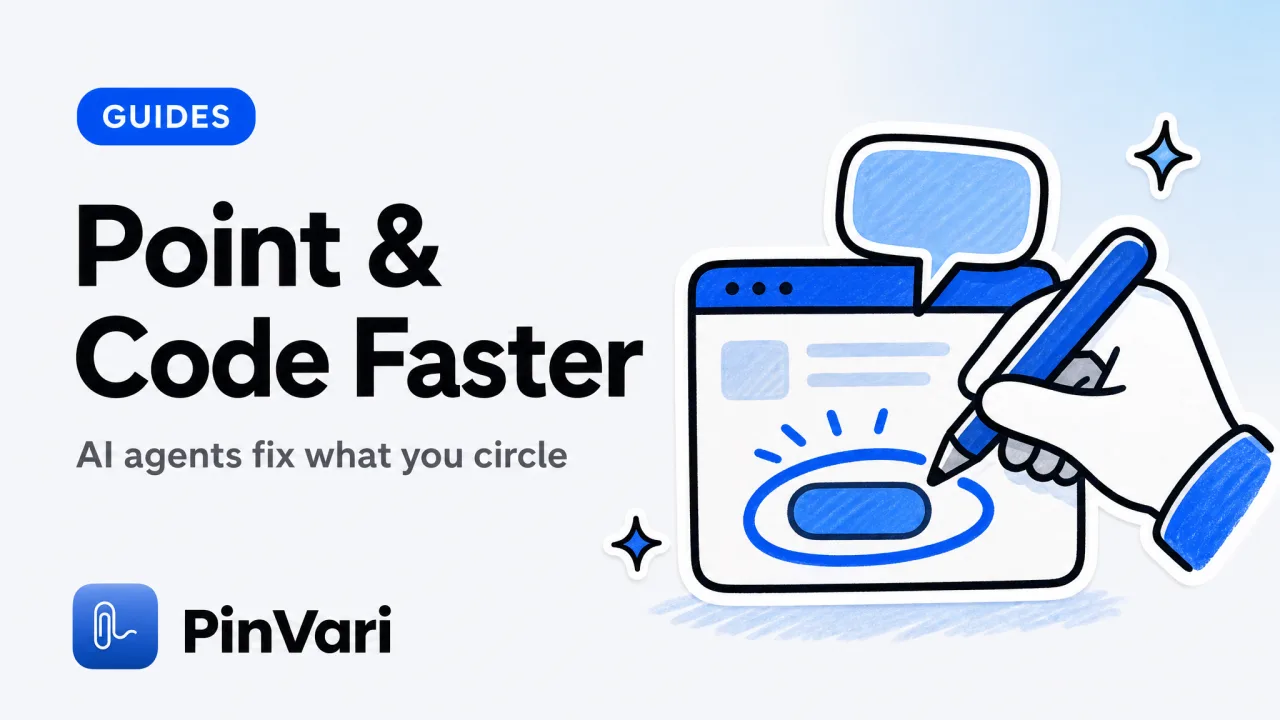
Coding with AI in 2026 means pointing at broken UI and speaking—your agent reads the named element, not a pixel guess. Most beginners waste hours describing "the blue button below the header" when the accessibility tree already labels it LoginButton role=AXButton. The fastest workflow: hold a hotkey, circle the element, speak the fix, let the agent resolve the exact frame and instruction.
What does coding with AI actually mean in 2026?
You write or fix code by describing what you want to an AI coding assistant (Claude Code, Cursor, Codex) instead of typing every line yourself. The assistant reads your project files, suggests edits, and writes functions from plain-English instructions. The shift: you point at on-screen UI (buttons, forms, errors) and the AI resolves the named accessibility element under your pointer—role, label, parent chain—so it knows exactly what to change, not a fuzzy "that thing near the top."
The best AI for coding in 2026 runs on-device (no upload) or brings your own API key (you control the model). It reads the accessibility tree (macOS AXUIElement, Chromium AXWebArea) to map UI structure, not screenshots alone. When you circle a broken dropdown, the agent gets role=AXPopUpButton title="Select Country" frame=(x,y,w,h)—it can write the fix without guessing coordinates.
The moat: accessibility APIs expose the UI element under any point. Agents that read the AX tree resolve the named element, not a pixel region.
How do I start coding with AI as a complete beginner?
Pick one AI coding agent and install it. The fastest start:
- Claude Code (free tier, pay as you go): install from the App Store or download the standalone app. Connect it to your text editor (VS Code, Zed) with one click. Bring your own Anthropic API key (~$3–5/mo for light use).
- Cursor ($20/mo after free trial): download the app, open your project folder, press ⌘K to describe what you want. Cursor indexes your codebase automatically.
- Codex CLI (bring your own OpenAI key): install via Homebrew, run
codex "create a landing page"from the terminal. Outputs code to stdout.
Start with a single-file project—a landing page, a to-do list, a calculator. Describe the feature in one sentence: "add a button that changes the background color." The agent writes the HTML/CSS/JS, you paste it into a file, open in a browser. When it breaks, point at the broken element and speak the fix instead of re-describing it in text.
Most beginners fail here: they write "fix the button" when there are twelve buttons on screen. Spatial capture tools (PinVari, others) let you circle the exact button, transcribe your voice on-device, and send the agent role=AXButton title="Submit" frame=(120,340,80,44) plus the instruction "make this green." The agent edits the right line.
Install PinVari if you're on macOS—hold ⌥⌘A, circle any UI element, speak the fix, and it sends the named element + cropped screenshot + instruction to Claude Code or Cursor over a local MCP server. No API keys, on-device transcription.
Which AI coding tools should I learn first?
| Tool | Price | Best for | Limitation |
|---|---|---|---|
| Claude Code | Free tier + API costs (~$3–5/mo) | Reasoning through multi-step edits; MCP servers for screenshots/context | Requires Anthropic key; slower on large codebases |
| Cursor | $20/mo (free trial) | Autocomplete in the editor; inline suggestions as you type | Closed-source; codebase sent to their servers |
| Codex CLI | OpenAI key costs (~$2–10/mo) | Terminal workflows; generating scripts/config files | No editor integration; outputs to stdout |
| PinVari | $39 one-time (launch price) | Pointing at UI to describe bugs; sending named elements to agents | macOS only; requires agent installed |
Start with Claude Code—the free tier lets you test agentic coding without upfront cost. When you hit "the dropdown doesn't work," use a spatial-capture tool to point at it instead of writing a paragraph. The agent gets the element's AX role/title/frame and fixes the right node.
If you're already comfortable in VS Code, add Cursor for inline autocomplete. If you build CLI tools, Codex is faster than a web UI. If you review apps or test prototypes on macOS, PinVari is the layer above—it resolves UI elements for you and pipes them to whichever agent you already use.
How do I point at UI instead of describing it?
Hold a hotkey (⌥⌘A in PinVari), draw a circle or hover over the element you want to fix, and speak the instruction. The tool:
- Resolves the named element via the macOS Accessibility API (
AXUIElementCopyElementAtPosition→ role, title, value, frame, parent chain). - Transcribes your voice on-device (no upload) using Apple's Speech framework.
- Binds deictic words ("this", "that") to the pointer position at the instant you said them (a timestamped trail).
- Sends the agent a
pinvari_next_instructioncall with the element path, the spoken text, the region circled, and a screenshot cropped to that region.
The agent (Claude Code, Cursor, Codex) reads the instruction and edits the code. You never wrote "the blue submit button in the bottom-right corner"—you pointed, and the tool resolved role=AXButton title="Submit" frame=(520,680,100,44).
When the accessibility tree is empty (canvas-based apps, some Electron windows), the tool falls back to on-device Vision OCR—it reads visible text and gives the agent a best-effort label. Most native macOS apps and browsers expose full AX trees, so you get exact names 95% of the time.
Below 0.8 confidence, the tool asks you to confirm the element instead of guessing. You see the resolved name and frame—accept it or redraw.
What should I build to practice coding with AI?
Pick a single-page project with visible UI you can test immediately:
- Landing page with a hero section, three features, and a contact form. Circle the "Submit" button, say "make it bounce on hover," watch the agent add the CSS.
- To-do list with add/delete/mark-done. Point at the "Add" button, say "disable this when the input is empty," the agent writes the conditional.
- Color picker that changes the page background. Circle the color input, say "save the last five colors to localStorage," the agent writes the logic.
After each change, open the browser, test the feature, point at what broke. If the dropdown closes too fast, hold ⌥⌘A, circle the dropdown, say "keep this open until I click outside." The agent gets role=AXPopUpButton title="Options" and adjusts the event listener.
Most beginners build invisible logic (sorting algorithms, API wrappers) where they can't see progress. Start with UI you can click and break—you'll learn faster when you point at the failure instead of describing it in a bug report.
How do AI agents read the accessibility tree?
The macOS Accessibility API exposes every on-screen UI element as a tree: windows contain groups, groups contain buttons/text fields/sliders, each node has a role (AXButton, AXTextField), a title/label, a value, and a frame (x, y, width, height). Apps must opt in (NSAccessibilityElement conformance), but every native macOS app and browser builds the tree automatically.
When you point at a button, tools like PinVari call AXUIElementCopyElementAtPosition(x, y) to get the element under that point. It walks the parent chain to resolve the full path: Window > Group > Button "Submit". The agent receives this path in a structured format:
{
  "role": "AXButton",
  "title": "Submit",
  "frame": {"x": 520, "y": 680, "width": 100, "height": 44},
  "parent": "AXGroup 'Form Container'",
  "confidence": 0.94,
  "provenance": "circled"
}
Electron and Chromium apps build AX trees lazily—the first hit-test might return an empty AXGroup. Tools set AXManualAccessibility and retry (~150ms) until labeled elements appear. When a point lands on a bare group, they descend to the deepest labeled child. Chromium adds AXDOMIdentifier and AXDOMClassList so title-less nodes get a name.
Read the accessibility tree guide for the full breakdown.
What's the fastest workflow loop in 2026?
- Open your project in Claude Code or Cursor.
- Describe the feature in one sentence: "add a login form with email and password."
- The agent writes the code. You save and open in a browser.
- Circle the broken element (PinVari ⌥⌘A or your tool), speak the fix: "make this field required."
- The agent edits the code (adds
requiredto the input tag). - Refresh. Test. Repeat.
The loop shrinks from minutes to seconds because you skip the "describe the element" step. Most beginners write paragraphs: "the email input field, which is the first text box below the 'Login' heading, should show an error if I leave it blank." The agent guesses which input. You point once, the tool resolves role=AXTextField title="Email" placeholder="[email protected]", and the agent knows exactly which line to change.
Install PinVari if you're on macOS—one-time $39, connects to Claude Code/Cursor/Codex with one click. Hold ⌥⌘A, circle, speak, done. The agent gets the named element and cropped screenshot automatically.
The 2026 workflow: point, speak, the agent edits. No typed descriptions, no guessing which element you meant.
How do I choose between Claude Code, Cursor, and Codex?
If you're learning and want low upfront cost, start with Claude Code. The free tier covers experimentation; you bring your own Anthropic API key (~$3–5/mo). It reasons through multi-step edits better than autocomplete-first tools and supports MCP servers for screenshots and context.
If you want inline autocomplete as you type, pick Cursor. It indexes your codebase and suggests completions in real time. The $20/mo subscription includes the model—no separate API key. Limitation: your code goes to their servers, and it's closed-source.
If you build CLI tools or scripts, use Codex CLI. Run codex "convert this CSV to JSON" and it outputs code to stdout. Faster than a web UI for one-off tasks. Requires an OpenAI key.
Compare the full breakdown at best AI for coding. All three integrate with PinVari—when you circle UI and speak, the instruction flows to whichever agent you connected.
FAQ
Can I code with AI for free?
Yes. Claude Code has a free tier; you bring your own Anthropic API key and pay ~$3–5/mo for light use. OpenAI's free tier lets you test GPT-4o via Codex CLI for small projects. Cursor offers a 14-day free trial, then $20/mo. The tools are free or cheap—the cost is the model API (unless you run a local model with Ollama, which is slower).
Do I need to know how to code already?
No, but you'll learn faster if you can read HTML/CSS/JS and recognize when the agent's output is wrong. Start with a single-page project—landing page, to-do list—where you can see the UI and test immediately. Point at what breaks, speak the fix, watch the agent edit. You'll pick up syntax by reading the code it writes.
How do I keep my code private when using AI agents?
Use on-device tools or bring-your-own-key agents. PinVari transcribes voice and runs OCR on-device (Apple frameworks), nothing uploaded. Claude Code sends code to Anthropic's API if you use their hosted models—bring a local model (Ollama) or a self-hosted API if privacy matters. Cursor sends your codebase to their servers by default; read their privacy policy before committing company code.
What if the agent fixes the wrong element?
When you point at UI instead of describing it, the agent gets the exact named element (role, title, frame). If it still edits the wrong line, the issue is usually: (1) duplicate elements with the same title—circle more precisely or speak a unique property ("the red submit button"), or (2) the agent hallucinated a selector—check the diff before accepting. Tools like PinVari show the confidence score (0.0–1.0); below 0.8, confirm the element before sending.
How long does it take to build a real app with AI?
A landing page or to-do list takes 10–30 minutes. A multi-page app with auth and a database takes days, not hours—the agent writes boilerplate fast, but you still design the schema, test edge cases, and fix bugs. The speedup: you point at broken UI and speak fixes instead of writing descriptions. Most beginners ship their first working prototype in under two hours when they start with visible UI they can test immediately.
Can I use AI coding tools on Windows or Linux?
Yes. Claude Code, Cursor, and Codex CLI run on macOS, Windows, and Linux. PinVari is macOS-only—the Accessibility API that resolves named UI elements is an Apple framework. Windows has UI Automation (UIA), but most spatial-capture tools target macOS first because the AX tree is richer and apps expose it by default.
Hand your agent the exact element
PinVari resolves what you point at into a named, executable instruction — on-device, no keys, your own agent. One click inside PinVari connects Claude Code, Cursor, VS Code or Codex — or paste one CLI line from pinvari.com/connect.
PinVari → Connect → your agent (one click)Get PinVari — $39 →