Claude Code for Product Managers: Feedback That Lands
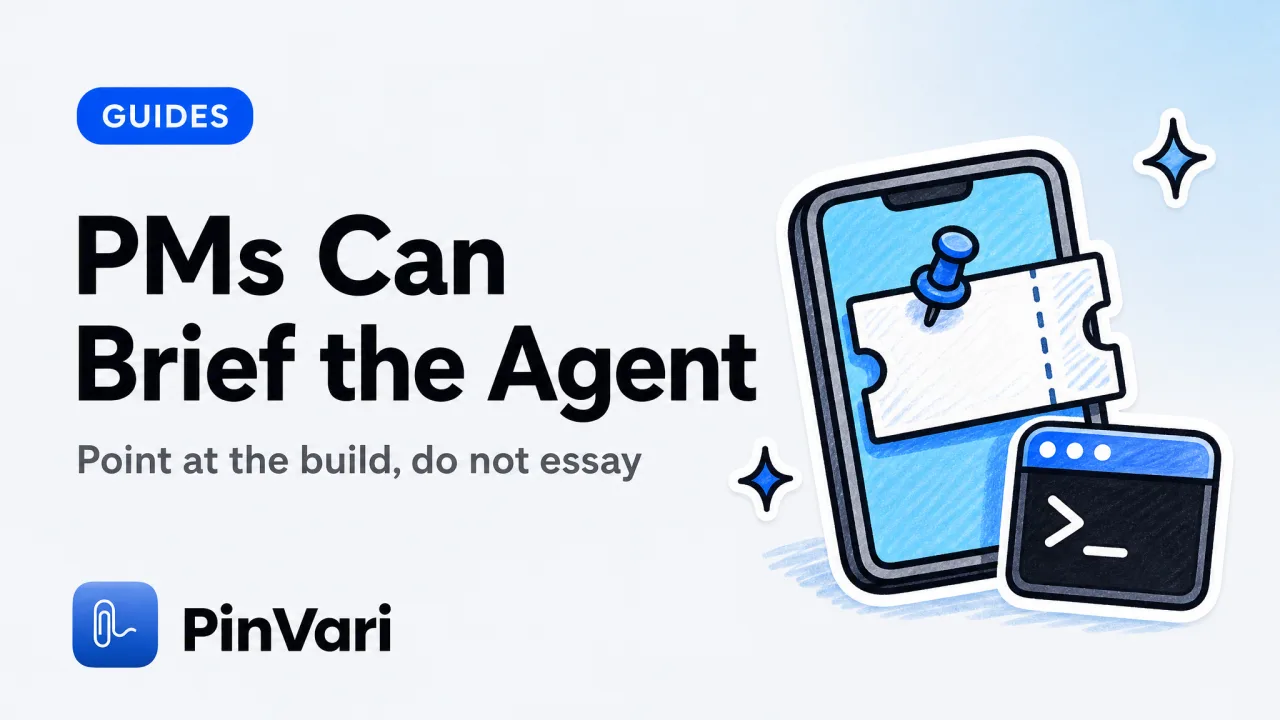
Claude Code for product managers is a practical loop: install the CLI, connect it to the repo your engineers already use, then give it feedback that names the exact UI control instead of a paragraph in Linear.
The agent can apply the change. It cannot read your mind through Slack.
Most PM-facing AI lists stop at note-takers and roadmap chatbots. Those tools do not open a pull request. Claude Code does, which is why the briefing has to be as tight as a good ticket.
Should a product manager use Claude Code at all?
Yes, if you already review a running build on a Mac and you have permission to run the project locally.
No, if the company will not give you a checkout, or if the only surface you review is a Figma file with no repo.
Claude Code is a developer tool that happens to accept English. It is not a safe sandbox for production credentials. Use a feature branch. Use a dummy account. Do not paste secrets into the prompt.
The how to use Claude Code guide is the install. The Claude Code tutorial is the longer tour. This page is the PM cut: feedback, not features.
Product manager AI tools covers the rest of the stack. Keep Claude Code in the "changes the product" bucket, not the "summarizes the standup" bucket.
If your engineer already uses Claude Code, your job is to feed it the same named control they would have circled. Duplicate tickets disappear when both of you point at the same node.
How do product managers brief Claude Code without writing code?
Three inputs. Skip the jargon.
The running UI. A local preview or a staging build you can see.
The instruction. One change, spoken or typed, with an expected result.
The target. The named control, not "the thing on the right."
Hold ⌥⌘A, circle the control, speak "this should be the primary style, Cancel stays secondary." Finish the mark.
PinVari transcribes on-device, hit-tests the Accessibility tree, and hands Claude Code the bundle over local MCP. You never have to say Button or AXCheckBox if the OS already did.
Deictic words bind to the pointer trail. "This" is the element under the pointer when you said it. Circle three nits in one breath and each mark keeps its own words.
If you would rather file a human ticket, the same capture goes to Linear or GitHub. The point-and-speak Linear and GitHub flow is that path.
A PM briefing that works
Bad: "The settings page feels inconsistent, can we clean it up."
Better: "Notifications pane, toggle labeled Email alerts. After relaunch it should stay off. Right now it snaps back on."
Best: The better sentence, plus the resolved element, plus a crop, plus the window text so the agent sees the neighbor labels.
Claude Code can work from the better sentence. It wastes turns on the bad one.
How do you connect Claude Code as a PM?
You need the app installed and running, then one MCP line. Do not type the bare claude mcp add pinvari. That errors.
claude mcp add --scope user pinvari -- "$HOME/.pinvari/mcp/pinvari-mcp"Or skip the CLI: PinVari → Connect → Claude Code. The connector talks to 127.0.0.1:3402.
Tools the agent can call: pinvari_next_instruction, pinvari_get_capture, pinvari_list_captures, pinvari_get_frame, pinvari_request_capture, pinvari_mark_done, pinvari_health.
When the agent is mid-change and lost, it can request a capture. The notch island lights up. You point again. That is cheaper than another Slack thread.
Keep a dedicated checkout for PM reviews, on a branch named after the ticket. Ask Claude Code to open a PR, then let engineering review. You are briefing, not merging to main on a Friday.
Claude Code vs Linear comments for PM feedback
Both are valid. They fail in different ways.
Linear comment
Reader: A human, later.
Risk: They skim. They pick the wrong button.
Best for: Decisions, scope, "don't do this."
Slack screenshot
Reader: Whoever is online.
Risk: Compression, no name, lost in scroll.
Best for: A quick "is this broken for you too."
Claude Code + named capture
Reader: The agent, now.
Risk: It will edit. Review the diff.
Best for: Visual nits and copy changes you can verify in the preview.
Use Linear when the change needs a product decision. Use the agent when the decision is already "yes, fix that alignment."
Claude Code will follow a vague instruction with confidence. If your capture confidence is below about 0.8, answer the ask. Do not let a low-confidence mark become a merged PR.
What a PM can and cannot expect
You can expect copy edits, spacing, simple state bugs, and "make this match that" if you pointed at both.
You cannot expect architecture, migrations, or anything that needs production data you do not have.
You can expect the agent to read up to 40,000 characters of focused-window text, including copy scrolled off the fold, when the capture includes it. That helps on long settings pages.
You cannot expect canvas-heavy surfaces to name themselves. OCR fallback is on-device and honest about confidence. Games and some Electron views stay messy.
You can expect multi-display marks to remember the monitor, and pause/resume (⌥⌘P) to cover a scrolling marketing preview.
You cannot expect the Mac App Store edition of a global capture tool to exist in the same form. The sandbox blocks the hotkey and foreign AXUIElement reads. PinVari ships as a notarized Developer-ID DMG for macOS 14+, Apple Silicon and Intel.
A weekly PM loop that does not annoy engineering
- Pull the latest main. Run the preview the README already documents.
- Walk the change list with ⌥⌘A. One mark per issue. Speak expected versus actual.
- Sort captures in the Command Center by app. Drop the ones that were you, not the build.
- Send obvious nits to Claude Code. File product calls to Linear with the same capture attached.
- Review every diff. If you cannot verify it in the preview, assign a human.
- Close marks with
pinvari_mark_doneso the queue stays honest.
Crash-safe session recovery matters when the preview dies. So does "ask, never guess" on unspecific speech.
Launch license is $39 for the first 500, then $59, Polar, team seats available, no subscription on the core app. Numbers live on pricing.
Nothing uploads by default. No API keys for capture. You bring Claude Code, which you or the company already pay for.
What does Claude Code for product managers need on day one?
A working preview, a branch you are allowed to push, and one capture of a real control. That is the whole day-one kit.
Skip custom slash commands and memory files until the first successful nit. Extra machinery hides a vague briefing.
If the preview takes engineering to start, pair for an hour and record the commands in the ticket template. Future you will not remember the env flag.
Then walk one screen with ⌥⌘A and send a single mark. Verify the result in the UI before you queue five more.
Day two is Linear plus the agent, not a new tool. The product manager AI tools list can wait until this loop is boring.
When engineering pushes back, ask for a recorded preview command, not for them to take the feedback over. The point of Claude Code for product managers is fewer translated tickets, not fewer reviews.
FAQ
Can product managers use Claude Code without knowing how to code?
Yes, for small, visible changes, if someone set up the repo and the preview. You still review the result in the UI. You do not have to read every line of the diff, but you do have to look at the build.
Is Claude Code for product managers a replacement for Linear?
No. Linear holds decisions and history. Claude Code applies a change. Send the same named capture to both when you want a record and a patch.
How do I stop Claude Code from changing the wrong thing?
Point at the control. Include the resolved name and a crop. Write one expected result. If the agent still drifts, mark it done and file a human ticket.
Do I need engineering permission to run Claude Code?
You need a checkout, credentials for a non-prod environment, and a branch policy. That is a team conversation, not a download. Do not run it against production.
What is the fastest way for a PM to give Claude Code UI feedback?
Circle the control, speak the change, let MCP deliver the bundle. Faster than a spec doc, and more specific than a Slack paragraph.
Does Claude Code work with voice feedback on a Mac?
The CLI does not listen to the room. A capture app that transcribes on-device and attaches the words to a mark is the voice layer. ⌥⌘V is voice-only when the element is already clear.
Hand your agent the exact element
PinVari resolves what you point at into a named, executable instruction — on-device, no keys, your own agent. One click inside PinVari connects Claude Code, Cursor, VS Code or Codex — or paste one CLI line from pinvari.com/connect.
PinVari → Connect → your agent (one click)Get PinVari — $39 →