AI Pair Programming: What Actually Works in 2026
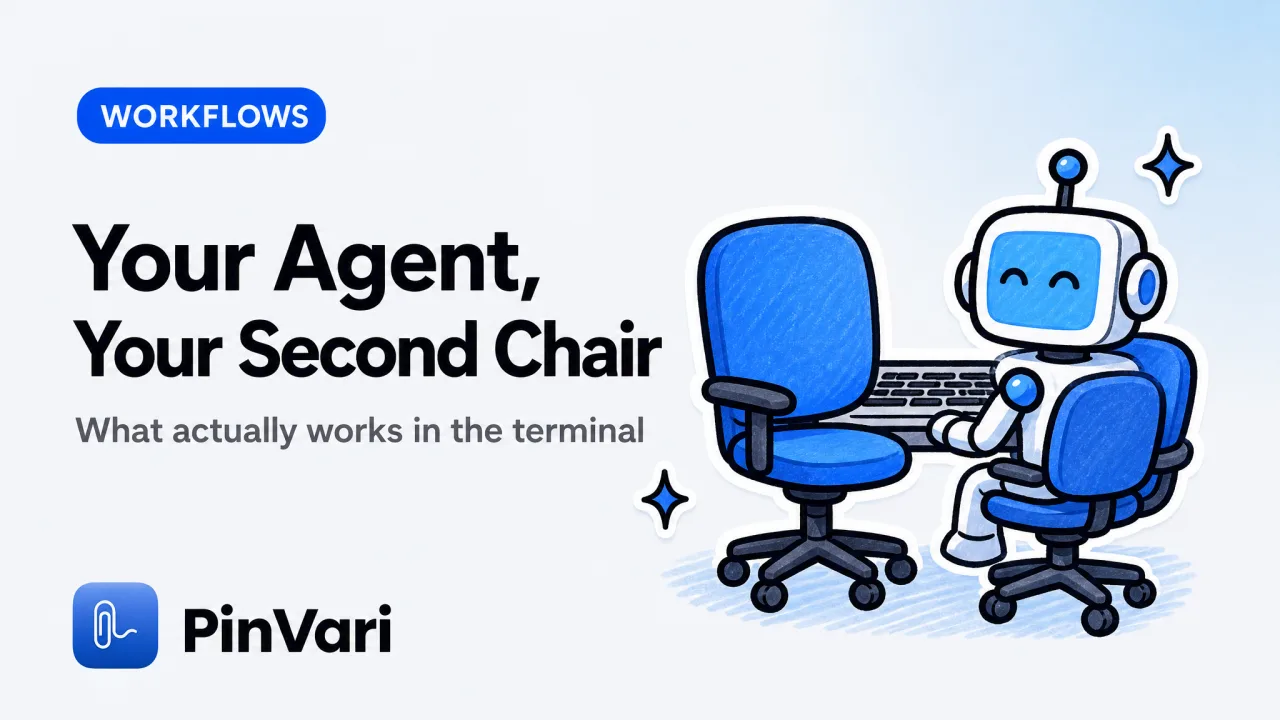
AI pair programming is a workflow where an AI agent writes, edits, and reviews code alongside you in real time, taking the "driver and navigator" idea from human pairing and putting the model in one of the seats. In 2026 the sharpest version of it lives in the terminal, where agents like Claude Code, Codex CLI, and Aider read your repo, run commands, and edit files directly instead of just suggesting a line at a time.
Most takes on AI pair programming still frame it as fancy autocomplete. That framing misses the real shift, which is that the hard part moved from generating code to telling the agent exactly what you mean.
What is AI pair programming, really?
Human pair programming has one person typing and one person thinking a step ahead. AI pair programming keeps that shape but swaps the navigator, and sometimes the driver, for a model that can hold your whole codebase in context.
The modern form is agentic, not suggestive. The agent acts, not just autocompletes: it opens files, runs your test suite, reads the error, and patches the code, then loops.
You review the diff and steer, which is the navigator's job.
That loop is why terminal agents took over the serious end of the market. An editor plugin that finishes your line is helpful, but an agent that can take "the login form rejects valid emails, fix it" and drive the whole change is a different category of tool.
If you want the landscape, the best AI pair programming tools comparison maps the current field.
AI pair programming in 2026 is a review loop, not a typing aid. The model drives a change end to end, and your leverage comes from steering it precisely, not from writing less code.
How is AI pair programming different from autocomplete?
Autocomplete predicts the next token inside the file you are looking at. An AI pair programming agent reasons across the whole repo, takes multi-step actions, and reports back with a diff you approve or reject.
The difference shows up the moment a task spans more than one file. Autocomplete cannot rename a function everywhere it is used, update the tests, and run them.
An agent can plan that, execute it, and show you the result, which is why the interaction feels like working with a junior engineer rather than a smarter keyboard.
That capability comes with a new failure mode. When the agent acts autonomously, a vague instruction becomes a wrong action, not just a bad suggestion you can ignore.
The cost of an unclear prompt went up, because the agent will confidently do the wrong thing across five files.
Where does AI pair programming still break?
It breaks at the input, not the output. The models are good enough to make almost any change you can describe precisely; the trouble is describing it precisely, especially for anything visual.
Picture a real session. You are looking at a rendered page and something is off: wrong padding on one card, a button that should be disabled, a tooltip pointing at the wrong anchor.
To get the agent to fix it, you either write a paragraph locating the element in words, or you paste a screenshot.
Both paths are lossy. Prose is ambiguous ("the second button, no, the other one"), and a screenshot is just pixels the agent has to decode, which burns tokens and still lands on the wrong element often enough to matter.
The pattern is common enough to have its own writeup: when Claude Code fixes the wrong element.
Pasting a screenshot feels like giving the agent context, but it is the opposite of precise. The model receives a grid of pixels with no labels, so it guesses which control you mean and sometimes edits a neighbor. A named element removes the guess.
The deeper issue is that a screenshot is the wrong primitive for saying "this one." The full argument for that is in how to give Claude Code context, and it holds for every agent, not just one.
There is a token cost hiding in here too. A high-resolution screenshot of a full page can consume a large slice of the context window before the agent has done any thinking, and it pushes out the code and history the model actually needs.
You end up paying for pixels the model then has to interpret, which is the least efficient way to spend a context budget.
Which AI pair programming setup fits the terminal?
The terminal agents differ less in raw model quality and more in how they take context and how they are configured. Here is a plain comparison of the common setups.
Skip the wide grid. Read each option as a card.
#
Claude Code
Form: Terminal CLI
Context style: Repo-aware, MCP tools
Best fit: Agentic multi-file changes
#
Codex CLI
Form: Terminal CLI
Context style: Repo-aware, sandboxed
Best fit: Scripted, sandbox-first runs
#
Aider
Form: Terminal CLI
Context style: Git-native diffs
Best fit: Tight commit-per-change loops
#
Copilot
Form: Editor plugin
Context style: In-file suggestions
Best fit: Line-level autocomplete
The terminal agents win for real pair programming because they act on the whole project. The editor plugin still shines for fast in-line suggestions, which is a different job.
For a deeper look at running the loop in a shell, see AI pair programming in your terminal.
Configuration matters more than the leaderboard here. The same model will feel sharp or clumsy depending on what context you give it, how you scope each task, and whether it can run your tests to check its own work.
A well-configured Aider loop that commits one change at a time can beat a poorly-steered agent running a stronger model, because the tight feedback loop catches mistakes early. Pick the tool that fits how you work, then invest in feeding it good context rather than chasing the newest model.
What none of these tools solve on their own is the input problem for UI work. They all take text and, at best, images.
Feeding them a resolved, named element is a job for a layer that sits on top of the OS.
How do you fix the wrong-element problem?
You fix it by resolving the element before the agent ever sees it, so the agent receives a name instead of a pixel guess. macOS already knows what is under any point on screen through the Accessibility API, which returns a control's role, label, value, and frame.
PinVari is a native macOS app built on exactly that. You hold ⌥⌘A, circle or point at any on-screen control, and speak; it screenshots, transcribes on-device, and resolves the exact accessibility element you circled, with a confidence score and whether you circled or dwelled on it.
It binds deictic words like "this" and "here" to where your pointer was at the instant you said them.
It then hands your agent a resolved, executable instruction over a local MCP server on 127.0.0.1. The agent-facing tool pinvari_next_instruction returns the element path, your spoken instruction, the region you circled, and a screenshot cropped to that region, so the agent acts on a named element instead of decoding a full-page image.
Everything stays on your machine. Transcription and OCR run on-device through Apple frameworks, there are no API keys, and nothing is uploaded by default.
You bring your own agent and model, whether that is Claude Code, Cursor, Codex, or Zed.
It is honest about hard surfaces too. On a bare AXGroup it descends to the deepest labeled child; on Chromium and Electron windows that build their accessibility tree lazily it sets AXManualAccessibility and retries; on a raw canvas with no tree it falls back to on-device Vision OCR, and below its confidence bar it asks rather than guessing.
It is a one-time $39 at launch, with details on the pricing page.
The result is a pairing loop where you point at the bug and speak, and the agent gets the one thing it was always missing: which element you mean, by name.
FAQ
#
What is AI pair programming?
AI pair programming is a workflow where an AI agent writes, edits, and reviews code with you in real time, taking one of the roles a human pair partner would. In 2026 the strongest form is agentic terminal tools that read your repo, run commands, and edit files directly rather than just suggesting lines.
#
Is AI pair programming better than a human pair?
They are complementary. An AI agent is faster at mechanical, multi-file changes and never tires, while a human partner brings judgment, product context, and accountability.
Most teams use the agent for execution and keep a human in the navigator seat for direction and review.
#
What are the best AI pair programming tools?
For agentic work in the terminal, Claude Code, Codex CLI, and Aider are the current leaders, each reading your whole repo and acting on it. GitHub Copilot remains strong for in-editor line suggestions, which is a different, narrower job than full pairing.
#
Why does my AI pair programming agent edit the wrong UI element?
Because you gave it a screenshot or a prose description, and both are ambiguous about which control you mean. The agent decodes pixels or parses your words and guesses, sometimes landing on a neighboring element.
Handing it a named accessibility element resolved from the point you circled removes that guess.
#
Can AI pair programming work fully in the terminal?
Yes. Claude Code, Codex CLI, and Aider are built for the terminal and drive complete changes there, reading files, running tests, and committing diffs.
The main gap is visual context, which is where an on-device point-and-speak tool feeds the agent a named element from what is on screen.
#
Does AI pair programming send my code to the cloud?
It depends on the tool. The agents themselves send prompts and code to their model providers, but supporting tools can stay local.
A screen-context tool that transcribes and resolves elements on-device keeps that layer off the network entirely.
Hand your agent the exact element
PinVari resolves what you point at into a named, executable instruction — on-device, no keys, your own agent. One click inside PinVari connects Claude Code, Cursor, VS Code or Codex — or paste one CLI line from pinvari.com/connect.
PinVari → Connect → your agent (one click)Get PinVari — $39 →