Prepare Web Images for AI Moodboard Tools
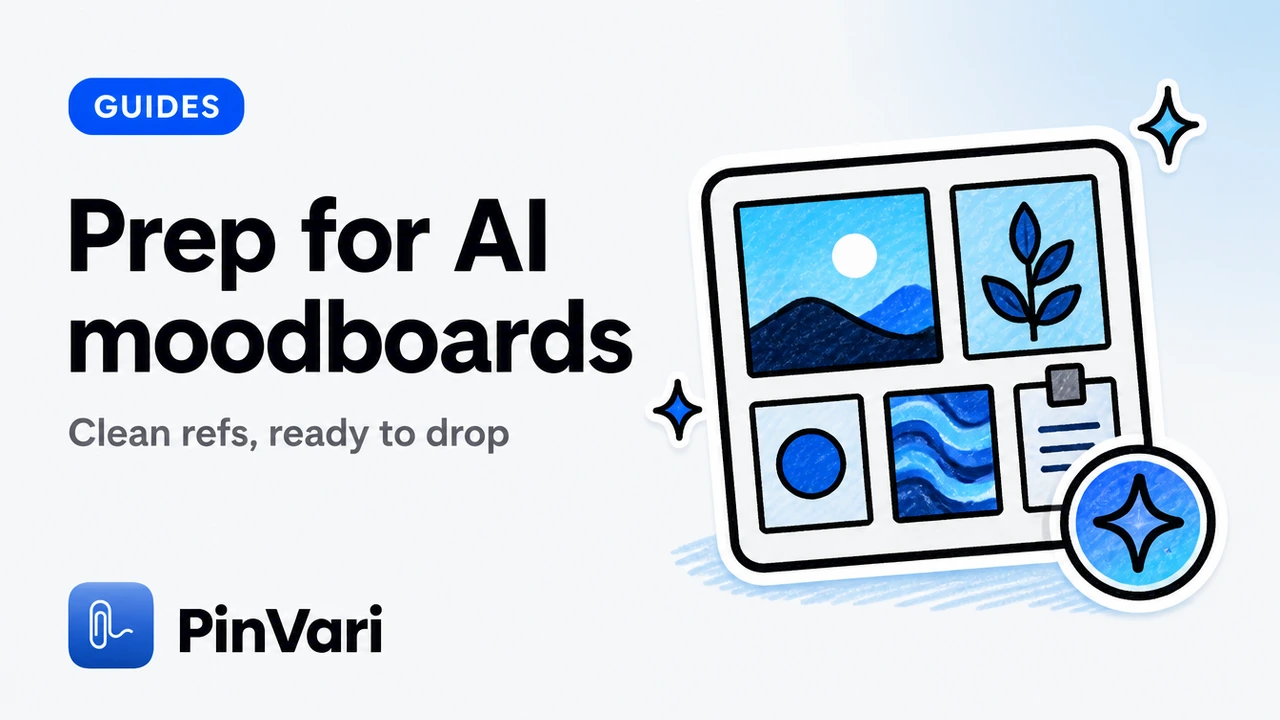
Permission-aware collection is the adult step. AI moodboard tools amplify whatever you feed them — including junk and licensed art. Image Downloader by PinVari approaches the job as collect → preview → organized ZIP on your device.
People searching this topic usually tried blind bulk saves first. permission-aware collection is the upgrade those dumps were missing.
Soft store note: version 2.5.3 is in Chrome Web Store review. Start on the Image Downloader product page. Use the Chrome Web Store listing as the secondary path while the release is in review.
Why does this job need more than Save Image As?
Resize and convert before upload quotas scream.
Right-click save still works for one file. It fails when you need filters, rename rules, convert, or a ZIP with provenance.
Modern pages lazy-load, serve srcset candidates, and bury heroes under UI chrome. A workspace that previews dimensions prevents thumbnail accidents.
Teams also need a shared habit. One person dumping unsorted files into Slack is how reviews stall.
Permission-aware collection is the adult step.
How should the Chrome workflow look?
Open the page. Use the side panel or right-click collect. Scroll until galleries load. Filter tiny assets. Preview versions the page exposed.
Convert WebP when the next tool is picky. Apply filename templates and folders by source. Export ZIP parts that fit chat limits. Add a CSV when audits matter.
Soft store note: version 2.5.3 is in Chrome Web Store review. Start on the Image Downloader product page. Use the Chrome Web Store listing as the secondary path while the release is in review.
Related reading: moodboard workflow, when not to use, WebP to JPG.
Where does Image Downloader by PinVari fit?
Image Downloader by PinVari is built as a home for the images you find. The loop is collect, preview, then download an organized ZIP.
Processing stays on your device. There is no account wall. The interface ships in 51 languages.
You can convert among JPG, PNG, and WebP, resize at export time, apply filename templates, and sort into folders. CSV and URL source records travel with the batch when you need provenance.
Side panel and right-click keep you on the page. Scroll & collect helps with lazy-loaded galleries. Library, favorites, and contact sheets support multi-day creative work.
Soft store note: version 2.5.3 is in Chrome Web Store review. Start on the Image Downloader product page. Use the Chrome Web Store listing as the secondary path while the release is in review.
How do common approaches compare for this job?
Pick the approach that matches the next reader, not the loudest install count.
Blind bulk dump
Type: one-click or mass-select ZIP.
Strength: speed on simple public pages.
Limit: icon junk, opaque names, weak provenance.
Preview-first workspace
Type: collect → inspect → export.
Strength: filters, convert, templates, sheets, CSV, library.
Limit: one short preview beat; still bound by page access.
Manual Save Image As
Type: native browser menu.
Strength: zero install for a single file.
Limit: no batch discipline; no templates; no contact sheet.
What mistakes should you avoid on this workflow?
Skipping Scroll & collect on infinite galleries. Trusting the first thumbnail URL. Mixing client folders without domain labels.
Overclaiming full-res when the page never exposed it. Treating capture as a license. Pasting unpublished comps into random online extractors.
Forgetting retries that keep completed files. Shipping a contact sheet whose names do not match the ZIP.
Resize and convert before upload quotas scream. Write that on a sticky note if you have to.
What does success look like for people doing this weekly?
Success is a short curated pack with readable names, not a 400-file landfill. Success is a reviewer who can mark keepers on a sheet in five minutes.
Success is a CSV that answers “where did this come from?” without spelunking browser history. Success is convert choices that match Figma, CMS, or deck tools.
Success is also saying no: skipping paywalled assets, skipping licensed art you cannot use, skipping pages your policies forbid.
permission-aware collection stays the north star when tools market unlimited promises.
What honest limits should you repeat to your team?
No extension downloads every image on every site. Availability depends on page access. Hidden originals stay hidden.
Do not promise full-res camera files from a marketing CDN that only exposes resized derivatives. Check dimensions first.
Do not use a downloader to bypass paywalls, auth walls, or license terms. Capture is not permission.
Conversion can flatten animation. Keep originals when motion matters. Prefer local processing when comps are unpublished.
If a host blocks bulk fetch or serves different URLs to extensions, retry and document the miss. Do not invent pixels.
What does a careful week of practice look like?
Day one: pick one real page you already use. Run Scroll & collect before you filter so lazy frames actually appear.
Day two: save a minimum-width preset that kills icon junk. Write the number where your teammates can see it.
Day three: export a ZIP with filename templates and open the CSV. Confirm source URLs match the story you will tell in Slack.
Day four: build a contact sheet and ask a reviewer to mark only three keepers. Practice curation, not hoarding.
Day five: retry a hard page — WebP-heavy, carousel, or long gallery — and note what the versions panel showed.
Small reps beat big dumps. The workspace rewards people who preview before they commit disk.
Keep a personal note of filters that worked on ecommerce versus portfolio sites. Those two page types lie differently about size.
How do you brief a teammate on this workflow?
Send three links: the product page, one sibling how-to, and one troubleshooting note. Ask them to run a single gallery with size filters on before they declare the tool broken.
Require filename templates on any ZIP that leaves the laptop. Require CSV when the next reader is legal, research, or migration.
Remind them that local processing does not mean the remote image host never sees a request. It means convert and package stay on device.
Schedule a fifteen-minute desk check the first week. Watch one Scroll & collect pass together. Correct filter defaults once, not in every critique forever.
What does good output look like on disk?
A good output folder has readable names, almost no icons, and a ZIP that opens without drama. A contact sheet sits beside it when stakeholders hate unzipping.
A good CSV has source URLs that still resolve for the reviewer. A good library entry is tagged so next quarter you can find the same competitive set.
Bad output is a flat dump of download (61).webp next to payment badges. Bad output is a thumbnail set labeled as heroes.
organized ZIP is the standard. If Finder looks chaotic, the export settings failed—not the designer.
How do you stay honest in stakeholder updates?
Say what the page exposed. Say what you filtered out. Say what failed and why you stopped retrying.
Do not promise full-resolution masters the CDN never published. Do not promise the extension works on every authenticated portal.
Point to the Image Downloader product page when someone asks what the tool is for. Point to the Chrome Web Store listing while the release remains in review.
Honesty keeps the tool trusted. Overclaiming creates ticket storms and quiet uninstalls.
What should you measure after two weeks?
Measure junk ratio in the ZIP, average minutes per gallery, and how often teammates ask for renames. Measure retry rate on the same hosts.
If junk ratio stays high, raise the minimum dimension. If minutes stay high, save presets. If retries cluster on one domain, document that domain as hostile and stop burning loops.
Measure whether CSV attachments actually get read. If nobody opens them, simplify the manifest columns.
For prepare-images-for-ai-moodboards, write the two-week numbers in the project channel once. Data beats opinions about which downloader feels nicer.
Keep the side panel open while you curate so context stays visible. Prefer right-click collect for one-off saves inside an already open session. Revisit favorites when a campaign returns next month. Use contact sheets for stakeholder previews before anyone unpacks binaries. Treat Scroll & collect as mandatory on infinite grids. Confirm site access when a scan returns empty without obvious cause. Export source records whenever legal or migration teams might ask where a file came from.
What should you strip before an AI moodboard upload?
Strip icons, badges, and tiny junk. Strip anything you lack rights to feed into a third-party tool. Strip huge masters that only waste quota — resize first.
Convert to a format the moodboard tool accepts. Many still prefer JPG/PNG over WebP.
Keep a local ZIP of what you uploaded plus CSV URLs. If the AI board disappears, you still have the inputs.
Permission-aware means reading site terms and your company policy. “I can see it in Chrome” is not the same as “I can upload it to a model.”
Use the downloader to curate; use the AI tool to rearrange. Do not outsource judgment about licenses.
FAQ
Is Image Downloader by PinVari free to try for this job?
The product is positioned as a no-account local workspace. Check the product page for current packaging and the Chrome Web Store listing while the release is in review.
Will it download every image on a site?
No. It works with images the open page exposes. Hidden originals, authenticated variants, and blocked hosts can fail. That is an honest page-access limit.
Do I need to convert formats every time?
No. Keep originals when pipelines need them. Convert when the next tool rejects WebP or another type.
How is this different from a random online extractor?
Processing stays on your device for convert and packaging. You are not pasting sensitive page URLs into an unknown web app by default.
How do I get Image Downloader by PinVari?
Start at the Image Downloader product page. The Chrome Web Store listing tracks the release while version 2.5.3 sits in review.
Hand your agent the exact element
PinVari resolves what you point at into a named, executable instruction — on-device, no keys, your own agent. One click inside PinVari connects Claude Code, Cursor, VS Code or Codex — or paste one CLI line from pinvari.com/connect.
PinVari → Connect → your agent (one click)Get PinVari — $39 →