Organize Downloaded Images into Folders
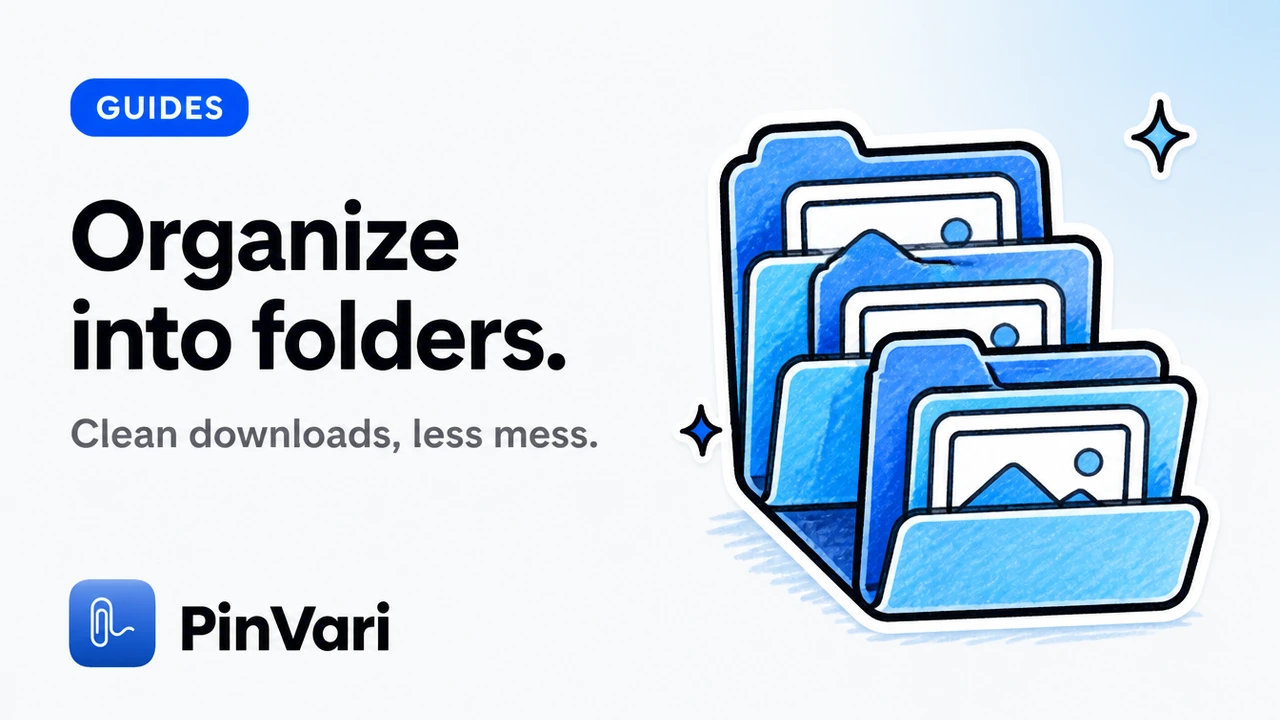
Organize downloaded images into folders by deciding the scheme before you hit download — source domain, format, or a custom collection name. Sorting two hundred files afterward is how afternoons disappear.
Flat image (1).jpg piles break moodboards and client handoffs. Structure at export time is cheaper than structure in Finder later.
Structure at export time is cheaper than structure later. Image Downloader by PinVari treats folders and filename templates as part of collect → preview → ZIP.
See the Image Downloader by PinVari product page for the collect → preview → ZIP workflow. The Chrome Web Store listing is the release-in-review detail page while version 2.5.3 completes review.
What folder schemes work for web image batches?
By source domain: useful for competitive research and multi-site days. You always know where a file came from.
By collection name: useful for a single brief such as spring-campaign-refs. Pair with favorites or library saves when you revisit the set.
By format: useful when one ZIP feeds both print-ish PNGs and web JPGs. Combine lightly — too many nested folders become their own mess.
By date only: weak as a sole axis. Dates help archives, not creative retrieval.
Pick one primary axis per job. Domain in the folder and brief slug in the filename often beats four nested levels.
Pick one primary axis per job. Deep nesting fights mobile unzip tools and Windows path limits.
How do filename templates support folders?
Templates give readable order inside each folder: zero-padded indices, title tokens, dimensions. Collisions drop when tokens include source and counter.
Read rename downloaded images with templates and filename templates for bulk image downloads for token patterns.
Also keep save image collections locally in Chrome in mind when the set should survive beyond one ZIP.
Zero-padding matters for slideshow order. Without it, 10 sorts before 2.
A folder without readable names is only half organized.
Domain folders
Best for: Multi-site research days
Watch for: CDN hostnames that obscure the brand — prefer page host when possible
Collection folders
Best for: One brief, one handoff
Watch for: Vague names like final2 — use the brief slug
How does PinVari organize on download?
During export you can shape folders and names so the ZIP opens ready for review. Optional CSV/URL source records keep provenance beside the files.
Library and favorites help when you return tomorrow. Contact sheets add a PNG grid for quick stakeholder review without unzipping everything.
Creative reference habits continue in organize creative references from the web.
Side panel collect keeps the page visible while you build the set. Right-click adds stragglers without losing place.
PinVari is local-first: organization happens on your device, not in a mandatory cloud library account.
Local organization means your folder scheme travels with the ZIP you hand off — no teammate needs your extension login.
When should you re-organize after the ZIP?
Re-organize when the brief changes — a campaign splits into two decks, or legal asks for source URLs per file.
Do not re-organize just to chase perfection. If filenames and folders already answer what and where-from, stop.
For failed files, retry into a sibling folder like retry-1 instead of mixing uncertain files into approved.
When migrating sites, keep a mirror of source folders plus a CSV. That pair survives replatforming better than pretty names alone.
Organization is a communication tool for future you and your teammates.
Enough structure
Test: A teammate finds three assets in under a minute without asking you
Action: Ship the ZIP
Too much structure
Test: You spend longer naming folders than collecting images
Action: Flatten one level; push detail into filenames
What mistakes create folder chaos later?
Mixing converted and original files without a token in the name. Nobody remembers which is authoritative.
Using Desktop as the download root for bulk ZIPs. Paths get noisy and backups balloon.
Saving every scan without preview. Folders full of favicons are not organized — they are deferred deletion.
Renaming manually after the fact without updating the CSV. Provenance drifts.
Ignoring ZIP part splits on huge jobs so one corrupt archive risks the whole set.
How do you brief a teammate on this workflow?
Send three links: the product page, one sibling how-to, and one troubleshooting note. Ask them to run a single gallery with size filters on before they declare the tool broken.
Require filename templates on any ZIP that leaves the laptop. Require CSV when the next reader is legal, research, or migration.
Remind them that local processing does not mean the remote image host never sees a request. It means convert and package stay on device.
Schedule a fifteen-minute desk check the first week. Watch one Scroll & collect pass together. Correct filter defaults once, not in every critique forever.
What does good output look like on disk?
A good output folder has readable names, almost no icons, and a ZIP that opens without drama. A contact sheet sits beside it when stakeholders hate unzipping.
A good CSV has source URLs that still resolve for the reviewer. A good library entry is tagged so next quarter you can find the same competitive set.
Bad output is a flat dump of download (61).webp next to payment badges. Bad output is a thumbnail set labeled as heroes.
organized ZIP is the standard. If Finder looks chaotic, the export settings failed—not the designer.
How do you stay honest in stakeholder updates?
Say what the page exposed. Say what you filtered out. Say what failed and why you stopped retrying.
Do not promise full-resolution masters the CDN never published. Do not promise the extension works on every authenticated portal.
Point to the Image Downloader product page when someone asks what the tool is for. Point to the Chrome Web Store listing while the release remains in review.
Honesty keeps the tool trusted. Overclaiming creates ticket storms and quiet uninstalls.
What should you measure after two weeks?
Measure junk ratio in the ZIP, average minutes per gallery, and how often teammates ask for renames. Measure retry rate on the same hosts.
If junk ratio stays high, raise the minimum dimension. If minutes stay high, save presets. If retries cluster on one domain, document that domain as hostile and stop burning loops.
Measure whether CSV attachments actually get read. If nobody opens them, simplify the manifest columns.
For how-to-organize-downloaded-images-folders, write the two-week numbers in the project channel once. Data beats opinions about which downloader feels nicer.
Keep the side panel open while you curate so context stays visible. Prefer right-click collect for one-off saves inside an already open session. Revisit favorites when a campaign returns next month. Use contact sheets for stakeholder previews before anyone unpacks binaries. Treat Scroll & collect as mandatory on infinite grids. Confirm site access when a scan returns empty without obvious cause. Export source records whenever legal or migration teams might ask where a file came from.
Keep the side panel open while you curate so context stays visible. Prefer right-click collect for one-off saves inside an already open session. Revisit favorites when a campaign returns next month. Use contact sheets for stakeholder previews before anyone unpacks binaries. Treat Scroll & collect as mandatory on infinite grids. Confirm site access when a scan returns empty without obvious cause. Export source records whenever legal or migration teams might ask where a file came from.
Keep the side panel open while you curate so context stays visible. Prefer right-click collect for one-off saves inside an already open session. Revisit favorites when a campaign returns next month. Use contact sheets for stakeholder previews before anyone unpacks binaries. Treat Scroll & collect as mandatory on infinite grids. Confirm site access when a scan returns empty without obvious cause. Export source records whenever legal or migration teams might ask where a file came from.
Keep the side panel open while you curate so context stays visible. Prefer right-click collect for one-off saves inside an already open session. Revisit favorites when a campaign returns next month. Use contact sheets for stakeholder previews before anyone unpacks binaries. Treat Scroll & collect as mandatory on infinite grids. Confirm site access when a scan returns empty without obvious cause. Export source records whenever legal or migration teams might ask where a file came from.
FAQ
Can I organize Chrome image downloads by website?
Yes. Folder-by-source-domain or page host is a common scheme. Confirm how your downloader labels the source.
Should I use folders or filename prefixes?
Use both lightly: one folder axis, descriptive filenames inside. Prefix-only flats also work for small batches.
Does PinVari support custom collection names?
Yes — collections, favorites, and export naming are part of the workspace model on the product page. Exact UI labels match the shipped 2.5.x extension.
How do I keep source URLs when folders change?
Export CSV/URL source records with the batch. Paths can move; URLs in a manifest still point at origins.
Is there a limit to how many folders I should create?
No hard creative law — but deep nesting fights mobile unzip tools and long path limits. Prefer shallow trees.
The Chrome Web Store detail page tracks the release while it is in review — use the product page for the full feature picture.
Hand your agent the exact element
PinVari resolves what you point at into a named, executable instruction — on-device, no keys, your own agent. One click inside PinVari connects Claude Code, Cursor, VS Code or Codex — or paste one CLI line from pinvari.com/connect.
PinVari → Connect → your agent (one click)Get PinVari — $39 →