Cursor AI Tips and Tricks I Use Every Week
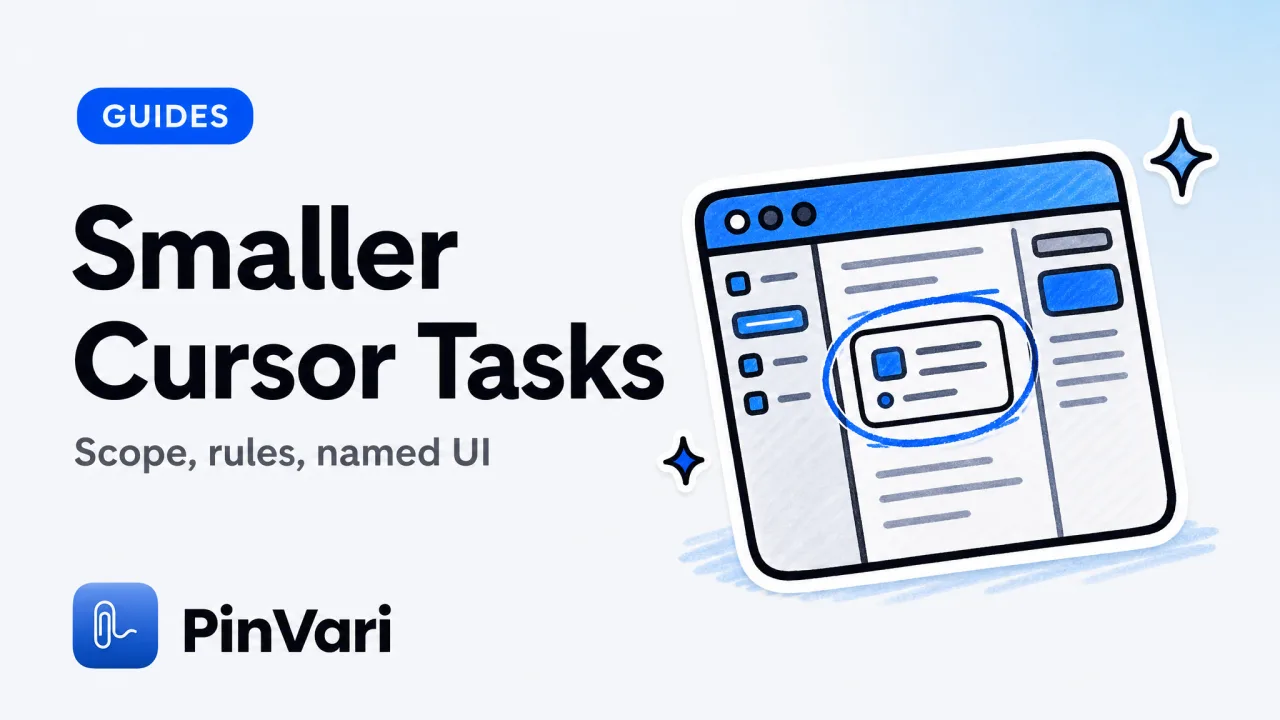
Cursor AI tips and tricks that matter are the ones that cut a wasted Agent turn: shrink the scope, write rules as verbs, attach the right MCP, and stop pasting paragraphs about UI you can point at. The model is rarely the bottleneck. The prompt and the files you attach are.
Most tip lists are keyboard shortcuts. Shortcuts help. They do not stop Agent from rewriting the wrong folder.
I keep a short list on a sticky and ignore the rest. Here it is, in the order I actually reach for it.
Which cursor ai tips and tricks save a turn this week?
The highest-leverage cursor ai tips and tricks are about context, not personality. Agent does what you pointed it at, plus whatever leaked in from an oversized folder.
Use @ to attach a file or folder, then say the verb. "Refactor this module to drop the legacy client" beats "clean up the networking code."
Prefer Agent for multi-file work. Prefer inline edit for a single function. Tab is for the next token, not architecture.
One verb per chat. A second verb is a second chat. Mixing "fix the test" and "redesign the settings page" is how you get a heroic, wrong diff.
Cursor examples has copy-paste tasks if you want to see this pattern in a repo.
If you cannot name the folder Agent is allowed to touch, you are not ready to run Agent. Write the path first. Then write the request.
How should I write Cursor rules so they fire?
Rules are not a manifesto. They are verbs the model can obey when a file matches.
Keep .cursor/rules short. "Never edit generated GraphQL types" is a rule. "We value craftsmanship" is not.
Scope a rule to a glob. A Python lint rule that applies to your Next app is noise.
Put secrets in the environment, not in rules. Rules get copied. Environment files get gitignored, if you are lucky.
I reread rules when Agent does something "helpful" I hate. That is usually a missing negative rule.
Write the rule after the incident, not before. A rule you invent on day one is fiction. A rule you write after a bad diff is documentation.
How do I keep Agent from eating the context window?
Long chats rot. After two good patches, start a new thread with the files and the leftover task.
Do not paste logs when a path exists. Attach the file.
Do not attach the whole monorepo. Attach apps/web/src/settings.
The Cursor context window size post is the numbers version. The habit version is: if you scrolled the chat to find the original request, the thread is dead.
New thread, same files. Continuity is the attachments, not the prose.
What MCP setup is worth the config?
Three servers cover most weeks: filesystem (if you need paths outside the attach), GitHub, and one local screen-context connector.
Prune the rest. Each extra tool is a schema Agent has to consider.
The Cursor MCP integration walkthrough is the file-level version. The tip is simpler: if you did not call a server this week, delete it.
PinVari is the screen-context case I use on a Mac. Option-Command-A, mark the control, speak. The connector at ~/.pinvari/mcp/pinvari-mcp talks to the app on 127.0.0.1:3402. Cursor one-click is PinVari, Connect, Cursor.
You get a named element, confidence, provenance, and a crop. You do not get another unlabeled JPEG.
When Agent is stuck mid-task it can call pinvari_request_capture. The notch island lights up. You mark. The capture returns.
Below 0.8 confidence it asks. That is a feature.
The one-time license is $39 launch, then $59. No subscription for the core app. You still pay Cursor for the model.
How do I report a UI bug without writing a novel?
Open the running app. Mark the control. Say the expected state in one sentence.
"Primary button, Save, should stay enabled after a failed validate. It greys out and I have to leave the sheet."
That is a ticket. It is also an Agent prompt.
A screenshot alone is a puzzle. Twelve similar buttons, no label, no frame.
Name the control. Role plus label plus frame is the difference between a patch and a guess.
On canvas or some Electron views AX is empty. PinVari falls back to on-device OCR and a lower confidence. If confidence is low, you get a question, not a silent sibling.
What should I never do in Cursor Agent?
Never let Agent run a migrate on prod because the prompt said "just fix it."
Never attach .env "for context."
Never approve a diff you did not scroll. Tab is cheap. A bad Agent commit is not.
Never keep a chat that already shipped two features. The third will merge them.
Never install fifteen MCP servers because a listicle said so.
Agent will happily follow a stale rule. If you changed the stack last month and the rule still says Redux, you will get Redux. Delete dead rules the same day you delete dead code.
Which keyboard habits are actually worth muscle memory?
Command-K / Command-I for inline, depending on your key map. I rebound nothing else for a year.
Command-Shift-P is still how I find settings I use once a month.
Accept Tab only when you can predict the next line. If you cannot, reject and type.
Multi-cursor still beats Agent for a rename you can see. Do not outsource a ten-line edit.
These are boring. Boring is why they stuck.
How do I review an Agent diff like a grown-up?
Read the file list first. If a file you did not name changed, stop.
Read tests second. If there are no tests and the change is logic, ask for tests before you read the implementation.
Read the implementation last, as if a stranger sent the PR.
I leave a comment in the chat: "revert path X, keep Y, explain Z." Then I let Agent do a second, smaller turn.
Two small turns beat one large apology.
Cursor examples again, because the good ones are small on purpose.
FAQ
Do cursor ai tips and tricks change with every model update?
The UI changes. The habits do not. Scope, one verb, short rules, new threads, named UI. I have kept that list across several model bumps.
Should I use Composer, Agent, or inline edit?
Inline for a function. Agent for a feature that spans files. Composer when you want a planned multi-file edit you will read as one diff. If you are unsure, start inline. You can always escalate.
How many Cursor rules is too many?
If you cannot recite them, too many. I stay under a dozen project rules and a handful of global ones. More than that and they start contradicting.
Can I use voice instead of typing Cursor prompts?
Yes. Voice-only is Option-Command-V in PinVari if you do not need a mark. For UI work, mark plus voice beats a dictated paragraph that never names the control.
Why does Agent ignore my screenshot?
Because a screenshot is pixels. Unless something resolved a label and a frame, the model is guessing among lookalikes. Give it a named element or a selector you trust.
Is it worth paying for both Cursor and a capture app?
If you file visual work more than a few times a week, yes. Cursor does not see the native window. A local capture app that resolves AX does. The license is one-time; the model bill stays with Cursor.
Steal the two or three cursor ai tips and tricks that match how you already fail. Ignore the rest. The list is a filter, not a personality.
How do I handle visual work without leaving Cursor?
Keep the preview app open on a second display if you have one. Mark the control, speak, return to the chat. The crop is already in the payload.
Do not rebuild the whole settings page because one label is wrong. Ask for the label path only.
If Agent asks which of three buttons you meant, that is success. Answer with the label, not the middle one, unless you also give a frame.
I keep a notepad line: last confidence score. If I see 0.6 twice, I stop and fix the AX label in the product instead of yelling at the model.
Multi-display marks remember the monitor. If you marked the laptop bar while looking at the studio display, say so.
What is a sane daily Cursor ritual?
Morning: one new Agent thread, one folder, one verb.
Midday: prune MCP if a server failed overnight. Stale GitHub auth looks like a dumb model.
Evening: read every diff you merged. If you cannot explain a file, revert it before you leave.
Once a week: delete rules that no longer match the stack. Delete chats you will never reopen.
This is not productivity theater. It is how you avoid a Friday surprise.
The rest of the cursor ai tips and tricks internet can wait. You already have enough to run a week without a secret setting.
Hand your agent the exact element
PinVari resolves what you point at into a named, executable instruction — on-device, no keys, your own agent. One click inside PinVari connects Claude Code, Cursor, VS Code or Codex — or paste one CLI line from pinvari.com/connect.
PinVari → Connect → your agent (one click)Get PinVari — $39 →