Chrome Extension to Download Images (No Account)
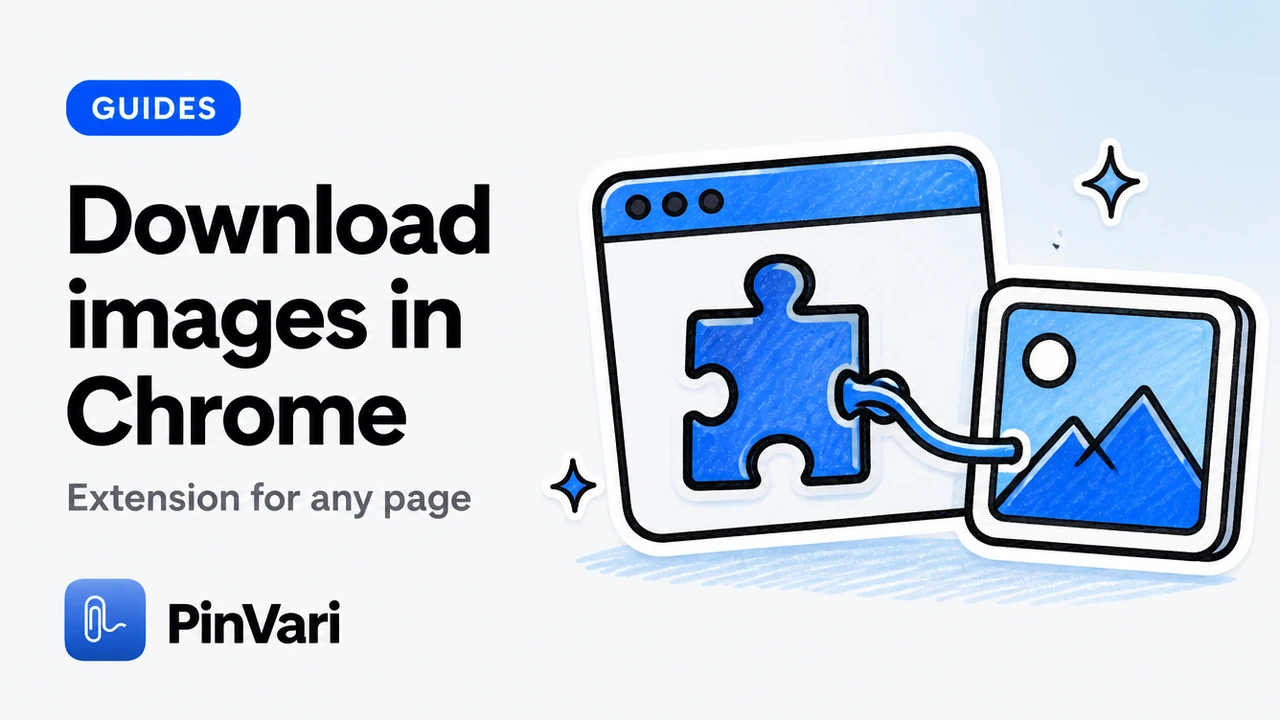
A Chrome extension to download images without an account lets you collect, preview, and save page images while settings stay on your device. No signup for a local save job is the bar for everyday creative work.
Account walls make sense for sync across devices. They are friction when you only need to save twelve product shots before standup.
This guide explains why local, no-account downloaders matter, what permissions still mean, and how Image Downloader by PinVari approaches the job.
Why does no-account matter for image download extensions?
Because the job is already happening inside your browser session. You can see the page. You want files.
Uploading that page to a hosted extractor adds a third party to a simple save. That may be unacceptable on client previews, staging sites, or research under NDA.
No-account also means faster first run. Install when available, open a page, collect, download. No email confirmations mid-flow.
PinVari does not require an account to collect, filter, convert, or download. Collections store references and settings locally—not a cloud mirror of every image.
Freelancers feel this on shared machines. You should not leave a downloader login behind on a client laptop after a workshop.
What still leaves your machine when you use a local extension?
Previews, checks, and downloads connect to the original image hosts. That is normal network fetching, not PinVari storing your shortlist for training.
Optional usage diagnostics are a separate channel. On PinVari, diagnostics may be on for new installs and can include usage counts, download outcomes, and device details—not images, page URLs, or filenames. You can turn them off in Help & privacy.
Read private / local image downloader and what free really means for adjacent trust framing. Download without signing up is the pure how-to twin of this guide.
If your team policy bans diagnostics entirely, disable them on day one. All download features are designed to work with diagnostics off.
How should a no-account Chrome image downloader be structured?
Collect without login
Current page, chosen tabs, right-click entry points, side panel while you browse.
Preview without uploading your shortlist
Inspector with dimensions and source. Versions only among page-provided URLs.
Export without a cloud render farm
Original or local convert to JPG, PNG, or WebP. Resize and quality on-device. ZIP on-device.
Return tomorrow without a SaaS library tax
Local favorites, collections, presets, optional library backup and restore on that browser profile.
That structure matches creative reality: most image grabs are session-bound and device-bound. Local library beats forced cloud sync when the brief dies at five o’clock.
What permissions should you expect anyway?
Extensions need enough access to see the page and to download files. Host access may be requested when a fetch needs it.
No account is not no permissions. It means identity is not the product. Study permissions explained before you install any downloader.
Manifest V3 changes how background work runs. Trust posts on MV3 help you read modern listings without panic.
Never confuse no-account with unlimited site bypass. Availability still depends on page access.
Availability depends on the website and your access. Protected browser pages, inaccessible frames, and some authenticated images may be unavailable. The extension does not bypass access controls or reconstruct hidden originals. Larger versions are not guaranteed, and page-provided versions may use different crops.
Where does Image Downloader by PinVari fit?
It is a Chrome extension positioned as a home for the images you find. Local processing. No account for core download. Fifty-one languages. Collect → preview → organized ZIP.
A selection can contain up to 2,400 images. ZIP parts split at 200 images or 100 MB. Source files are limited to 20 MB each. Conversion supports inputs up to 32 megapixels. Contact sheets contain up to 12 images per page. Keep the workspace open while a download runs.
Image processing runs on your device. Image contents, page URLs, and filenames are not sent to PinVari for analytics. Previews and downloads connect to original image hosts. Usage diagnostics may be on for new installs and can be turned off.
Review Image Downloader by PinVari on the product page for the workspace tour, and keep the Chrome Web Store listing handy while the release is in review.
How do agencies and freelancers benefit from no-account flows?
Faster onboarding on a client laptop. No shared password for a downloader service. Clearer data boundaries in a security review.
You can still keep professionalism: CSV manifests, contact sheets, named collections, filename templates. No-account does not mean messy.
Handoff to Figma or a drive folder stays a file problem, not a seat problem. That keeps procurement out of a thirty-minute research spike.
How do you explain a no-account downloader to security reviewers?
Lead with data flows: image bytes travel between your browser and the image hosts you already load while browsing.
Separate that path from optional diagnostics. Show where diagnostics are disabled and what fields they would have included.
Image processing runs on your device. Image contents, page URLs, and filenames are not sent to PinVari for analytics. Previews and downloads connect to original image hosts. Usage diagnostics may be on for new installs and can be turned off.
Document permissions and why each exists. Host access requested at need is easier to defend than blanket access claimed without a UI gesture.
Point reviewers to permissions explained and private local downloader for plain-language coverage.
Finally, state the reuse policy: the tool does not grant copyright. Reviewers care about that sentence as much as the network diagram.
What does local-first change about creative research habits?
You stop pasting client URLs into random web extractors. You keep staging sites inside the browser session that already has cookies.
You build named collections for recurring competitors or categories. Tomorrow’s kickoff starts from a library, not from a blank Downloads folder.
{CAPS}
Local-first also pairs well with contact sheets: review on-device, share a grid, then export bytes only after approval.
How do filename templates support a no-account workflow?
Without a cloud library forcing structure, templates become your structure. Put collection name, index, and optional domain tokens into filenames you can sort later.
Preview the path before download. Collision handling should stay stable across retries so failed items do not renumber completed ones.
Export a CSV beside the ZIP when legal or archival questions may appear. Provenance travels even when no account syncs your history.
That habit replaces the false comfort of a hosted project folder you never reopen.
Teams that treat download-all as an unattended scrape usually inherit junk. Treat it as a supervised collect with a clear stop condition, then archive with names you can defend in a critique.
How do you brief a teammate on this workflow?
Send three links: the product page, one sibling how-to, and one troubleshooting note. Ask them to run a single gallery with size filters on before they declare the tool broken.
Require filename templates on any ZIP that leaves the laptop. Require CSV when the next reader is legal, research, or migration.
Remind them that local processing does not mean the remote image host never sees a request. It means convert and package stay on device.
Schedule a fifteen-minute desk check the first week. Watch one Scroll & collect pass together. Correct filter defaults once, not in every critique forever.
What does good output look like on disk?
A good output folder has readable names, almost no icons, and a ZIP that opens without drama. A contact sheet sits beside it when stakeholders hate unzipping.
A good CSV has source URLs that still resolve for the reviewer. A good library entry is tagged so next quarter you can find the same competitive set.
Bad output is a flat dump of download (61).webp next to payment badges. Bad output is a thumbnail set labeled as heroes.
organized ZIP is the standard. If Finder looks chaotic, the export settings failed—not the designer.
How do you stay honest in stakeholder updates?
Say what the page exposed. Say what you filtered out. Say what failed and why you stopped retrying.
Do not promise full-resolution masters the CDN never published. Do not promise the extension works on every authenticated portal.
Point to the Image Downloader product page when someone asks what the tool is for. Point to the Chrome Web Store listing while the release remains in review.
Honesty keeps the tool trusted. Overclaiming creates ticket storms and quiet uninstalls.
FAQ
Is a Chrome extension to download images safe without an account?
Safety comes from permissions review, publisher clarity, and privacy behavior—not from whether an email was collected. Use the Store listing, privacy page, and permission prompts.
Can I sync collections across computers without an account?
Local collections stay on that browser profile unless you export a library backup and restore it elsewhere. That is intentional for a local-first design.
Does no-account mean the extension is always free?
Not necessarily across the category. This article focuses on the account boundary. Check the PinVari product page for current packaging.
Will converting images upload them?
In PinVari’s model, conversion is local subject to stated megapixel limits. Prefer original when you must preserve exact source bytes or animation.
What if a site blocks the extension?
See troubleshooting posts on blocked sites and missing lazy images. Sometimes the fix is permission; sometimes the asset is simply unavailable.
Hand your agent the exact element
PinVari resolves what you point at into a named, executable instruction — on-device, no keys, your own agent. One click inside PinVari connects Claude Code, Cursor, VS Code or Codex — or paste one CLI line from pinvari.com/connect.
PinVari → Connect → your agent (one click)Get PinVari — $39 →